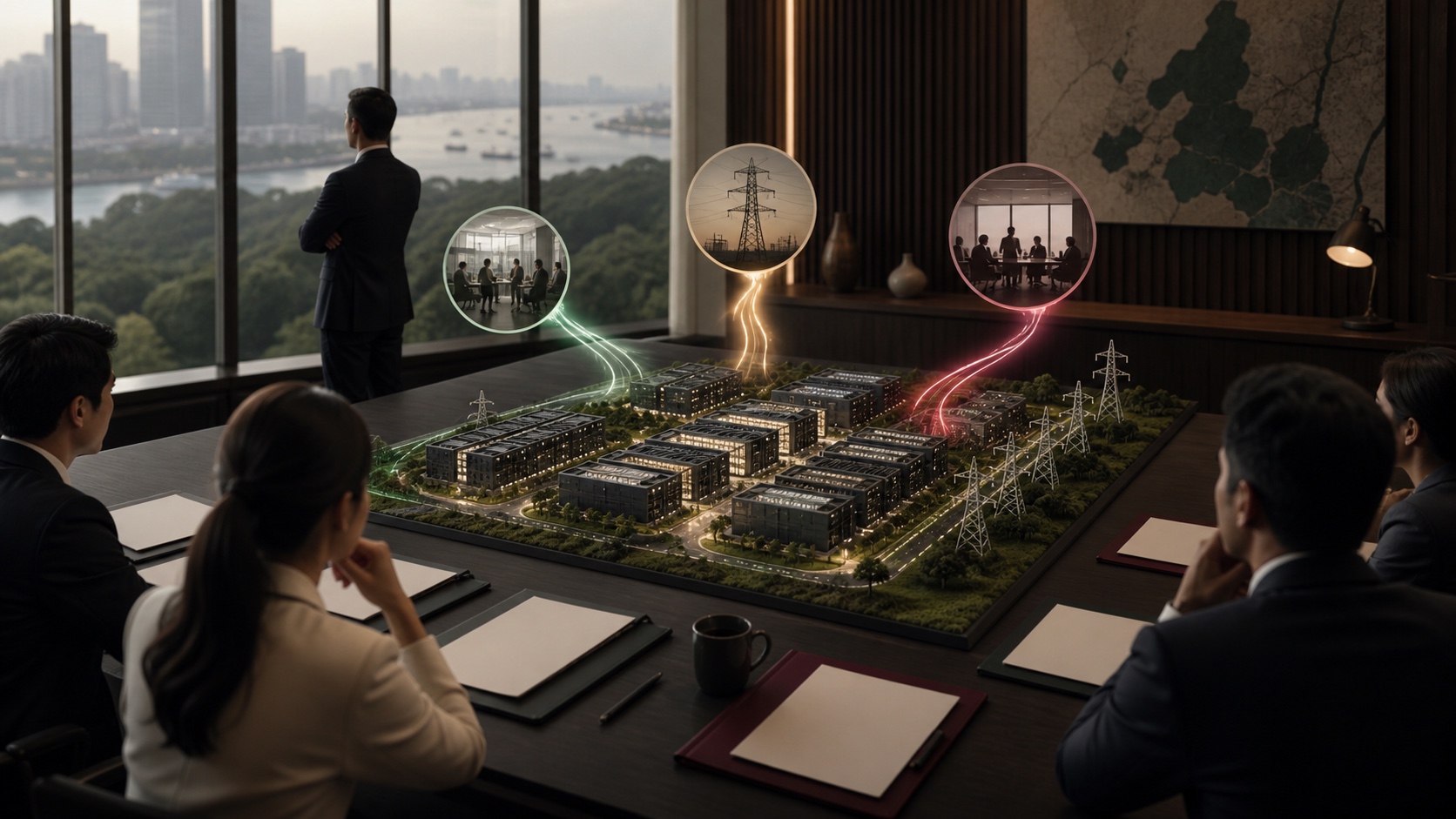
You are halfway through an investment pitch when the interviewer asks a simple question: “What exactly are we buying?” If the answer is still “AI infrastructure in Southeast Asia,” you have named a theme, not an asset. A powered shell, a colocation operator, a cooling-equipment supplier and a captive enterprise data centre can all benefit from digital demand while carrying very different contracts, capital needs and failure modes.
This case lab converts the theme into a decision. It uses a fictional asset and illustrative assumptions, not a live transaction or market quote. The aim is to show how a PE candidate should connect public evidence to customer demand, power delivery, free cash flow and exit—not to predict which real project will win.
Start by drawing the asset boundary
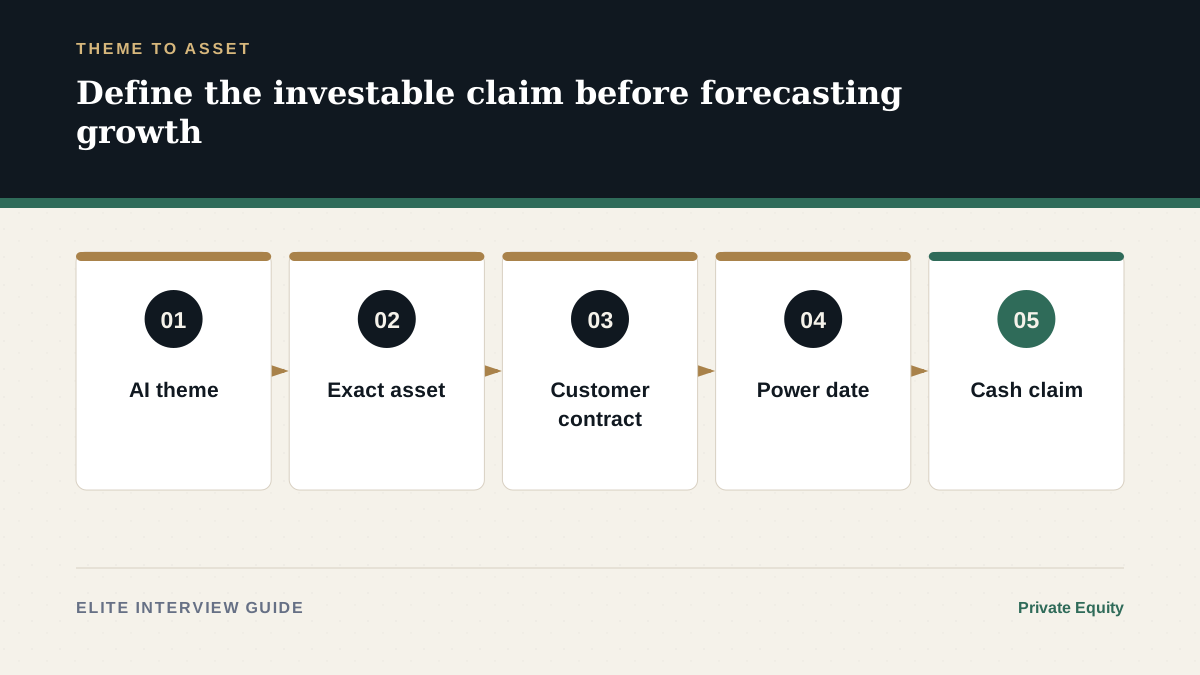
Define five things before discussing growth:
- What physical or operating asset is acquired?
- Who signs the revenue contract and for how long?
- Who pays for land, power connection, fit-out and recurring maintenance?
- When does capacity become ready for service?
- What can a future buyer own or control at exit?
The IEA’s Energy and AI report examines the rapid rise in data-centre electricity use and the uncertainty around future demand. That supports treating power as a system constraint. It does not prove that a specific site will receive grid capacity on time, that a tenant will take space, or that every AI-linked asset deserves the same valuation.
Singapore’s IMDA Green Data Centre Roadmap describes a pathway to provide at least 300 MW of additional capacity in the near term, with more possible through green-energy deployment. The same roadmap emphasises energy and water efficiency. For underwriting, “capacity may be added” must therefore become several asset-level questions: which project, which connection date, which conditions, which efficiency requirement and which source of capital?
Synthetic case: Atlas Compute Campus
Atlas is a fictional company seeking equity to build a 24 MW data-centre campus in a Southeast Asian market. Phase one is planned for 8 MW. Management presents the following illustrative facts:
| Item | Synthetic case input |
|---|---|
| Phase-one construction cost | US$96 million |
| Target ready-for-service date | 24 months |
| Signed capacity | 3 MW |
| Additional customer pipeline | 7 MW, non-binding |
| Largest signed customer | 67% of contracted capacity |
| Contract term | 5 years |
| Power connection | Conditional allocation letter |
| Equity requested | US$55 million |
| Proposed debt | US$50 million after conditions are met |
The marketing deck calls the pipeline “nearly full.” An investor should separate 3 MW of signed capacity from 7 MW of indications. The first is not automatically risk-free; the second is not contracted revenue.
Underwrite customers before utilisation
Build a contract ledger for every meaningful customer:
- Signed, conditional, reserved or merely discussing?
- Commencement date tied to which delivery milestone?
- Minimum payment, ramp schedule and service credits?
- Termination rights if power or commissioning is late?
- Parent guarantee, deposit and counterparty credit?
- Renewal and pricing terms after the initial period?
Then model occupied, billable and paid capacity separately. A site can be physically complete but not accepted by the tenant. It can be accepted but ramp slowly. It can be billed but expose the company to credits because service levels are missed. Those timing differences drive liquidity.
Customer concentration is not solved by saying the anchor tenant is “high quality.” If one customer represents two-thirds of signed capacity, test the cash impact of delay, cancellation and renegotiation. Also ask whether a second buyer would value the facility if the tenant leaves: location, power density, cooling design and connectivity may limit re-leasing.
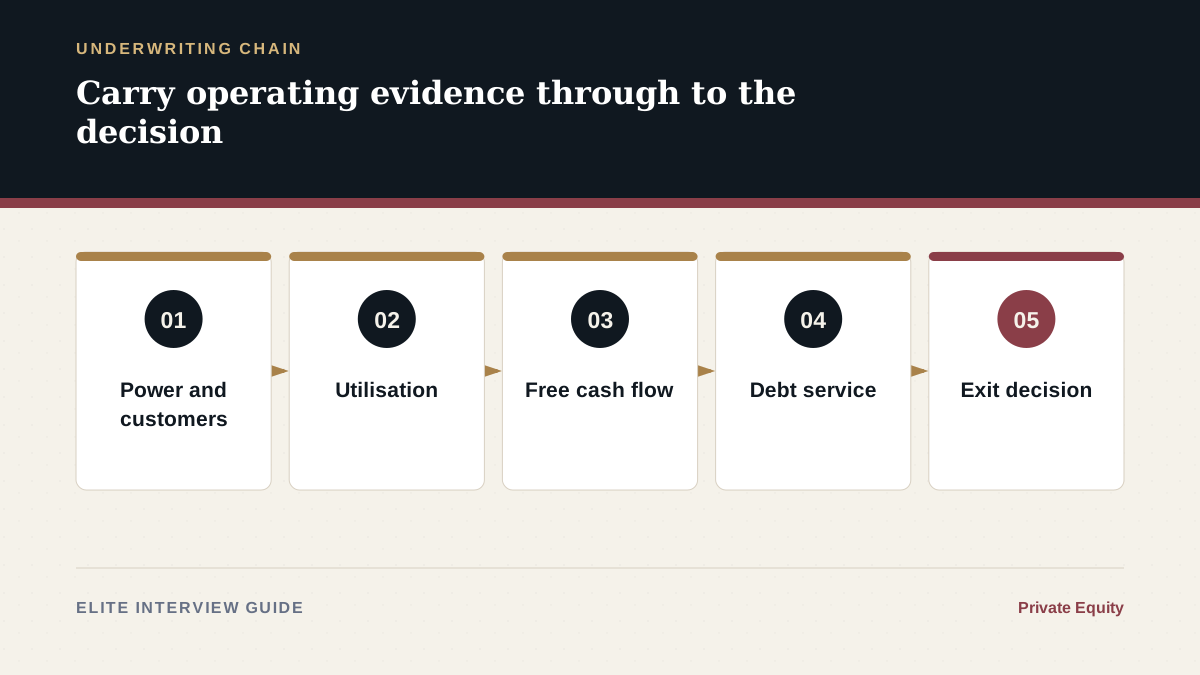
Underwrite power as a dated deliverable
“Power secured” is too imprecise for an investment committee. Request the utility agreement, connection works, responsible party, milestones, deposits, curtailment terms and remedies. Build separate dates for:
- land and planning approval;
- grid connection and substation completion;
- energisation and testing;
- customer fit-out;
- commissioning and revenue start.
The downside is a chain, not one sensitivity. A six-month power delay can postpone tenant acceptance, extend construction interest, require additional equity and miss the customer’s deployment window. The interviewer should hear how the operating event reaches cash and return.
Cooling and climate also belong in the model. IMDA’s Tropical Data Centre Standard explains a framework for safely operating at higher temperatures in tropical climates. It is useful evidence that operating design can affect resource efficiency. It is not permission to assume a lower power-usage effectiveness number without an engineer’s design, equipment specification and operating test.
Build the cash-flow bridge
Do not jump from MW to EBITDA. For each phase, connect:
available MW × accepted utilisation × contracted price = recurring revenue
Then subtract power and network pass-through differences, staffing, maintenance, insurance, land payments and corporate costs. Keep development capex, tenant-specific fit-out and lifecycle replacement outside an artificially clean EBITDA number. Ask who bears power-price volatility and whether escalation clauses match the cost base.
The financing case needs its own gates. If debt is available only after signed leases, power certainty or completion, the equity cheque must fund the gap. Test interest during construction, covenant headroom and the amount of additional equity required when dates slip.
Base, downside and deal breaker
An illustrative base case might assume phase one opens after 24 months, signed demand expands before commissioning and utilisation ramps over 18 months. The downside should change causes, not only percentages:
- grid works arrive nine months late;
- the anchor tenant reduces its initial deployment;
- construction cost rises 12%;
- debt draw is delayed until additional capacity is contracted;
- the next phase cannot start before the first reaches an agreed utilisation level.
Trace those facts through completion funding, cash burn, leverage and return. A mitigable risk has a named action, owner, cost and deadline. A possible mitigation might be phased construction, a stronger tenant deposit or a committed equity reserve.
A deal breaker is different. Examples include no enforceable route to the required power by the customer deadline, an anchor contract that can exit without compensating the project, or total funding needs beyond the sponsor’s capacity. “Lower the exit multiple” does not repair an asset that cannot become operational.
Exit is a buyer thesis, not a terminal multiple
Name plausible buyer categories and what each would need. An infrastructure investor may value contracted cash flow and long asset life. A strategic operator may value network density, power rights or customer access. Another PE sponsor may require a proven expansion platform and management team. A listed vehicle may require scale, reporting quality and a suitable market window.
For each route, test transferability of land rights, power arrangements, customer contracts and licences. Explain what the business must look like at exit, who could buy it and why ownership would create value during the hold. Use a flat or lower exit multiple in the downside so operational delivery, rather than multiple expansion, carries the conclusion.
A 90-second investment answer
Use this order:
- Asset: “I am underwriting an 8 MW first phase, not the AI-infrastructure theme.”
- Reason to continue: name the strongest customer and power evidence.
- Value creation: identify the dated milestones that unlock utilisation and financing.
- Downside: state one causal failure chain and funding impact.
- Decision: recommend proceed, reprice, restructure or stop, with the next evidence required.
A defensible conclusion for Atlas could be: continue diligence, but do not commit the full equity cheque until the power milestones, anchor-customer remedies and completion-funding reserve are verified. That is conditional, not vague. It tells the committee what must become true.
Your next action
Take one AI-infrastructure company or project described in public documents. On one page, write the exact asset, customer-contract status, dated power evidence, full funding need, base/downside cash bridge and two credible buyer types. Mark every statement as public fact, your inference or an unanswered diligence question. If the page still begins and ends with “AI demand is growing,” the thesis is not ready for an interview.