
Your interview invitation arrived at 6:12 p.m. You now have seven days, a 400-question PDF and three folders of notes you have never answered aloud. Re-reading all of them feels productive because every page is familiar. Then you try “walk me through your resume,” miss the point of your own internship, and realise recognition is not retrieval.
This plan builds an answer stack: a small set of connected spoken answers that covers your resume, accounting, valuation, one public transaction, one market view and full-interview delivery. It does not predict the exact questions. It gives you evidence of what holds up under follow-up.
Read the invitation before studying another topic
Create a one-page control sheet:
| Field | Record exactly |
|---|---|
| Employer and division | Do not prepare “banking” when the role names a specific product or coverage team |
| Office | Hong Kong, Singapore or another named location |
| Stage | Recorded video, first-round call, assessment centre or final round |
| Date and time zone | Include the calendar conversion |
| Platform and duration | Link, login, camera, microphone and any stated response limits |
| Language | Required, preferred or unspecified—copy the wording |
| Interviewers | Names and roles only if supplied through an authorised source |
| Current role description | Save the live link or PDF |
JPMorganChase’s How We Hire FAQ says assessments are used for certain roles and can include structured live interviews, on-demand recorded interviews and virtual skills assessments. It notes that a recorded interview may evaluate language, verbal presentation or technical abilities. That is a menu of possible formats, not a promise about your interview.
Goldman Sachs’ student careers page currently tells candidates to understand the firm and businesses, align their experience with a division and prepare for an initial video meeting if selected. Bank of America’s student application process says candidate experiences vary and directs candidates to the individual job description for specific technical or language requirements.
The minimum answer stack
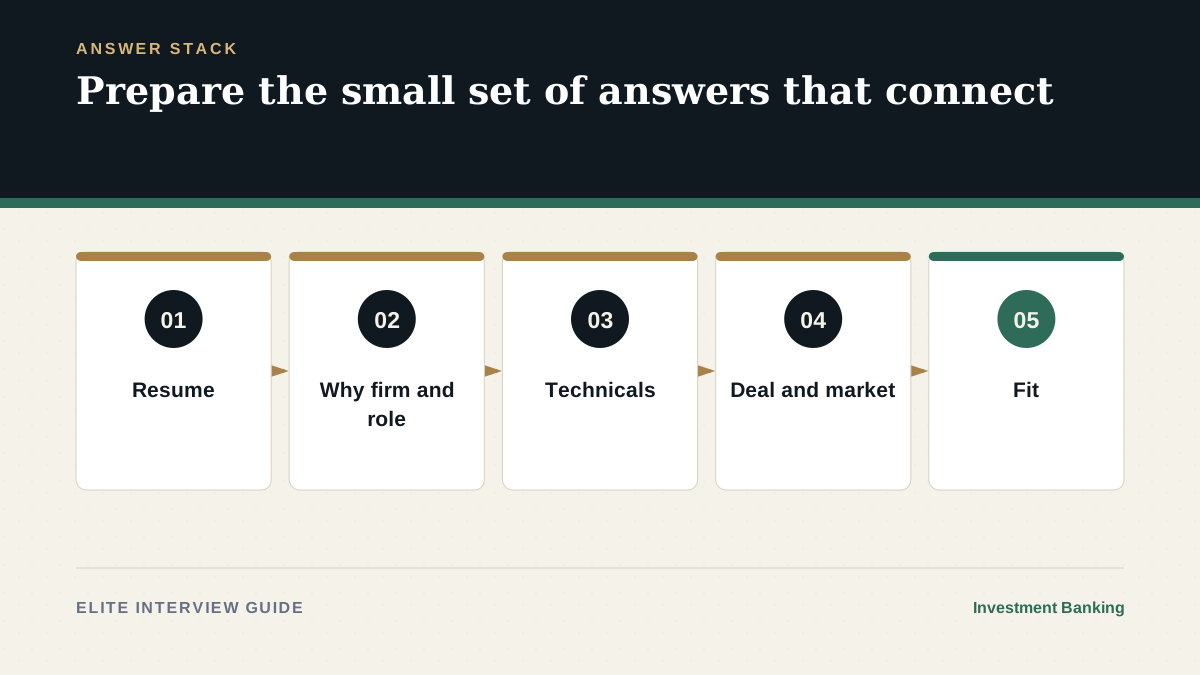
By Day 7, have these answers in spoken form:
- A 90-second resume walkthrough.
- Three motivation answers: why banking, why this division, why this office or firm.
- Five experience stories with distinct evidence.
- One connected three-statement chain.
- One valuation map and two follow-up calculations.
- One public transaction discussion.
- One market view with a dated source.
- Two thoughtful questions for the interviewer.
- One full simulation recording.
This is not the entire technical syllabus. It is the smallest stack that exposes whether the foundations connect.
Day 1 — Resume and motivation
Build the 90-second walkthrough
Use four moves:
- Present: degree or role and the direction you are pursuing.
- Evidence: two experiences that built relevant skills.
- Choice: what made investment banking the logical next step.
- Target: why the named division and office fit that evidence.
Do not narrate every line. The interviewer has the document. Your job is to make the logic easy to follow and invite useful follow-ups.
Build five evidence cards
| Card | Question it can answer | Required evidence |
|---|---|---|
| Analysis | Tell me about a difficult problem | Your decision, method and result |
| Detail | When did accuracy matter? | The error risk and your check |
| Team | Describe conflict or pressure | What you personally did |
| Initiative | When did you act without being told? | Trigger, action and consequence |
| Setback | Tell me about a failure | Your responsibility and changed behaviour |
One story can answer several questions, but do not force every behavioural prompt into the same internship anecdote.
Day 1 test: deliver the walkthrough in 90 seconds, then answer “why not consulting, investing or corporate finance?” without contradicting it.
Day 2 — Accounting chain
Start with one event and carry it through the statements:
- What changes on the income statement?
- What is the after-tax effect on net income?
- How does the cash-flow statement reconcile non-cash items and working capital?
- What happens to ending cash?
- Which balance-sheet accounts change, and does it balance?
Use at least four events:
- Depreciation increases.
- Inventory is purchased but not sold.
- A customer pays for a service not yet delivered.
- The company raises debt and pays interest.
Do not memorise only the final numbers. Say the timing and accounting reason. If the chain breaks, reopen the statements—not a list of 50 edge cases.
Day 2 test: answer two unseen variations without notes and explain why net income and cash can differ.
Day 3 — Valuation and enterprise/equity bridge
Build one map:
| Method | What it estimates | Core drivers | Main limitation to discuss |
|---|---|---|---|
| Trading comparables | Relative market value | Peer selection, metric, period | Market price and comparability |
| Precedent transactions | Relative deal value | Control, timing, transaction set | Deal context and scarcity |
| DCF | Present value of forecast cash flow | Operations, reinvestment, discount rate, terminal value | Assumption sensitivity |
Then practise:
- Why enterprise-value multiples pair with pre-interest operating metrics.
- How to move from enterprise value to equity value.
- Why a capital-intensive company can look different on EBITDA and cash flow.
- How higher rates can affect DCF value and transaction financing.
Day 3 test: value the same fictional company with two methods, reconcile why the ranges differ, and state which assumption matters most.
Day 4 — Transaction mechanics and rationale
Prepare the logic before formulas:
- What is the buyer trying to achieve?
- Why this target rather than build, partner or do nothing?
- What form of consideration is used?
- How does financing affect risk and ownership?
- What approvals or conditions remain?
- Where could value creation fail?
Practise one simple accretion/dilution bridge, but do not let the calculation replace strategy. A transaction can be financially accretive and strategically poor; it can also be dilutive initially for reasons that require careful interpretation.
The current JPMorganChase Investment Banking Analyst Internship page describes work across coverage, advisory or capital markets and training in accounting fundamentals, financial modelling and valuation. It also names analytical, quantitative, interpretive and communication skills. Use the live role description to understand the work—not as a disclosed question bank.
Day 4 test: explain a fictional acquisition in two minutes, then answer what could stop completion and what new fact would change your view.
Day 5 — One public transaction and one market view
Public transaction card
Use only disclosed material:
- Company and transaction.
- Announcement date and status.
- Consideration and financing, if disclosed.
- Stated strategic rationale.
- Your interpretation, clearly labelled.
- Two risks and one unresolved question.
Never imply you worked on the deal. Do not turn an announced transaction into a completed one.
Market-view card
Use:
Choose one view you can defend. Three shallow headlines are less useful than one view that survives “so what?”
Day 5 test: deliver each card in 90 seconds and answer three unplanned follow-ups.
Day 6 — Full simulation
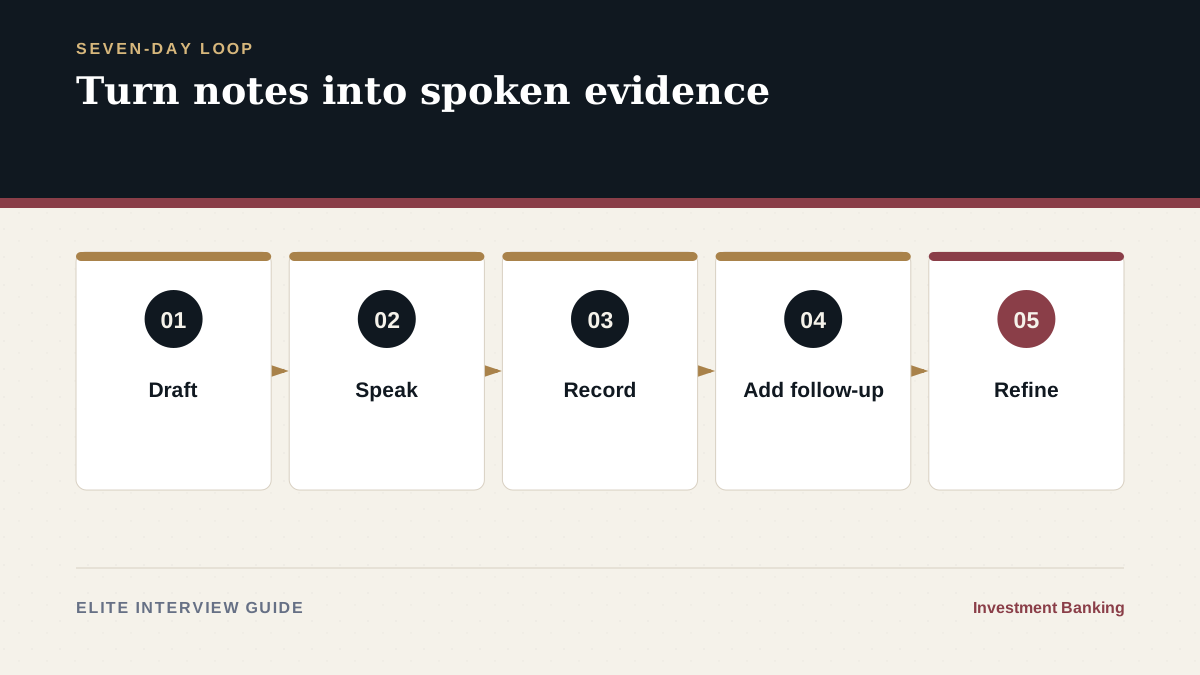
Run 40–50 minutes without pausing the recording:
- Five minutes: resume and motivation.
- Ten minutes: experience follow-ups.
- Fifteen minutes: accounting and valuation.
- Ten minutes: transaction and market view.
- Five minutes: your questions.
Use a reviewer if available, but keep the evidence even if practising alone. Mark every answer:
| Status | Definition | Next action |
|---|---|---|
| Red | Incorrect, contradictory or cannot complete aloud | Rebuild the chain and retest today |
| Amber | Correct core but slow, vague or weak under follow-up | One targeted drill |
| Green | Clear, correct and repeatable twice | Stop polishing |
Green is not “I read the answer and understand it.” Green is two spoken attempts without notes.
Day 7 — Retest and logistics
Retest every red item and the two highest-risk amber items. Do not reopen the full question bank.
Then check:
- Time-zone conversion and calendar entry.
- Interview link, login and identity details.
- Camera, microphone, power and connection.
- Quiet location, background and lighting.
- CV and permitted materials.
- Contact route if the platform fails.
- Travel time for an in-person interview.
Finish with one warm-up accounting chain and one motivation answer. Stop early enough to sleep.
What to cut when time is short
Cut:
- Rare technical edge cases before the three statements connect.
- A second transaction before the first survives follow-up.
- A fifth valuation method before you can reconcile the core three.
- Word-perfect behavioural scripts.
- Firm trivia that does not change why you want the work.
Do not cut:
- Reading the exact invitation.
- Your own resume.
- Accounting-to-cash logic.
- Enterprise-to-equity bridge.
- One public transaction and one market view.
- A full spoken simulation.
- Technical and travel logistics.
A daily scorecard
| Day | Deliverable | Pass evidence |
|---|---|---|
| 1 | Resume and five stories | One 90-second recording plus follow-ups |
| 2 | Accounting chain | Two unseen variations correct aloud |
| 3 | Valuation map | Two methods and EV/equity bridge |
| 4 | Transaction mechanics | Two-minute recommendation plus stop risks |
| 5 | Deal and market cards | Dated sources and three follow-ups each |
| 6 | Full simulation | Timestamped red/amber/green review |
| 7 | Retest and logistics | Reds cleared or explicitly contained |
Next action
Close the 400-question file. Record the 90-second resume walkthrough now, then mark the first point where you become vague or chronological. That point—not the next unread page—is the start of Day 1.
Sources
- JPMorganChase How We Hire FAQ — variable assessment and recorded-interview formats.
- Goldman Sachs Students — firm, division and initial-interview preparation.
- Bank of America Student Application Process — candidate-experience variation and role-specific requirements.
- JPMorganChase Investment Banking Analyst Internship — current APAC role and training description.