
Three classmates have interviews. Your portals still say “under consideration,” and one application has disappeared without feedback. The tempting response is to rewrite every CV bullet, change offices, add another course and conclude that your profile is not competitive. But “no interview yet” contains too little information to support any one of those actions.
This diagnostic separates what happened at each gate, what you can verify and what you can repair in seven days. It does not estimate hidden selection rates or promise that a change will produce an interview. Its purpose is to replace a personal verdict with a controlled review.
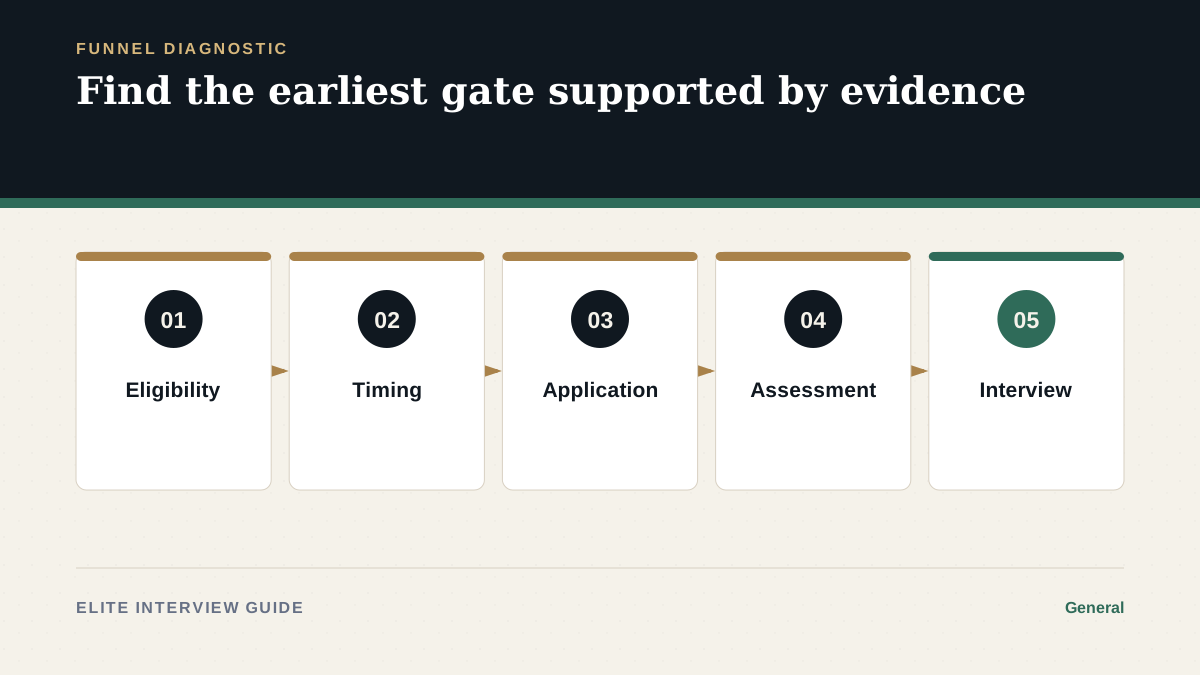
First, identify the gate
An application can stop before an interview for different reasons:
- Eligibility: graduation year, location, degree, work authorisation or another stated condition did not match.
- Timing: the role was reviewed on a rolling basis, filled, changed or reached a practical capacity before you applied.
- Office or team demand: hiring needs differ across locations and groups, often without a public explanation.
- Application evidence: the CV or written answers did not make relevant impact and motivation clear.
- Assessment: an online test, video response or other pre-interview stage did not progress.
- Interview performance: relevant only if you actually reached an interview.
Do not use a case-interview diagnosis for a rejection that occurred before any case. McKinsey’s official interviewing overview distinguishes personal-experience and problem-solving components. That helps define what to practise after an interview invitation; it does not tell you why a CV was not selected.
Build an evidence table from exact applications
Review five to ten applications, not every application you have ever made. Use this table:
| Field | What to record |
|---|---|
| Exact role | Programme, team, office and year |
| Eligibility | Each stated requirement and your evidence |
| Submitted | Date, time zone and version sent |
| Review mode | Rolling only if the official page says so |
| Materials | CV version, cover letter and written answers |
| Stage reached | Submitted, test, video, interview or final |
| Known outcome | Exact message and date |
| Unknown | Anything the employer did not disclose |
Requirements cannot be generalised from brand names. For example, BCG’s current UK page for international opportunities lists distinct locations, language expectations and a specific full-time deadline for the cycle shown. Goldman Sachs’ 2027 Asia Pacific Summer Analyst page states its own eligibility, closing date and rolling-review approach. These are examples of exact public requirements, not a universal calendar for consulting or banking.
If a page changed after submission, keep a dated copy or note. Do not reconstruct a deadline from a classmate’s memory.
Separate controllable from uncontrollable
Mark each observation:
- Verified and controllable: you submitted a generic CV; an impact bullet lacks your action; a written answer names no reason for that office.
- Verified and not currently controllable: the published graduation rule excludes you; the stated deadline passed.
- Unknown: office demand, number of applicants, reviewer preference, internal referral effect, exact cut-off score.
Unknown is a legitimate category. Do not turn it into “they rejected me because I lack leadership” without evidence. A strong diagnostic often ends with fewer confident explanations, not more.
Find a repeated, repairable pattern
Look across the sample for one pattern that appears more than once.
Pattern 1: impact is unreadable
Weak bullets list tasks: “supported research,” “helped with a model,” “worked on strategy.” Rewrite one experience using context, your action, decision informed and verifiable result. Do not manufacture a number. A precise non-numeric result is better than a false percentage.
Pattern 2: motivation is portable
If the firm or city name can be swapped without changing the answer, add one real point of contact: a project, sector, team output, conversation or market problem. State what you learned and why it changes your choice.
Pattern 3: office selection is scattered
Applying to many offices may be rational, but your evidence must fit each route. Check language, mobility, work rights and recruiting rules. Do not claim “regional flexibility” when you have not considered the trade-offs.
Pattern 4: language claims outrun spoken evidence
If the CV says fluent, test a 90-second professional answer and follow-up in that language. Adjust the claim or improve the capability; do not rely on nationality or years studied as proof.
Pattern 5: timing is unmanaged
You repeatedly submit near published deadlines despite rolling review, or wait for a perfect CV while live roles move. Build a submission buffer and a minimum-quality gate for the next cycle.
Do not overfit one outcome
One rejection can reflect many combinations of supply, timing and fit. Even five outcomes may use different roles and criteria. Avoid these false inferences:
- “A classmate with lower grades progressed, so grades do not matter.”
- “A referral failed, so networking never matters.”
- “One office rejected me, so every office will.”
- “A rewritten bullet led to an interview, so that bullet caused it.”
You can still act under uncertainty. The standard is not causal proof; it is choosing a low-cost improvement supported by repeated evidence and no false promise.
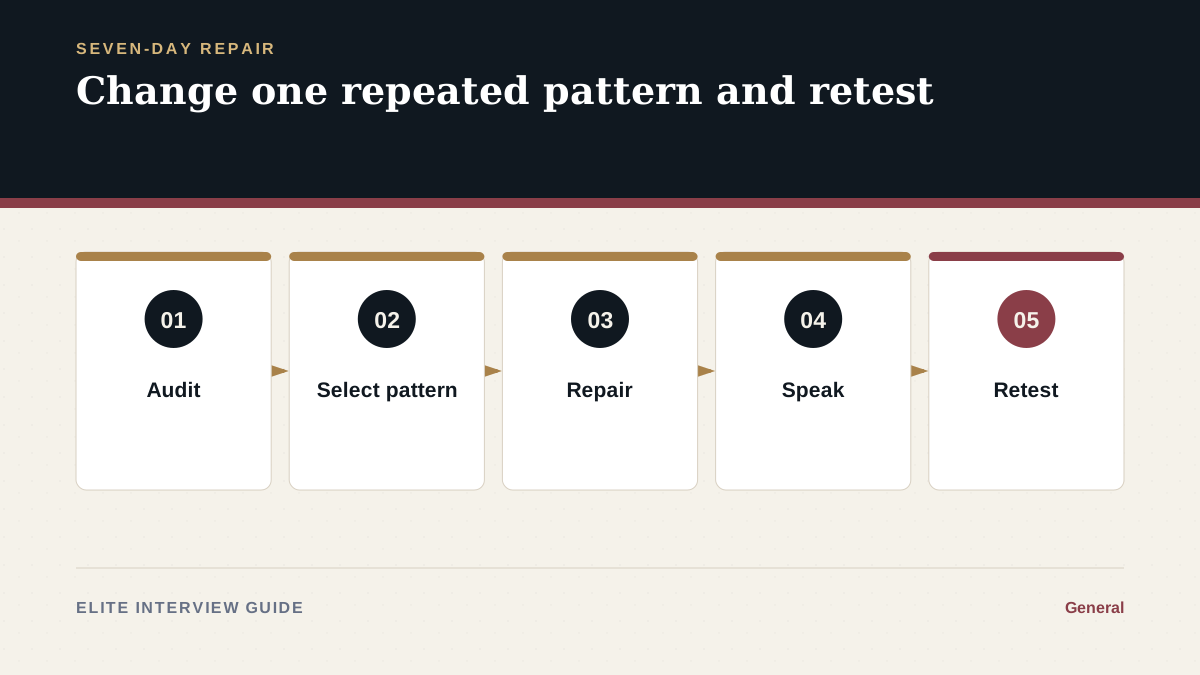
A seven-day repair sprint
Choose one pattern only.
Day 1: build the exact-application table and mark unknowns.
Day 2: select two representative CV bullets or one written answer. Preserve the original files.
Day 3: rewrite for relevance, ownership and truth. Ask a reviewer what decision or impact they can infer.
Day 4: check the next three target roles against official pages. Record eligibility, office, deadline and review mode.
Day 5: speak the revised 60-second motivation answer and one experience story. Fix the first vague link.
Day 6: apply the same standard to one additional role; do not mass-edit every document.
Day 7: decide whether the pattern improved and set the next submission plan.
The stop rule matters: check portals at one scheduled time, then return to work you control. Repeated refreshing does not create evidence and often triggers unnecessary rewrites.
Keep alternative paths specific
An alternative role is not a consolation prize if it builds relevant evidence. Compare the work itself: client problem, analytical output, ownership, sector exposure and next transition. A corporate-finance, strategy, research or operating role may close a real gap—but only if the responsibilities do so. The title alone is not proof.
Preserve multiple timelines. If the current graduate cycle is closed, examine experienced-hire routes, laterals, internships permitted by your status or roles where your existing skill has stronger fit. Verify each route independently.
Your next action
Open the exact files and official role pages for your last five applications. Fill the table without guessing any hidden criterion. Circle one repeated, controllable weakness and write a seven-day repair with a measurable output: two stronger bullets, three verified office choices, or three recorded answers. Leave the rest of your profile unchanged until that small test gives you a reason to do more.