
You have spent two years normalising EBITDA, reconciling working capital and answering late-night diligence requests. A private-equity application asks why you are ready to invest. You say, “I have worked on many deals.” The interviewer asks which recommendation was yours, what return you underwrote and when you would have walked away. Suddenly, proximity to transactions is not the same as owning an investment decision.
This guide maps what can transfer from transaction services, valuation or due diligence—and what still needs proof. It ends with a 30-day plan using public information.
Start with the work you actually did
Deloitte Southeast Asia describes acquisition and vendor diligence as analysis of issues, risks and opportunities that support investment decisions, negotiations and value realisation. PwC Singapore’s Deals Advisory page covers work across strategy, diligence, valuation, execution, integration and value improvement.
Those descriptions show why deals experience can be relevant. They do not establish that every employee performed every task, made the client’s decision or owned the investment return.
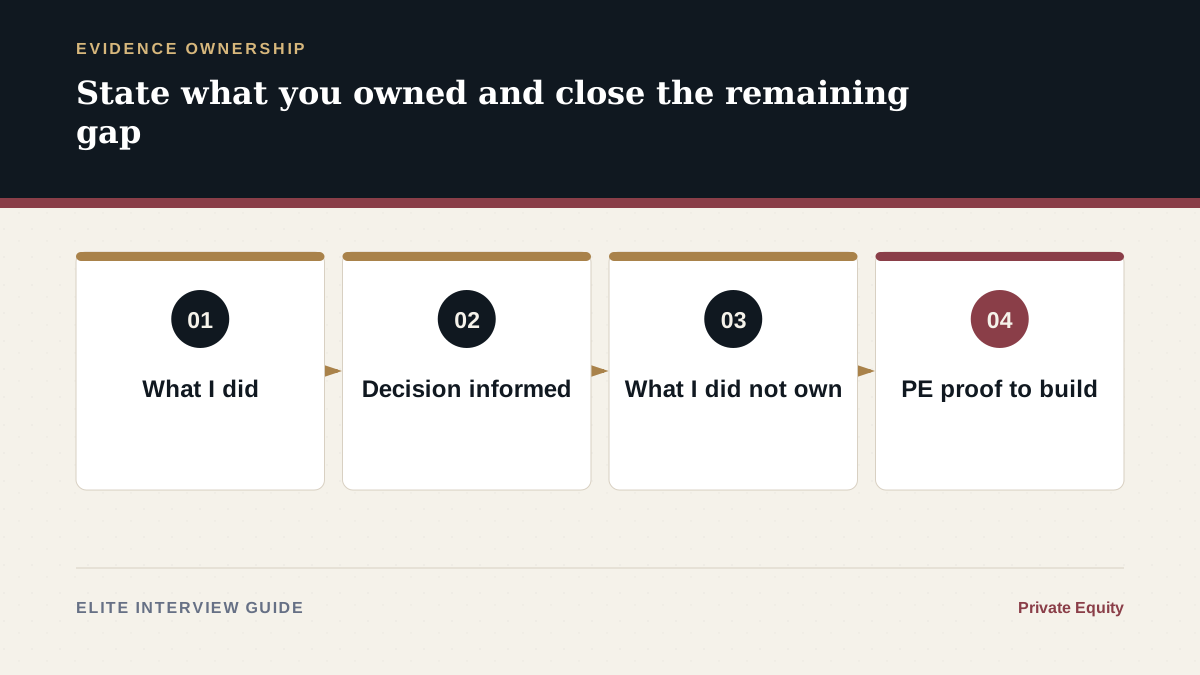
Create an evidence inventory with four columns:
| Project | What I personally owned | What decision it informed | What I did not own |
|---|---|---|---|
| Buy-side diligence | Built quality-of-earnings bridge and tested working capital | Informed price and SPA discussions | Did not choose whether to bid |
| Vendor diligence | Reconciled management adjustments and data book | Supported sale preparation | Did not underwrite buyer return |
| Valuation | Built comparable-company analysis | Informed a valuation range | Did not negotiate transaction terms |
| Operational diligence | Analysed site-level cost and capacity | Identified execution risks | Did not design the ownership plan |
The final column protects credibility. “I supported the analysis that informed…” is stronger than a false “I invested in…”
The transferable-skill map
| Deals skill | What transfers to investing | Proof to show | Limit to state |
|---|---|---|---|
| Quality of earnings | Distinguish recurring from one-off earnings | One adjustment, evidence and cash consequence | You may not have set the final price |
| Working capital | Test cash needs and purchase-price mechanics | Seasonality, normal level and downside | Mechanism varies by agreement |
| Accounting analysis | Find liabilities, policies and timing issues | How an accounting fact changed economics | Accounting issue is not automatically a deal breaker |
| Valuation | Compare companies and examine drivers | Why peers and metrics fit the business | A range is not an investment recommendation |
| Diligence process | Prioritise questions under time pressure | How you found and escalated one key issue | Process ownership is not capital ownership |
| Management interaction | Test explanations and data quality | One respectful challenge and follow-up | Do not reveal confidential identities or answers |
| Cross-functional work | Integrate tax, commercial, legal and operating inputs | How you resolved conflicting evidence | Do not claim to be the expert in every workstream |
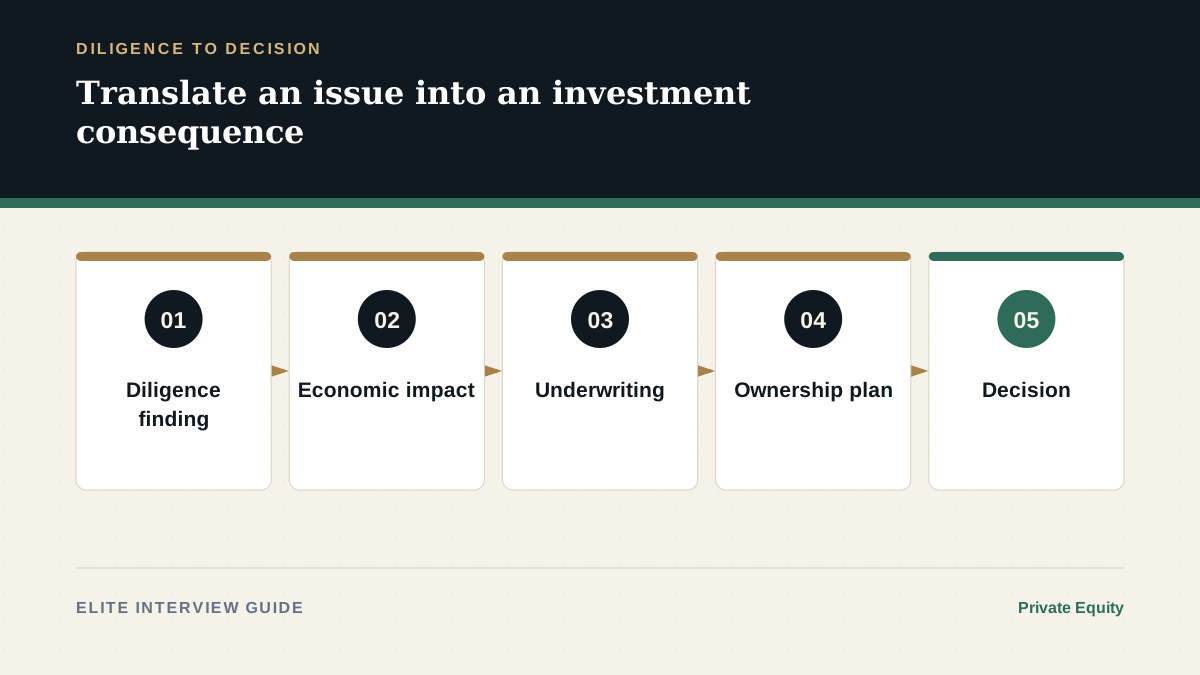
The best interview story begins with the investment question, not the size of the data room.
The missing-proof map
Private-equity investing can require evidence that transaction-services work did not provide:
Thesis formation
Can you state why this company is a good investment at this price, rather than only report historical performance?
Recommendation ownership
Can you choose invest, do not invest or continue only under a condition—and explain what changes your mind?
Return and capital structure
Can you connect operating drivers to debt capacity, cash generation and equity return rather than stop at adjusted EBITDA?
Value creation
Can you define actions, owners, cost, timing and KPIs for the hold period?
Downside and survivability
Can you show how a commercial failure reaches liquidity, covenants and equity value?
Exit
Can you identify plausible buyers, strategic reasons and evidence without treating an exit multiple as a plan?
CFA Institute’s public page on private-equity careers names analytical skills, LBO work, market research and prior related experience, while also describing entry as competitive. Its article on private-market careers highlights due diligence, valuation, deal execution and strategic judgement. Use these as broad role context, then read the exact target job description. “PE” does not describe one universal job.
Audit a project story before using it
Ask eight questions:
- What was the client decision?
- What analysis was specifically mine?
- Which fact changed the direction or priority?
- How did the issue affect earnings, cash, price, structure or risk?
- What did I recommend within my role?
- What happened next that I am allowed to disclose?
- Which part belongs to the client, partner or another workstream?
- Can I tell the story without identifying the client or revealing confidential data?
If the story requires a company name, exact undisclosed number or invented outcome to sound important, do not use it.
Rewrite from process to decision relevance
The following example is a synthetic composite. It does not describe a real client.
Weak version
The tasks are credible but interchangeable.
Stronger version
The stronger story gives:
- The decision context.
- Personal ownership.
- A specific issue and method.
- Economic relevance.
- A truthful authority boundary.
- The investing skill still missing.
Build two proofs with public information
Proof 1: a public-company investment memo
Choose a listed Southeast Asian company with:
- Recent annual and interim filings.
- Understandable segment disclosure.
- A business you can explain.
- Enough public peers to examine valuation.
Write no more than five pages:
- Recommendation and price condition.
- Business model and industry structure.
- Two thesis drivers.
- Base, downside and upside operating cases.
- Cash conversion and capital needs.
- Valuation range.
- Three diligence questions.
- Deal breaker and change-of-mind fact.
The memo is not evidence that you can access or transact in the company. It is evidence of how you organise public facts into a recommendation.
Proof 2: a paper LBO
Use the same company or a clearly fictionalised version. Build:
- Entry enterprise value and equity cheque.
- Debt schedule and interest.
- Operating case linked to business drivers.
- Capex and working capital.
- Base and downside cash sweep.
- Exit routes and sensitivities.
- A one-page investment-committee opening.
Do not optimise the model until it produces an attractive return. Preserve the case where it fails and explain why.
A 30-day evidence plan
| Days | Work | Deliverable |
|---|---|---|
| 1–3 | Read five target job descriptions | Role-requirement matrix |
| 4–7 | Audit six real project stories | Two usable stories and four rejected or revised |
| 8–14 | Research one public company | Source ledger and operating model |
| 15–20 | Write the investment memo | Five-page recommendation |
| 21–25 | Build paper LBO and downside | Model plus one-page IC opening |
| 26–28 | Run role-specific follow-ups | Recorded answers and gap list |
| 29–30 | Retest and tailor applications | Evidence matched to each role |
The plan cannot create live-deal ownership. It can show whether you understand the missing work and have begun producing relevant evidence.
Decode the target role
| Role | Questions to emphasise |
|---|---|
| Buyout investing | Entry price, leverage, control, operating plan and exit |
| Growth equity | Unit economics, market, governance, capital needs and path to scale |
| Private credit | Cash-flow durability, downside, covenants, security and recovery |
| Portfolio operations | Execution, KPI design, management capability and value-creation delivery |
| Fund / secondaries role | Portfolio construction, cash flows, valuation, manager and asset selection |
A diligence story useful for private credit may focus on cash leakage and covenant capacity. The same story for buyout may focus on whether earnings and management can support an ownership plan. Do not use one generic “I like investing” pitch for every role.
Answer “Why move?”
Use:
- What your current work taught you.
- Which decision you want to own next.
- What evidence you have already built.
- Which gap you are still addressing.
Example:
Next action
Complete the four-column evidence inventory for six projects. Select one story only if it contains personal ownership, decision relevance and a confidentiality-safe boundary. Then choose the missing proof—thesis, return, downside or exit—that your 30-day plan must address first.
Sources
- Deloitte Southeast Asia Acquisition and Vendor Diligence — diligence, risk, negotiation and value-realisation work.
- PwC Singapore Deals Advisory — deal lifecycle, diligence, valuation, integration and value improvement.
- CFA Institute: What Is a Career in Private Equity? — broad career skills, related experience and competitiveness.
- CFA Institute: Behind the allure of a private markets career — diligence, valuation, execution and strategic-judgement context.