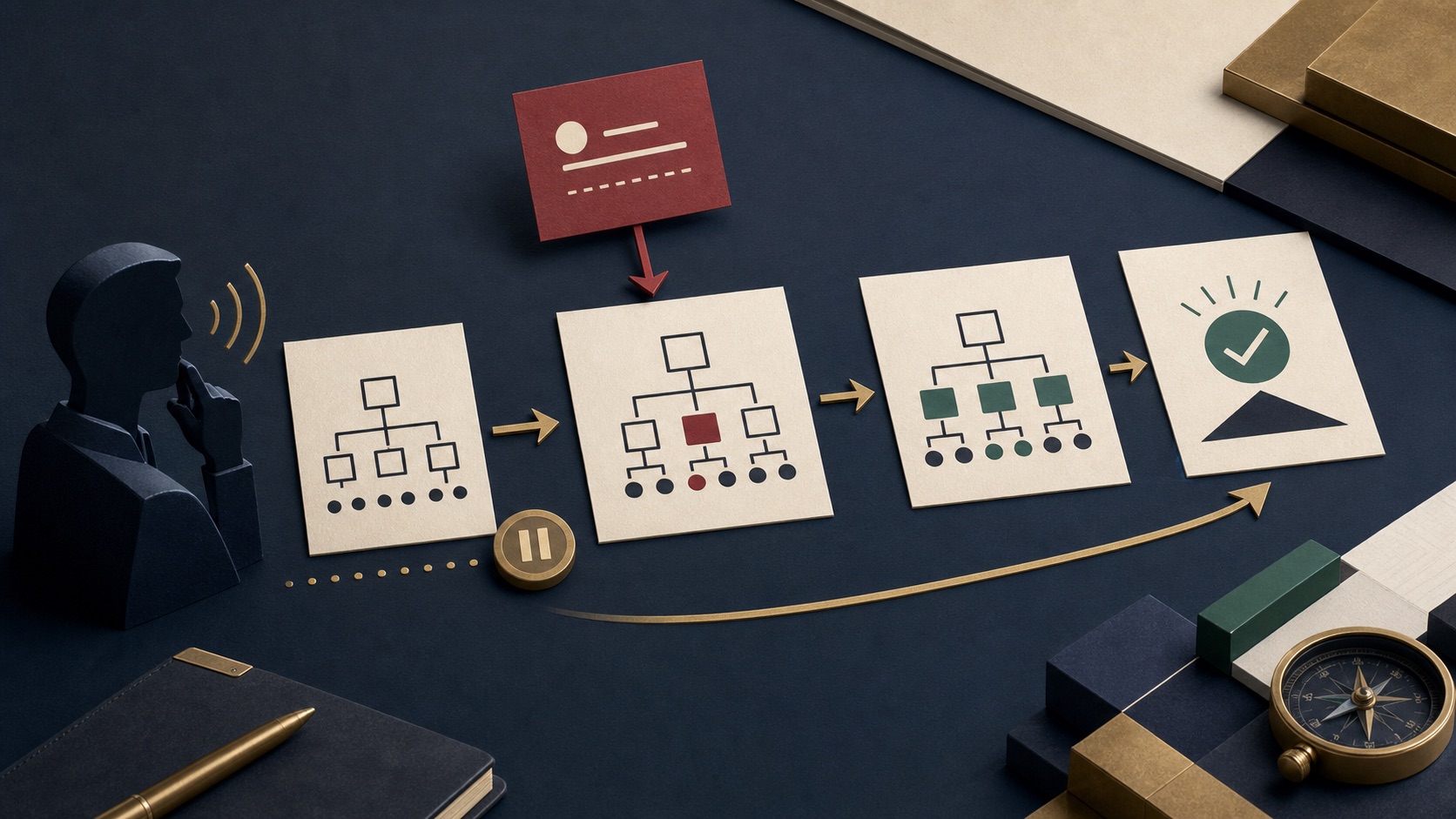
You have delivered the first two branches of your case structure when the interviewer cuts in: “Assume demand is not the issue. What would you look at next?” You know the sentence matters, but you cannot tell whether it is a correction, a hint or a test. So you defend the demand branch for another 30 seconds—and turn useful information into friction.
This guide gives you a three-move recovery script and five original drills. The aim is not to agree with every interruption. It is to show that you heard the new information, updated the priority and kept the client decision visible.
The five drills below are original practice scenarios designed to test how you handle new information.
A case interview is a working conversation
BCG’s official case interview preparation page describes a process that includes structuring, questions, data analysis, calculations and identifying important factors. Its stated guidance includes listening actively, communicating clearly, clarifying assumptions and showing your thinking; it also warns against ignoring feedback.
McKinsey describes its problem-solving interview as a discussion of a client scenario used to understand analytical thinking and approach. Bain’s interview page says case interviews involve working through a client problem with assistance.
None of these pages publishes a universal meaning for every interruption. That is why your first job is classification, not mind-reading.
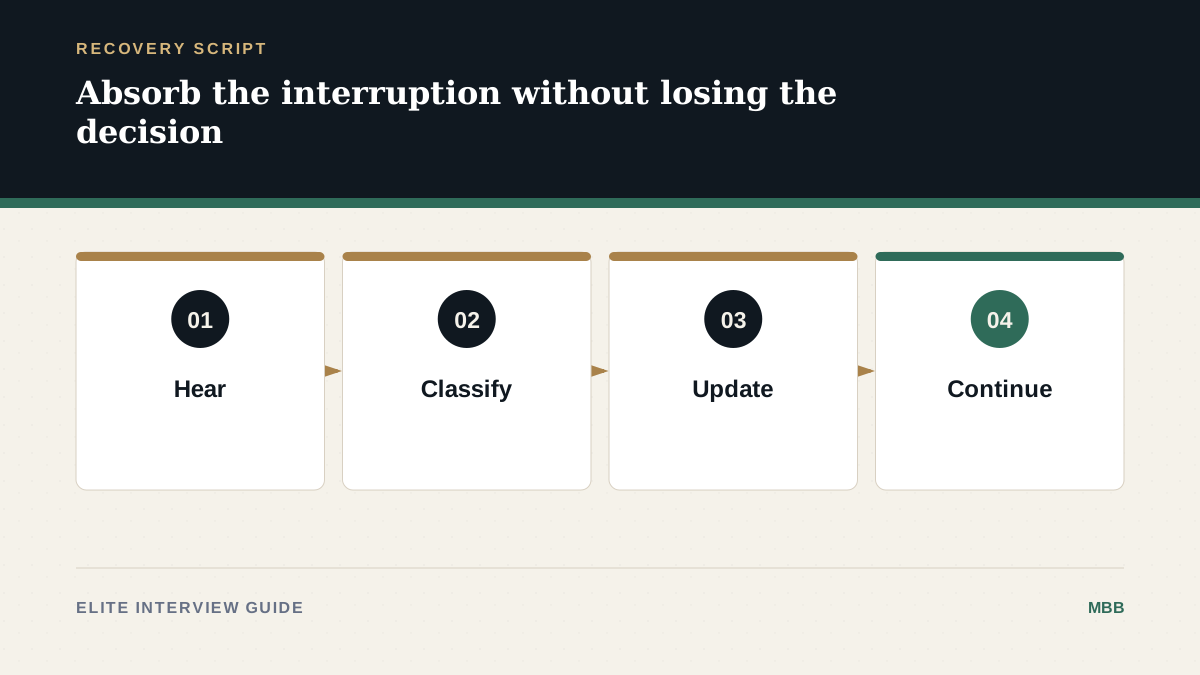
Classify the interruption before responding
| Type | What you may hear | What it probably changes | Useful response |
|---|---|---|---|
| Correction | “That figure is annual, not monthly.” | A fact or calculation | Correct it, state the consequence, continue |
| New fact | “Customer churn doubled last quarter.” | Priority or hypothesis | Re-rank the analysis around the new fact |
| Time-saving redirect | “Assume demand is not the issue.” | Removes a branch | Park it explicitly and move to the next driver |
| Challenge | “Why would price be the main driver?” | Strength of your logic | Defend with evidence or revise the hypothesis |
| Clarification request | “What do you mean by market attractiveness?” | Precision of language | Define the term with decision-relevant components |
You do not need to announce the category. You need to respond in a way that fits it.
The three-move recovery script
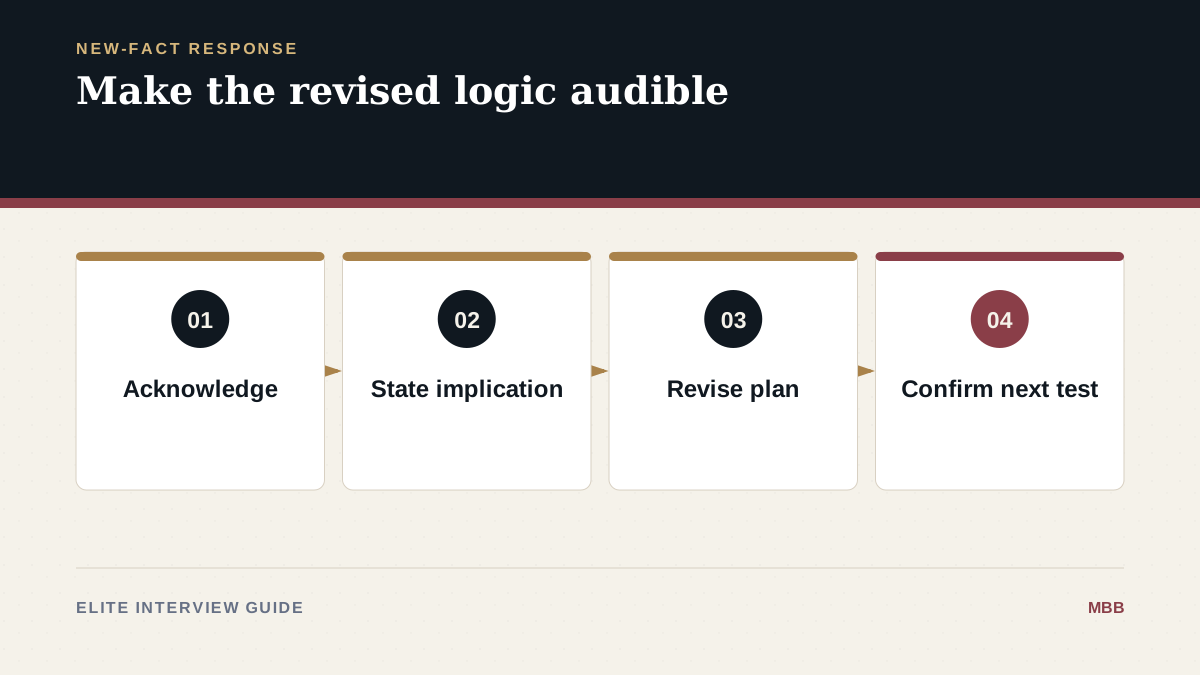
1. Acknowledge
Show what you heard without over-apologising:
- “Understood—so the figure is annual.”
- “That makes churn the more immediate signal.”
- “I will set demand aside.”
- “You are right to challenge the price hypothesis; I have not proved it yet.”
Avoid “yes, exactly” when the new information contradicts your prior point. Accuracy is more credible than pretending continuity.
2. Update the priority
State how the logic changes:
- “That reduces the monthly revenue estimate by a factor of twelve.”
- “I would now prioritise retention over acquisition.”
- “With demand held constant, the remaining profit drivers are unit economics and capacity cost.”
- “Without price evidence, I should test mix and volume before keeping price as the lead hypothesis.”
This sentence is the part many candidates skip. They acknowledge the hint and then return to the same branch.
3. State the next test
Make the next action observable:
- “I would split churn by cohort and channel to locate where it changed.”
- “I would compare contribution margin per order before and after the service change.”
- “I would calculate utilisation at peak and off-peak times.”
- “I would ask whether the mix shift is customer-led or supply-constrained.”
The complete move should take roughly 10–20 seconds. It is a bridge, not a second opening structure.
Four responses to the same interruption
Synthetic prompt: a regional grocery-delivery company has falling profit. You begin with demand, pricing, fulfilment cost and overhead. The interviewer says: “Assume order volume and average basket size are stable.”
| Response | What happens |
|---|---|
| “I still think demand matters because competitors may be growing.” | Defends a parked branch and ignores the assumption |
| “Okay, I will look at costs.” | Moves on but does not show which cost or why |
| “Understood. With volume and basket size stable, I would deprioritise demand and compare contribution margin per order. I would first split rider, promotion and payment costs to see which unit cost changed.” | Updates the priority and names the next test |
| “Can I clarify whether stable volume applies to every city and customer cohort?” | Useful only if the distinction could change the decision; otherwise it delays the provided assumption |
The third answer is usually the cleanest. The fourth can be appropriate, but clarification should resolve real ambiguity—not reopen a branch the interviewer deliberately closed.
Five interruption drills
Drill 1: Consumer retention
Prompt: A subscription product in Indonesia has slowing revenue growth. Your opening hypothesis: New-user acquisition weakened. Interruption: “Marketing leads are unchanged, but three-month retention fell.”
Recovery:
Ten-second synthesis:
Drill 2: Port congestion
Prompt: A regional manufacturer faces late deliveries through a Southeast Asian port. Your opening hypothesis: Port capacity is insufficient. Interruption: “The port has spare berth capacity outside two daily peaks.”
Recovery:
Ten-second synthesis:
Drill 3: Public transport
Prompt: A city wants to improve bus reliability without raising the operating budget. Your opening hypothesis: Add more buses to unreliable routes. Interruption: “Fleet size is fixed for the next three years.”
Recovery:
Ten-second synthesis:
Drill 4: Digital-bank profitability
Prompt: A digital bank is growing customers but losing money. Your opening hypothesis: Raise account fees. Interruption: “Why is price your first lever when you have not seen customer profitability?”
Recovery:
Ten-second synthesis:
Drill 5: Data-centre location
Prompt: An operator is choosing between two Southeast Asian sites. Your opening hypothesis: Choose the site with lower land cost. Interruption: “The cheaper site cannot secure the required power connection before the anchor customer’s start date.”
Recovery:
Ten-second synthesis:
When you should not immediately agree
An interviewer may challenge your hypothesis to understand its basis. Use a short evidence test:
- What fact supports my current view?
- Does the interruption add a stronger fact, or only ask for justification?
- Would retaining the hypothesis change the next analysis?
If evidence still supports your view:
That response is neither defensive nor passive. It shows why the hypothesis survives and what would falsify it.
Keep one decision thread visible
After two or three case steps, use a ten-second checkpoint:
A checkpoint contains:
- The original decision.
- What the analysis has established.
- What changed because of new information.
- The next test.
It should not repeat every branch you have discussed.
Review the recording, not your intention
Score each drill from 0 to 2:
| Criterion | 0 | 1 | 2 |
|---|---|---|---|
| Heard the new fact | Ignored or contradicted it | Repeated it | Stated its implication |
| Updated priority | Returned to old branch | Moved vaguely | Re-ranked the analysis |
| Named next test | No action | Broad topic | Specific data or comparison |
| Preserved decision | Lost the objective | Mentioned it late | Connected the next test to it |
| Delivery | Defensive or long | Understandable | Calm and under 20 seconds |
Do not give yourself credit for what you meant to say. Use only the recording.
Next action
Record all five drills in one take. After each interruption, force a two-second pause and use “acknowledge → update → next test.” Re-record only the two lowest-scoring responses, then finish each with a ten-second synthesis.
Sources
- BCG Case Interview Preparation — active listening, structured reasoning, clear communication, assumptions and feedback.
- McKinsey Interviewing — official problem-solving interview description.
- Bain Interviewing — role-customised interviews and assisted case discussion.