In a China B2B pricing case, compare contribution before and after the discount, then test whether the required volume fits available capacity. A 10% price cut from CNY 100 to CNY 90, with variable cost of CNY 70, requires 50% more volume just to preserve contribution. Extra rollout costs and overtime raise that hurdle further. The discount's scope matters as much as its percentage.
For consulting candidates discussing China–Southeast Asia supply chains, a commercial question can involve several locations within one customer group. A procurement team may negotiate centrally while factories order locally and distributors provide support. Your answer needs to establish which purchases become cheaper, which orders are additional and who pays for serving them.
Define the deal before calculating its benefit
Suppose a China-based industrial-seal supplier sells 100,000 units per quarter to an assembler's Chinese plant. The assembler requests a 10% discount on every unit, promising 125,000 quarterly units by adding its Vietnam and Thailand plants.
Assume the existing 100,000 units remain at the current price if the supplier declines. All figures are in CNY, excluding indirect taxes; exchange rates are held constant. The product and payment terms stay unchanged. Ordinary fixed costs do not change, so compare contribution after any new deal-specific costs.
| Input | Assumption for one quarter |
|---|---|
| Existing price and volume | CNY 100 × 100,000 units |
| Variable cost per unit | CNY 70 |
| Requested price and volume | CNY 90 × 125,000 units |
| Regular-shift capacity available for this account | 140,000 units |
| Additional overtime capacity | 30,000 units |
| Extra cost per overtime unit | CNY 8 |
| One-time regional rollout cost | CNY 120,000 |
Variable cost includes avoidable production, freight and routine support costs for each destination. The separate rollout cost covers customer-specific qualification and onboarding. These are assumptions to test, rather than facts inferred from the customer's location.
Check the amount the supplier ultimately retains. McKinsey's transaction-pricing discussion shows why invoice price can miss freight, rebates and financing costs associated with customer payments. Here, those items must be captured in the price or cost assumptions once, without double counting. McKinsey, The power of pricing.
Replace the revenue argument with a contribution test
Contribution is revenue less variable costs: the amount available to cover fixed costs and profit. Before the discount, each unit contributes CNY 30, giving CNY 3 million per quarter. At CNY 90, contribution falls to CNY 20 per unit—a one-third reduction, despite only a 10% price cut.
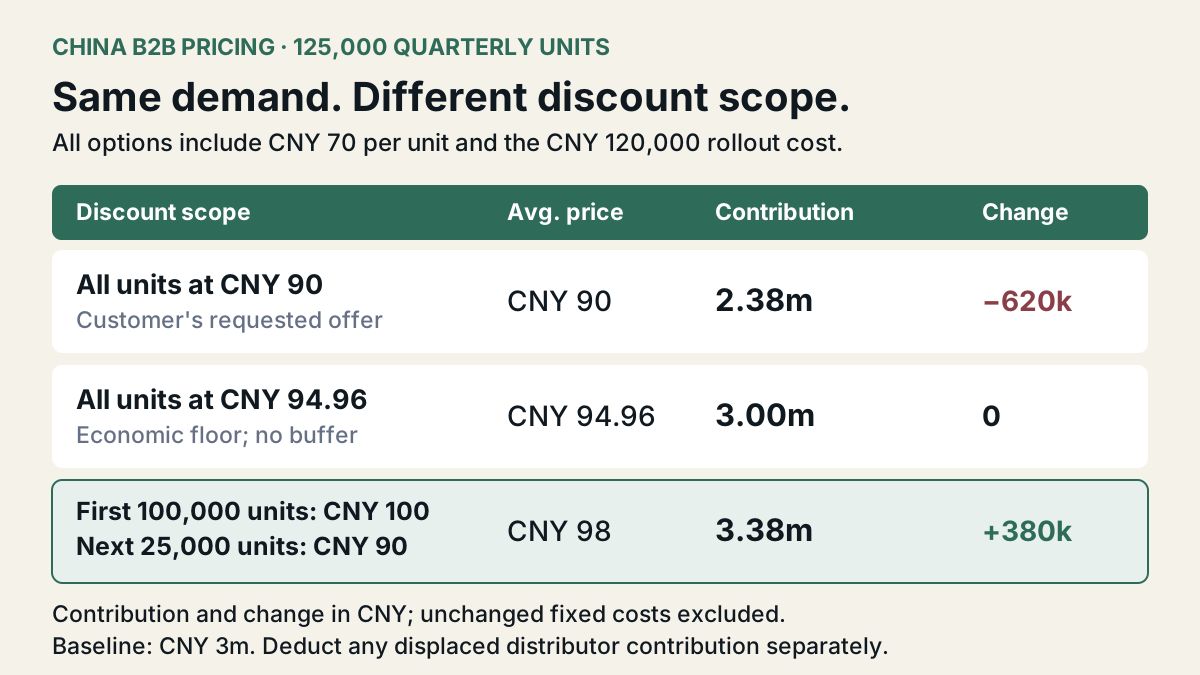
The customer promises 25% more volume. Revenue would rise from CNY 10 million to CNY 11.25 million, but contribution would be only 125,000 × CNY 20 = CNY 2.5 million. Subtract the CNY 120,000 rollout cost and the deal leaves CNY 2.38 million, or CNY 620,000 less than the baseline.
Ignoring rollout and capacity costs temporarily, the required volume is:
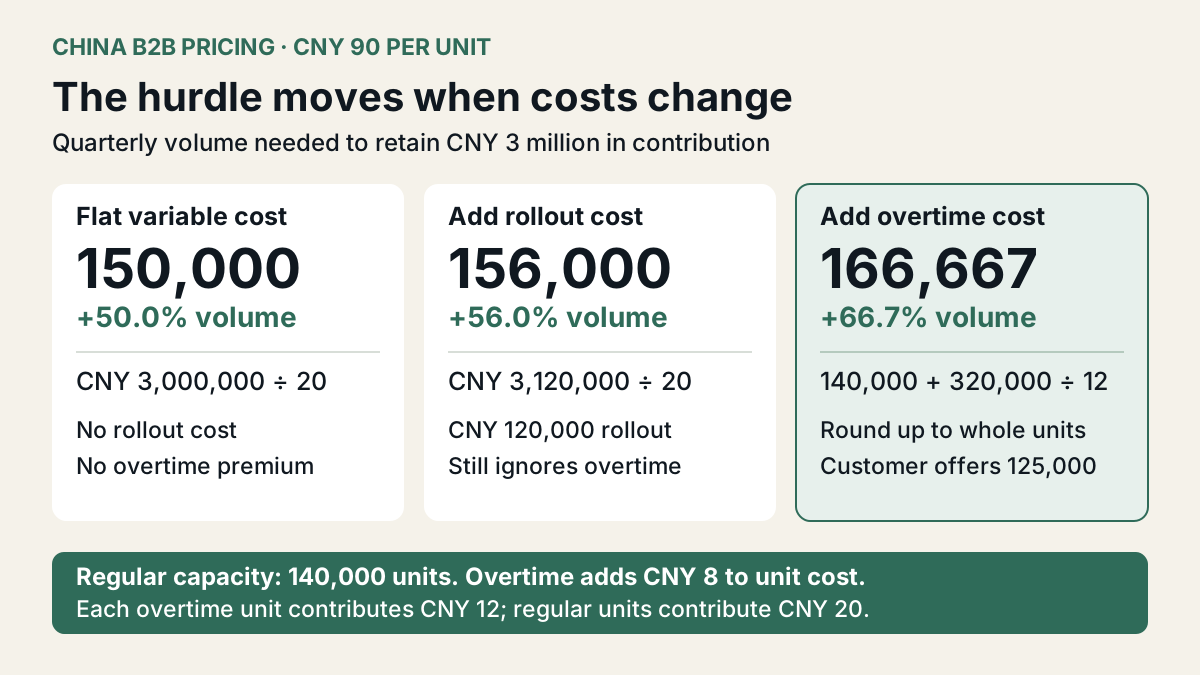
100,000 × (100 − 70) ÷ (90 − 70) = 150,000 units.
The extra-volume requirement is 50%, not 10% or 25%. You are replacing lost contribution on all existing units as well as earning contribution on new ones. This formula assumes a constant variable cost and a positive contribution per discounted unit; it cannot justify an offer that loses money on each additional unit.
Recalculate when the factory reaches regular capacity
Adding the rollout cost raises the apparent hurdle to (CNY 3 million + CNY 120,000) ÷ CNY 20 = 156,000 units. That answer still assumes every unit costs CNY 70, although regular capacity ends at 140,000.
At that boundary, the discounted deal contributes 140,000 × CNY 20 − CNY 120,000 = CNY 2.68 million. Overtime units cost CNY 78 and contribute only CNY 12. Closing the remaining CNY 320,000 gap requires 320,000 ÷ 12 = 26,666.7 additional units.
The true hurdle is therefore 166,667 whole units, approximately 66.7% above the original volume. It fits the assumed maximum of 170,000, but the customer has offered only 125,000. A feasible production schedule does not establish customer demand.
Make a counteroffer with an explicit economic boundary
At 125,000 units, the lowest uniform price that preserves this quarter's CNY 3 million contribution is:
CNY 70 + (CNY 3 million + CNY 120,000) ÷ 125,000 = CNY 94.96.
That permits a maximum 5.04% discount under the assumptions. It is an economic floor, not the recommended opening price: it provides no buffer for extra costs or missed volume.
Another structure keeps the first 100,000 units at CNY 100 and offers CNY 90 only on the additional 25,000. Contribution becomes CNY 3 million + 25,000 × CNY 20 − CNY 120,000 = CNY 3.38 million. The customer's average price is CNY 98, so be explicit that this is a 2% overall discount. Calling it “10% off” without explaining the eligible units would obscure the offer.
Propose a one-quarter arrangement with named eligible plants, an agreed baseline and a minimum purchase commitment. Apply the incremental rebate only to qualifying purchases above that baseline, with credit for returns. Confirm support responsibilities, costs and ordering dates before accepting. A customer's forecast alone should not earn the full discount in advance.
Check whether the new volume already belongs to another channel
The counteroffer's CNY 380,000 gain assumes every additional unit is new to the supplier. Regional service can involve more than shipping from China. Haitian International describes overseas sales and service partners and an Indonesian application center covering mold testing, training and spare-parts storage. That operating example makes support ownership a useful question when evaluating a regional quote. Haitian International, Worldwide Presence.
For the hypothetical supplier, ask whether the Vietnam or Thailand plants already buy through its distributors. Suppose 10,000 proposed units replace distributor sales that previously contributed CNY 18 each to the supplier. Deduct the displaced CNY 180,000: the incremental-only counteroffer now improves contribution by CNY 200,000, rather than CNY 380,000. If the distributor still provides service for a fee, update the support-cost assumption before recalculating. A new direct customer order can represent a channel transfer rather than company-wide growth.
Prepare for the questions that change your recommendation
What if declining loses the original account? Rebuild the baseline using credible retained volume. The current answer depends on keeping 100,000 units at CNY 100; evidence of a competing offer could change it.
What if another customer wants the overtime capacity? Compare contribution per scarce production hour, including the contribution displaced elsewhere. A positive margin alone does not establish the best use of capacity.
What happens after the rollout quarter? Remove the one-time CNY 120,000 only when it no longer recurs, then reassess service costs and renewal pricing. Do not promise a permanent discount using a temporary volume forecast.
Practise a 60-second recommendation: decline the requested all-unit discount, explain the 66.7% volume hurdle, and propose a conditional offer tied to additional purchases. Recalculate the counteroffer with 115,000 total units and 10,000 displaced distributor units before continuing to MBB Case Interview Prep at Elite Interview Guide.