
The application asks for your first and second office preferences. You type Singapore because you study there, Jakarta because you grew up nearby, and Kuala Lumpur because a friend says the team is expanding. Then you try to explain the order aloud. “They are all regional hubs” is not a reason, and “I am flexible” does not show where you can contribute.
This guide gives you a hard-gate check, a weighted office-choice sheet and a 60-second answer for your first choice. It will not decide where you should live. It will show whether your preference is supported by language, market evidence, eligibility and a credible reason to work with that office.
Southeast Asia is a region, not one application choice
BCG’s current international opportunities page lists Bangkok, Ho Chi Minh City, Jakarta, Kuala Lumpur, Manila and Singapore within its Southeast Asia group. The same page says requirements differ by location and directs candidates to local careers pages for eligibility, timelines and role availability. It also carries office-level language guidance rather than one rule for the whole region.
BCG’s current Southeast Asia open-roles page separates application instructions by school route. It warns that office preferences in a candidate profile should be correct before applying because later profile changes may not flow into an application already submitted.
McKinsey’s campus deadline finder similarly asks candidates to find the deadline that applies to their programme and office. The practical lesson is broader than any one firm: do not infer one Southeast Asia process from a regional label.
Record this before scoring anything:
| Hard gate | What to verify in the live source | If unclear |
|---|---|---|
| Role exists | Exact office, programme and intake | Do not assume a nearby office offers the same role |
| Candidate route | Local school, overseas school, MBA, graduate or experienced hire | Ask recruiting through the published channel |
| Eligibility | Degree timing, work authorisation wording and any stated criteria | Treat the written requirement as controlling |
| Language | Required and preferred language for the named office and role | Separate professional fluency from conversational comfort |
| Submission mechanics | Number and order of office preferences; whether edits carry over | Save the instruction and check before submitting |
A failed hard gate is not a low score. It is a reason to verify or remove an option until the issue is resolved.
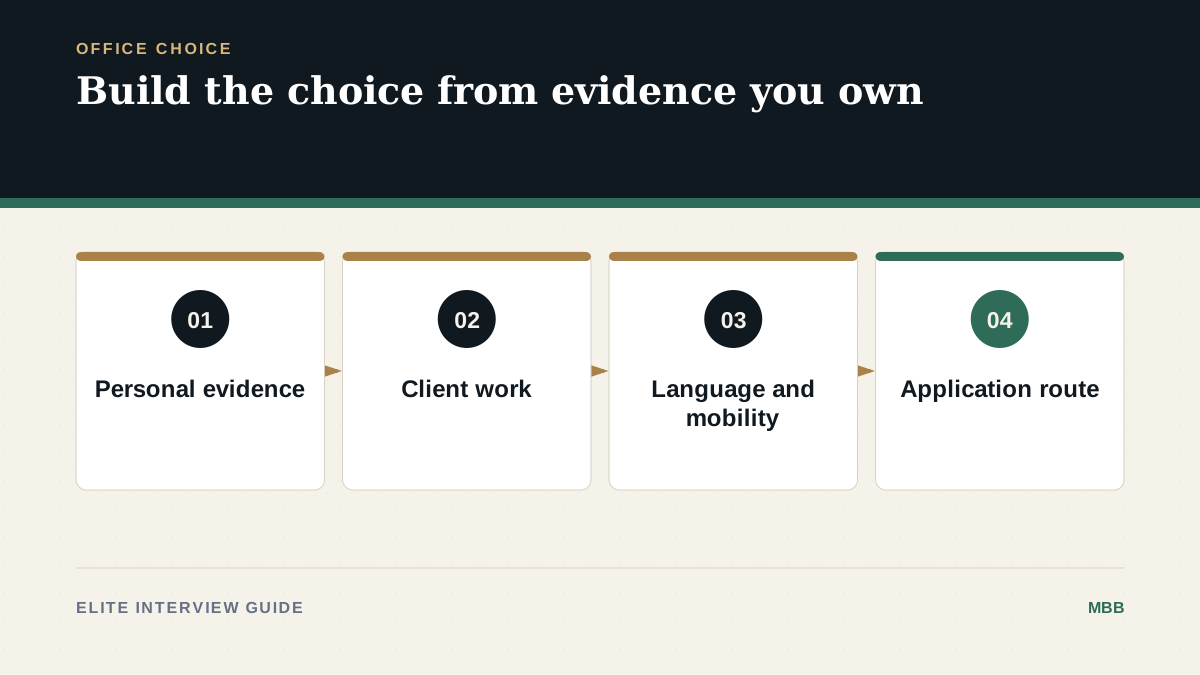
Build the weighted office-choice sheet
Once the hard gates pass, score each office from 0 to 3 on five dimensions. Use evidence, not aspiration.
| Dimension | Weight | 0 | 1 | 2 | 3 |
|---|---|---|---|---|---|
| Language deployability | 25% | Cannot work in a required language | Social only | Can discuss familiar business topics | Can handle meetings, ambiguity and written follow-up |
| Market evidence | 25% | No contact beyond headlines | Travel or general interest | Relevant study, project or repeated exposure | Lived or worked there with specific business evidence |
| Sector relevance | 15% | No connection | General sector interest | One relevant project or course | Repeated experience tied to office-relevant work |
| Personal reason | 15% | Prestige or hearsay | Lifestyle preference only | Specific long-term reason | Specific reason supported by choices already made |
| Contribution evidence | 20% | Generic “diverse perspective” | One untested claim | Transferable skill with an example | Skill plus evidence it helped a team in a comparable setting |
Multiply the score by the weight, but do not treat the result as an official hiring formula. Its purpose is to expose where your story depends on a blank.
Evidence that counts
- You worked on Indonesian distribution economics and can explain what you learned and what you still do not know.
- You speak Bahasa Indonesia professionally and have used it in a project or workplace.
- You studied Malaysian industrial supply chains and can connect the work to a client decision.
- You have lived in Singapore and can name a specific regional problem you want to work on, beyond “it is a hub.”
- You made a prior choice—coursework, internship, language study or relocation—that is consistent with the stated preference.
Evidence that does not carry much weight alone
- You visited the country once.
- You like the food or lifestyle.
- A friend told you the office is growing.
- The city appears to have more prestigious exits.
- You list six Southeast Asian trends without showing why one matters to your work.
Two candidates can study in Singapore and reach different answers
The following profiles are synthetic composites, not real candidates and not descriptions of any firm’s decision.
Candidate A: Singapore first
Candidate A studies engineering in Singapore, completed a regional logistics project covering Malaysia and Indonesia, and interned with a company whose Southeast Asian planning team sits in Singapore. They work only in English but can show repeated experience coordinating across markets.
Singapore may be the strongest first choice because the candidate has direct regional-team evidence and a credible contribution: turning technical operating detail into decisions across several markets. Kuala Lumpur can remain a second choice only if the live role and language expectations fit. Jakarta should not be added merely because the project included Indonesian data.
Candidate B: Jakarta first
Candidate B also studies in Singapore but grew up in Indonesia, works professionally in Bahasa Indonesia and English, and has analysed consumer distribution outside Jakarta through a family-business project without claiming to be a national expert.
Jakarta may be the stronger first choice because language, lived context and a specific commercial question align. Singapore can still be credible, but the answer must explain why a regional platform is more relevant than returning home—not hide the home-market evidence to sound international.
The same university and degree do not produce the same office choice. Deployability and evidence do.
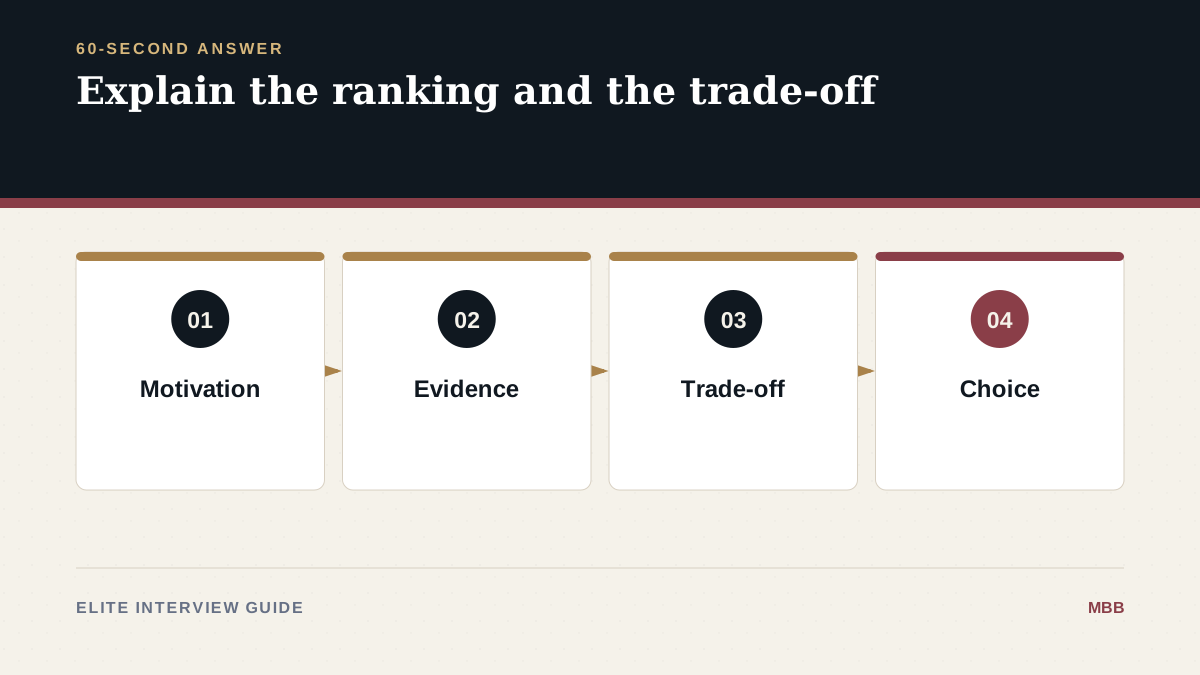
Turn the sheet into a 60-second answer
Use four parts:
- Choice: Name the office directly.
- Contact: Give one concrete piece of lived, worked or studied evidence.
- Problem: Name a business question you want to understand through that office.
- Contribution and limit: Explain what you can contribute now and what you still need to learn.
Weak version
Nothing is necessarily false. Nothing distinguishes this candidate.
Stronger version
This answer does not claim knowledge of every Southeast Asian market. It establishes contact, a problem, contribution and learning boundary.
Stress-test the preference
“Why not your home market?”
Do not criticise your home market or imply that the first-choice office is more prestigious. Explain which work pattern fits your evidence. If your home market is actually the better fit, the stress test has done its job.
“What do you know outside the city?”
Replace a country list with one concrete corridor, customer group or operating constraint. Then say what evidence you would need before advising a client.
“What would make you change your preference?”
A credible answer can change. You might revise the order if the role is unavailable, a language is required, work authorisation differs from your understanding, or the live team’s work is materially different from the assumption behind your answer.
“Why this office rather than this firm generally?”
Separate the two questions. Firm-level reasons concern people, work and operating model supported by your research. Office reasons concern market contact, deployability and the type of problems you can credibly discuss.
Final submission check
- I opened the exact role and office page today.
- I recorded the candidate route and eligibility wording.
- I checked language expectations rather than relying on a forum.
- My profile and application show the same office order.
- My first choice has at least two pieces of evidence.
- My second choice has its own reason; it is not a spare slot.
- My answer names one contribution and one learning boundary.
- I can explain why the ranking would change if a key fact changes.
Next action
Score no more than three offices, remove any option that fails a hard gate, and record the 60-second answer for the highest-scoring office. Listen once for unsupported claims and once for whether the answer would still make sense if the city name were removed.
Sources
- BCG International Opportunities — current Southeast Asia office, campaign and language guidance.
- BCG Southeast Asia Open Roles — current school-route and office-preference instructions.
- McKinsey Campus Application Deadlines — school- and office-specific deadline route.