
The interviewer asks for a recent Southeast Asian transaction. You did not work on one, so you choose between sounding uninformed and saying “we advised” when you did not. There is a third option: build a disciplined discussion from issuer, buyer and regulator sources, state exactly what is disclosed, and label your interpretation.
This guide uses Allianz’s announced acquisition of HSBC Life Singapore as a worked example. You will get a one-page source sheet, a 90-second answer, follow-up questions and a method for replacing the example next quarter.
HSBC and Allianz announced the transaction on 24 July 2026. At the article date it had not completed and the parties expected it to close in the first half of 2027, subject to regulatory approval.
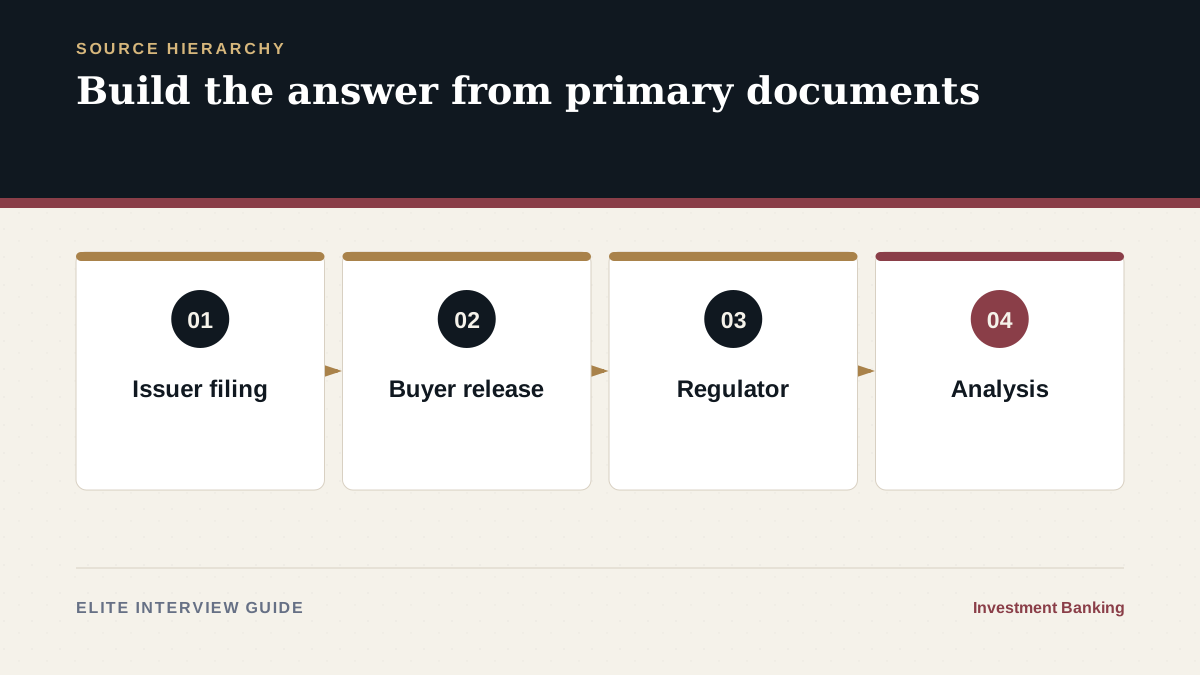
Start with the source hierarchy
Use:
- Stock-exchange or issuer announcement for transaction terms and seller disclosures.
- Buyer announcement or filing for buyer rationale and reported target metrics.
- Regulator or exchange material for licence, review and completion status.
- Reputable reporting only for context that primary sources do not provide.
For this case, HSBC’s 24 July 2026 stock-exchange announcement and Allianz’s investor-relations announcement are the core documents. The Monetary Authority of Singapore’s Financial Institutions Directory listed HSBC Life Singapore as a direct composite insurer and exempt financial adviser when checked on 1 September 2026.
The directory confirms current licence categories. It does not confirm transaction approval.
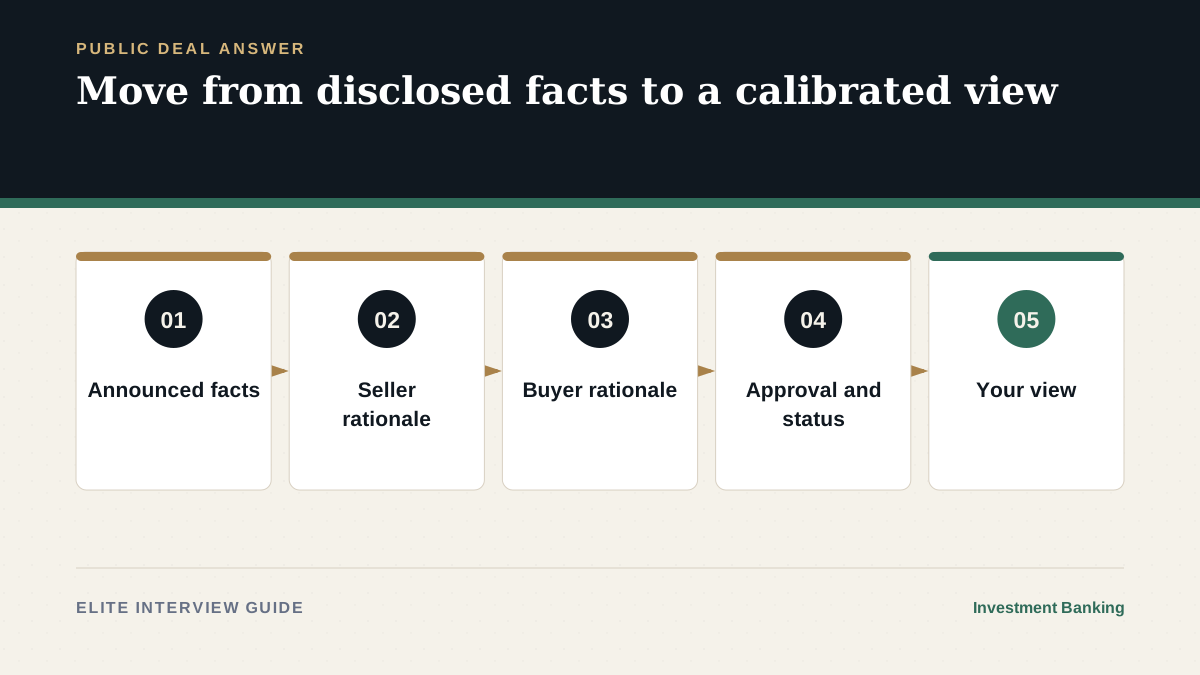
The one-page public deal sheet
| Field | Disclosed fact | Source / boundary |
|---|---|---|
| Announcement | 24 July 2026 | HSBC and Allianz |
| Seller | HSBC Insurance (Asia-Pacific) Holdings Limited, an indirect HSBC subsidiary | HSBC |
| Buyer | Allianz Asia Holding Pte Ltd, an Allianz subsidiary | HSBC and Allianz |
| Target | 100% of HSBC Life (Singapore) Pte Ltd | HSBC |
| Share consideration | S$2.7 billion for the issued share capital | HSBC |
| Distribution agreement | On completion, a 15-year exclusive bancassurance arrangement; HSBC disclosed a S$0.2 billion initial payment | HSBC |
| Combined amount | Allianz described combined consideration for the acquisition and distribution agreement as €2.0 billion, or S$2.9 billion | Allianz; includes two agreements |
| Status | Announced; subject to regulatory approval | Both parties |
| Expected completion | First half of 2027 | Both parties’ expectation, not a completed fact |
| Seller impact | HSBC expected a US$1.8 billion pre-tax disposal gain and up to 15 basis points of CET1 benefit, based on stated assumptions | HSBC forward-looking estimate |
| Target performance | HSBC reported 2025 PBT of S$118 million; Allianz reported 2025 operating profit of €80 million and comprehensive equity of €1.2 billion using its stated definitions and conversions | Do not treat unlike metrics as directly interchangeable |
| Buyer financing | Not detailed in the core announcements used here | Open question; do not invent |
This table is intentionally conservative. It preserves what the documents do not say.
Separate stated rationale from your interpretation
What HSBC stated
HSBC said the sale followed a strategic review and forms part of group simplification, focusing on areas where it sees clear competitive advantage and growth opportunity. It also said Singapore remains important to its wealth and wholesale-banking strategy. The distribution agreement would allow HSBC Singapore to continue distributing the insurer’s products after completion.
What Allianz stated
Allianz said the acquisition would expand its Singapore presence, product reach and customer access. It highlighted the 15-year distribution partnership, HSBC Singapore’s customer relationships and Singapore’s role in Allianz’s Asia-Pacific strategy.
A candidate’s interpretation
You can infer that the structure separates ownership of insurance manufacturing from bank distribution: Allianz would own the insurer, while HSBC would retain an exclusive channel relationship under the announced agreement. That may allow HSBC to release capital and simplify ownership while preserving an insurance offering for bank customers; it may allow Allianz to acquire an operating platform plus long-duration distribution.
Use “I interpret” and “may.” The parties disclosed their reasons; they did not publish every internal alternative, synergy case or negotiation consideration.
Do not calculate a careless headline multiple
It is tempting to divide S$2.7 billion by HSBC’s reported S$118 million PBT and announce a transaction multiple. That shortcut has several problems:
- PBT is not net income, distributable earnings or embedded value.
- One year may not represent sustainable earnings.
- Insurance accounting includes balance-sheet and contractual-service-margin considerations not captured by one profit figure.
- The S$0.2 billion distribution payment is separate from the share consideration.
- Capital requirements, growth, product mix and the value of distribution matter.
- The announcements do not provide the full forecast, diligence adjustments or buyer return model.
You can say the disclosed price appears substantial relative to one reported profit measure, then explain why a defensible valuation requires more data. Knowing not to manufacture precision is part of the answer.
The transaction mechanics in plain language
If completed:
- Allianz’s Singapore subsidiary would acquire all issued shares of HSBC Life Singapore.
- The insurer would leave HSBC ownership and become Allianz-owned.
- HSBC Bank Singapore and the insurer would enter the announced exclusive 15-year distribution agreement.
- HSBC disclosed an initial S$0.2 billion payment for the exclusive terms, recognised over the agreement term alongside variable consideration under the contract.
- Employees would continue with the target, according to HSBC’s announcement.
Completion remains subject to approval. Do not shift your verbs from “would” to “did” until a completion source exists.
Five strategic questions behind the announcement
1. Why sell ownership but retain distribution?
Possible logic: a bank can continue offering insurance through a partner while reducing the capital, operational and management burden of owning the insurer. Test that interpretation against customer economics, contract terms and strategic alternatives.
2. Why would Allianz pay for both the insurer and a long agreement?
The insurer provides licences, products, people and existing operations; distribution provides access to bank customers. The value of the two components depends on retention, product economics, channel productivity and execution.
3. What makes the buyer better placed to own the asset?
Allianz points to insurance capabilities, broader products and Asian growth. A banker should still ask where scale, product, investment, technology or operating synergies actually arise and what they cost.
4. What could block or delay completion?
Regulatory approval is explicit. Other general execution risks can include conditions precedent, migration planning and transaction readiness, but do not claim a specific condition unless disclosed.
5. What happens to customers and employees?
HSBC said employees would continue with the target and the parties would work toward a smooth transition. Customer proposition, product continuity, systems and branding still require execution. Separate stated intention from delivered outcome.
Two risks and two open questions
| Area | Interview point |
|---|---|
| Regulatory / timing | Approval or conditions could change timing or economics |
| Integration / distribution | The long-term agreement creates value only if products, systems, incentives and customer experience work together |
| Open question: buyer funding | Core announcements do not explain the complete financing plan |
| Open question: valuation | Public documents do not provide a full forecast, synergy case or standalone valuation |
Add a third risk only if you can explain its mechanism. A longer risk list is not automatically stronger.
A 90-second deal discussion
This answer identifies the transaction, terms, status, structure, both parties’ rationale, your interpretation and key limits.
Follow-up questions to practise
- Why is the distribution agreement economically important?
- What alternatives could HSBC have considered?
- How might an insurer be valued differently from an industrial company?
- Why might the buyer and seller report different profit metrics?
- What does CET1 impact mean for the seller, and why is it an estimate?
- What conditions must be met before you call the transaction complete?
- What information would you need to assess whether Allianz is paying an attractive price?
- How could customer retention affect the value of the 15-year arrangement?
Reuse the method next quarter
Replace the transaction when a new one has better primary documentation. Preserve:
- Exact announcement and status dates.
- Seller, buyer, target and structure.
- Consideration, financing and conditions only where disclosed.
- Stated rationale for both sides.
- Your interpretation with calibrated language.
- Two risks and two unanswered questions.
- A final status recheck on interview day.
Do not choose a deal merely because it is large. Choose one whose public documents let you explain mechanics and uncertainty.
Next action
Open the HSBC and Allianz announcements side by side. Build the one-page sheet without using this article, then record the 90-second answer. Highlight every sentence that comes from a source and underline every sentence that is your interpretation.
Sources
- HSBC: sale of HSBC Life Singapore to Allianz — seller terms, rationale, expected effects and status.
- Allianz: acquisition of HSBC Life Singapore — buyer terms, target information, rationale and expected completion.
- MAS Financial Institutions Directory — HSBC Life Singapore licence categories at the check date.