For a Japan consulting application, describe Japanese proficiency through three kinds of evidence: your actual qualification, recent tasks completed in Japanese, and your ability to discuss those tasks without a script. Check the role's stated language requirement first. Then show that you can explain a decision, preserve its assumptions across languages, and respond when the facts change.
This matters if you are applying from Taipei, Shanghai, Seoul or Singapore with an English-language degree and substantial Japanese study. Your application may document both achievements while leaving a practical question unanswered: what can you do in Japanese when a client needs a useful answer? A small, defensible example helps make that question concrete.
Read the requirement before describing your level
Language wording belongs to a particular role and recruiting route. For example, Bain's Tokyo experienced-hire page lists business-level Japanese and English for its October 2026 interview event, with Japanese at a level equivalent to Japanese-Language Proficiency Test (JLPT) N1 for non-native speakers. That is the wording of this event; it does not establish an identical threshold for every consulting firm, specialist role or graduate application. Check the relevant live posting and any instructions addressed to your application. Bain Tokyo experienced-hire recruiting.
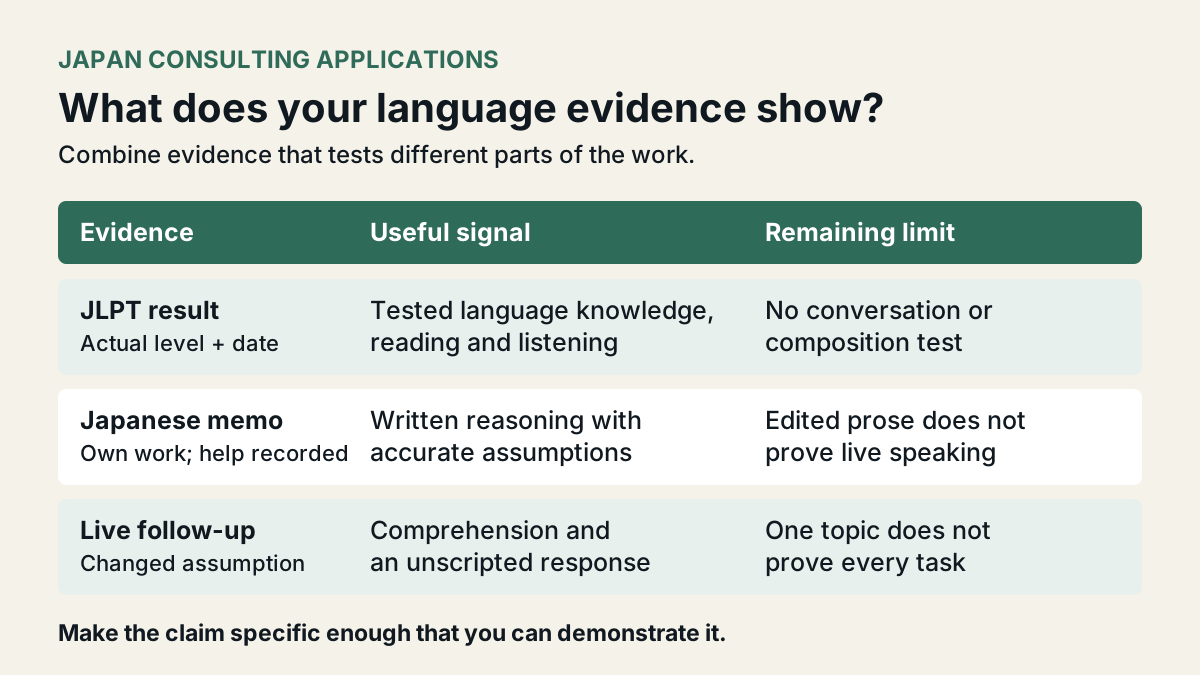
Keep certification and self-description separate. If you passed the JLPT, give the level and test date accurately. If you have not passed N1, do not write “JLPT N1” because a tutor thinks your skills are similar. Where a posting uses “equivalent,” ask the recruiting contact what evidence it accepts if the application does not explain this.
The distinction has a concrete basis: the JLPT's official FAQ says that it does not include conversation or composition tests. A result can therefore support your tested proficiency without directly demonstrating how you lead a discussion or write a recommendation. Add task evidence to show those skills alongside the qualification. Official JLPT FAQ.
Turn “business Japanese” into observable tasks
Choose evidence that resembles the communication you expect to use. Reading a Japanese industry release and explaining its implication is different from translating each sentence. Giving a prepared update is different from answering an unexpected objection. A well-edited memo shows written reasoning, but its polish alone cannot establish spontaneous speaking ability.
Build a compact evidence inventory before changing your CV. For each example, note the audience, task, language used, your individual contribution, date and assistance received. A university project can be relevant if described as a university project. An internship example can be stronger when you can explain precisely what you wrote or presented. Neither should become a fictional client engagement.
Use work samples for preparation; submit them only where the application accepts them or a recruiter requests them. Existing work must be yours to share. If it contains restricted material, create a fresh exercise using public information or clearly stated assumptions. Removing a company name does not necessarily make a document shareable.
Build one bilingual recommendation around a decision
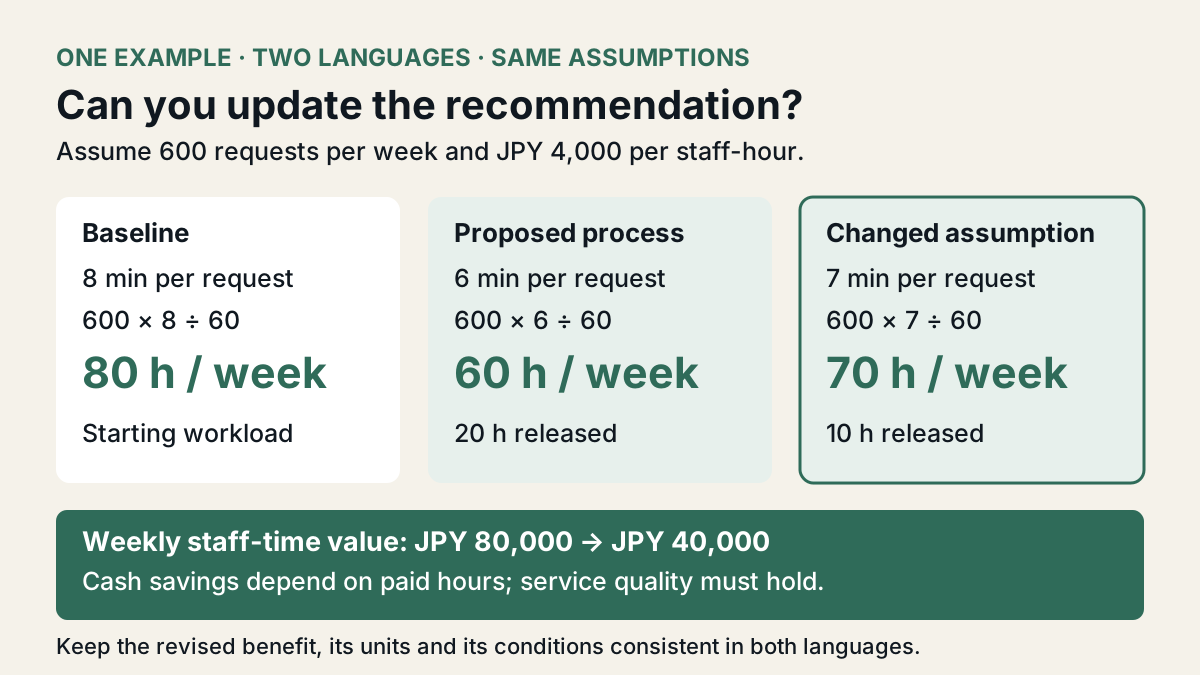
Suppose a Japan customer-service team handles 600 requests each week. Each request takes eight minutes on average. You are assessing a proposed process that could reduce handling time to six minutes, while keeping service quality unchanged. Assume a staff-time value of JPY 4,000 per hour.
The baseline workload is 600 × 8 ÷ 60 = 80 hours per week. The proposed process would require 600 × 6 ÷ 60 = 60 hours, releasing 20 hours. Multiplying by JPY 4,000 gives JPY 80,000 per week of staff-time value. That is not automatically a cash saving: if paid hours remain unchanged, the benefit is capacity for other work. Implementation costs are still unknown.
Write a short Japanese memo for the team manager and an English summary for a regional colleague. Both should recommend a two-week pilot, subject to confirming its cost, to test handling time and service quality before committing to a wider rollout. Track repeat requests as well as speed: quicker handling is unhelpful if customers must contact the team again. The Japanese version might include:
The corresponding English meaning is: “This estimate assumes that we can reduce work by 20 hours per week. It does not mean that personnel costs will immediately fall.” Notice the preserved boundary between time and cash. A translation that drops the second sentence changes the commercial recommendation, even if its grammar is excellent.
Now explain the memo aloud in Japanese. Have a partner interrupt: actual handling time may only fall to seven minutes. Recalculate the workload as 70 hours per week, leaving ten hours of released capacity and JPY 40,000 of weekly staff-time value. Revise your recommendation's expected benefit; do not continue quoting the original number because it is on the slide.
Make the application claim as narrow as the evidence
Separate the language line from the experience bullet. The language line records the credential and an accurate description of use. The experience bullet explains a real task and its outcome. Avoid a single label such as “fully bilingual” when your strongest evidence is reading technical material and delivering prepared presentations.
Suppose your university project involved Japanese updates and an English handover. A specific experience bullet could read: “Prepared weekly Japanese progress summaries for a university project team; presented the team's recommendation in Japanese and consolidated follow-up actions in English.” The sentence identifies the setting, outputs and language responsibilities. Use it only if those actions describe your actual contribution.
If your only relevant output is the exercise above, discuss it as a self-directed work sample. Do not place it under an employer's name or imply that the projected benefit occurred. Keep an unassisted draft so you can see what you can produce independently; record any language or analytical help used in the final version.
Test the weak task before adding a stronger adjective
Ask a capable Japanese-speaking practice partner to test three things: whether the conclusion is understandable, whether the numbers and qualifications stay intact, and whether you answer the question actually asked. The partner's feedback guides practice; it does not replace a firm's language assessment.
Use follow-ups that reveal different weaknesses:
- “Which assumption would you test first?” checks whether you can prioritise evidence.
- “Why is JPY 80,000 not automatically a cash saving?” checks commercial meaning and terminology.
- “What did you personally prepare?” checks ownership of the work sample.
- “What changes at seven minutes?” checks whether you can update the answer.
If you understand the question but cannot respond, practise that exchange rather than repeatedly polishing the introduction. If you answer fluently but change the unit or overstate the benefit, repair the reasoning. If a material language requirement remains unclear, resolve it with the recruiter before presenting your evidence as satisfying it.
For your next practice session, produce the one-page Japanese memo and English summary, then repeat the changed-assumption exchange without reading either. Use the MBB case interview preparation guide to strengthen the underlying recommendation. Practise the Japanese delivery separately with a suitable partner.