For a Japan succession-buyout case, start with the business that will remain after the founder steps back. Identify which customer relationships and decisions still depend on that person, estimate the cost of transferring those responsibilities, and price the earnings that a successor can sustain. A signed share purchase agreement does not establish that the management handover has worked.
This is a useful distinction for candidates interviewing with Japanese funds or regional teams covering Japan. The Small and Medium Enterprise Agency's 2025 White Paper separates having a successor candidate from obtaining that person's agreement. It also emphasizes early preparation when a business has many customers and employees. That makes succession readiness a diligence question, rather than something to infer from the owner's desire to retire. 2025 White Paper, succession section.
Find what the founder still controls
Suppose a Japanese precision-components company has annual revenue of JPY 2,000 million and reported EBITDA of JPY 200 million. EBITDA is earnings before interest, taxes, depreciation and amortization. The founder wants to retire, and the buyer is evaluating successor candidates.
For an internal candidate, ask which decisions they already make without the founder. Can they approve a quotation, resolve a quality complaint and negotiate an annual customer agreement? An internal promotion may preserve technical knowledge while leaving a commercial gap. An external hire may bring that experience but need time to earn customer confidence.
Build the customer map from records, not the founder's reassurance. In our example, customers representing JPY 600 million of annual revenue deal primarily with the founder; the remaining JPY 1,400 million already have established relationships with the team. This classification measures dependence, not a forecast that all founder-led revenue will disappear.
For the exposed accounts, inspect who attends reviews, signs off specifications and negotiates prices. Compare actual orders and complaints during the founder's absences. With suitable customer-contact permissions, test whether the proposed successor can explain the customer's next requirement. A shared contact list helps, but it does not prove that the customer accepts the new decision-maker.
Turn the handover into an earnings bridge
Assume the exposed customers generate a 35% contribution margin: each lost yen of sales reduces EBITDA by JPY 0.35 after costs that vary with those sales fall away. Other operating costs remain fixed. The founder's annual compensation of 20 is already included in reported EBITDA, and we assume the buyer hires an external chief executive at 35. All financial amounts below are JPY million; revenue and earnings figures cover a full year.
Before customer losses, ongoing EBITDA becomes 200 + 20 − 35 = 185. Adding back the entire founder salary without deducting a replacement would overstate what the business can earn independently.
| Founder-led revenue retained | Revenue lost from the 600 cohort | Contribution lost at 35% | Ongoing EBITDA |
|---|---|---|---|
| 95% | 30 | 10.5 | 174.5 |
| 90% | 60 | 21 | 164 |
| 70% | 180 | 63 | 122 |
These are alternative full-year scenarios with unchanged prices, mix and other customer revenue. They are not probability-weighted outcomes. If the founder's exit happens halfway through the year, separate that year's reported result from the full-year earnings level you are valuing.
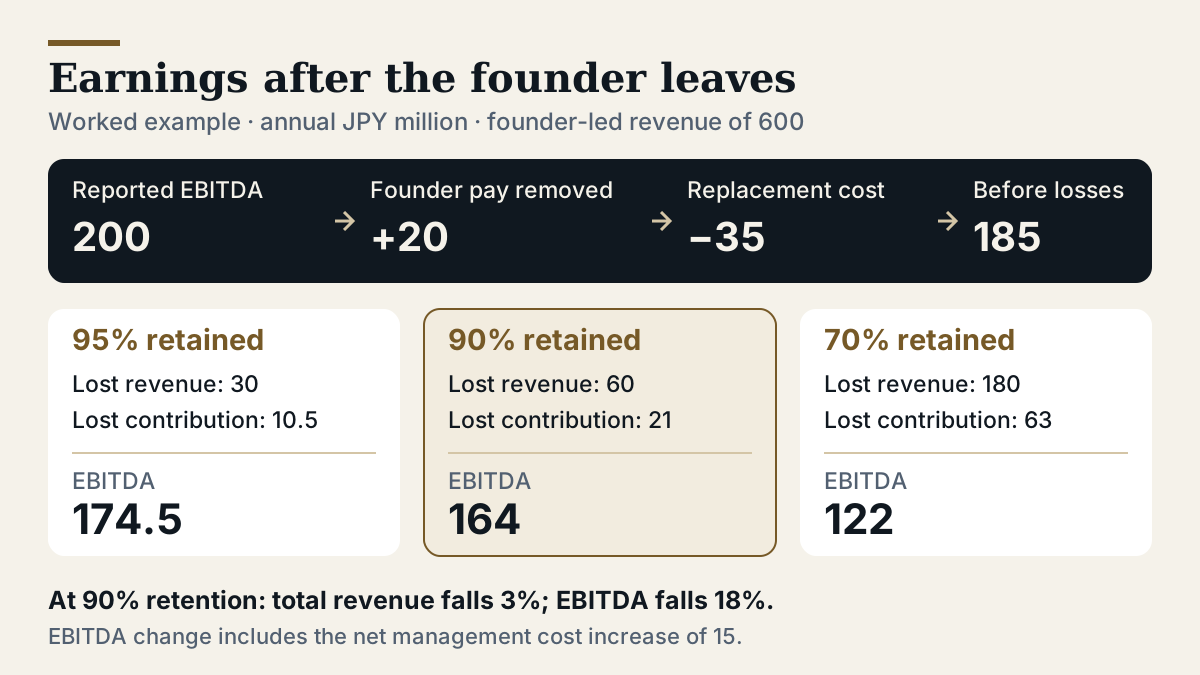
At 90% retention, losing only 3% of total company revenue removes 21 of EBITDA. Including the net management cost increase, EBITDA falls 18%, from 200 to 164. Customer dependence matters because fixed costs amplify the revenue loss.
Use payment terms to address a defined uncertainty
Suppose the seller asks for 1,600, presented as eight times reported EBITDA. Against ongoing EBITDA of 164, that is about 9.8 times. If you use an eight-times multiple of ongoing earnings for this exercise, the corresponding value is 1,312. Eight times is an assumption here, not a Japanese market benchmark.
For clarity, assume the company has no debt or surplus cash, so enterprise value equals the equity purchase price. An illustrative proposal is 1,100 at closing and a further 212 after the first year only if both agreed conditions are met: revenue from the defined founder-led customer cohort reaches at least 540, and annual EBITDA, after the replacement salary and excluding only agreed one-time transition expenses, reaches at least 164. The payment is zero unless both conditions are met. Compare nominal consideration here, without timing discounts or transaction costs.
The second payment is contingent consideration: its amount depends on performance. Simply postponing a fixed 212 payment would change cash timing while leaving the obligation intact. Neither arrangement transfers customer relationships on its own.
Define the customer cohort, measurement period, returns, discounts, replacement management expense and information access precisely. Revenue bought through uneconomic discounts should not count as a successful handover. The parties would also need workable documentation and dispute procedures; the illustration does not assume that these terms are standard or enforceable in every deal.
Even the contingent payment provides limited protection. At 70% retention, eight times EBITDA of 122 is 976, below the 1,100 paid at closing. Paying less later does not undo the initial overpayment. If customer evidence cannot support the retention assumption, reduce the initial price, secure better evidence before closing or decline the transaction.
Make the first 100 days resolve those risks
Japan's SME integration guidance connects management and operating integration with trust among the seller, employees and customers. Its basic section also calls for clarifying the seller's role and tenure and identifying important customers before closing. That supports preparing the handover during diligence. SME Post-Merger Integration Guidelines, summary.
For this company, agree the successor's appointment and decision authority before closing. Define the founder's temporary advisory role, availability and separate cost; a temporary advisory fee is an additional transition cash cost, excluded from our ongoing EBITDA calculation but included in the acquisition funding plan. A founder who stays indefinitely and still approves every quotation has postponed the succession problem.
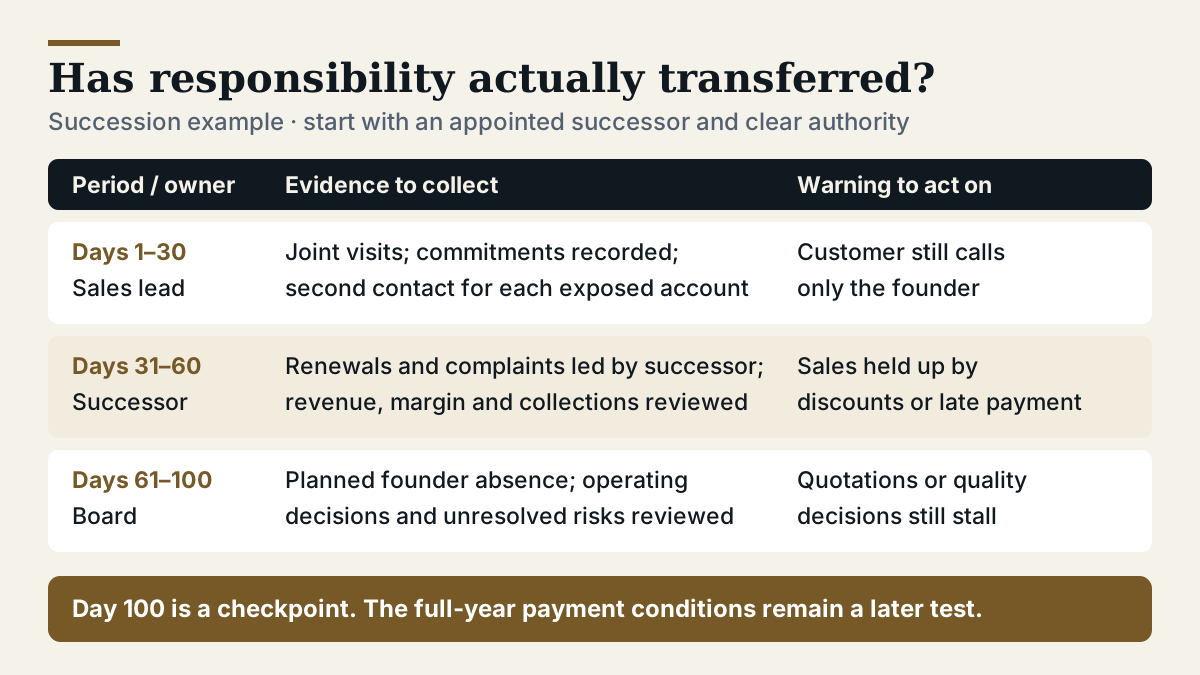
During days 1–30, the successor and sales lead should visit the exposed accounts with the founder, record open commitments and nominate a second contact for each relationship. Preserve deliveries and quality responses while authority changes. Do not launch an aggressive price increase before understanding those commitments.
During days 31–60, the successor should lead renewals and complaint resolution. Review retained revenue alongside contribution margin, overdue receivables and the founder's remaining interventions. Strong shipments with deteriorating collections are weak evidence of a successful transition.
During days 61–100, test whether routine decisions continue during a planned founder absence. The board should review unresolved account risks and decide whether additional commercial support is needed. A 100-day review is an early checkpoint; it cannot establish the full-year payment outcome or guarantee later retention.
Practise a conditional investment recommendation
Give a two-minute recommendation covering the exposed customer cohort, sustainable EBITDA, maximum price under your assumptions and the evidence required before closing. Then answer three follow-ups: What if the proposed successor declines? What if retained customers demand lower prices? What if the founder cannot provide transition support?
For a numerical variation, assume 80% retention of the exposed cohort with every other assumption unchanged. The contribution loss becomes 42, ongoing EBITDA becomes 143, and eight times those earnings gives 1,144. Explain how that changes your initial-payment proposal, then continue with Private Equity Interview Prep.