In a Korean carve-out interview case, reconstruct the cost of running the business independently before applying an earnings multiple. Remove historical group charges only where they cease, then include the functions and commercial benefits that must be replaced. Keep temporary transition costs, seller obligations and buyer-specific synergies in separate calculations. An optimistic earnings adjustment can otherwise conceal a more expensive acquisition.
This distinction matters for candidates interviewing in Seoul or covering Korea from Hong Kong or Singapore. Samil PwC's November 2024 analysis identifies additional IT and administrative costs, temporary service arrangements and the risk that trading terms change after separation. Those dependencies give you concrete questions to investigate. They do not establish that every Korean group offers the same support. Samil PwC, Korean carve-out analysis.
Identify what actually leaves the parent
A carve-out separates a business from a larger company. The financial statements describe its past inside that company; your investment case must describe its future outside it.
Begin with the transaction boundary: which people, contracts, systems and assets transfer? Then map every shared function to a future provider. A group charge allocated by revenue may differ substantially from the price of replacing the underlying service. Removing the charge does not remove the need to process payroll, close accounts or maintain production systems.
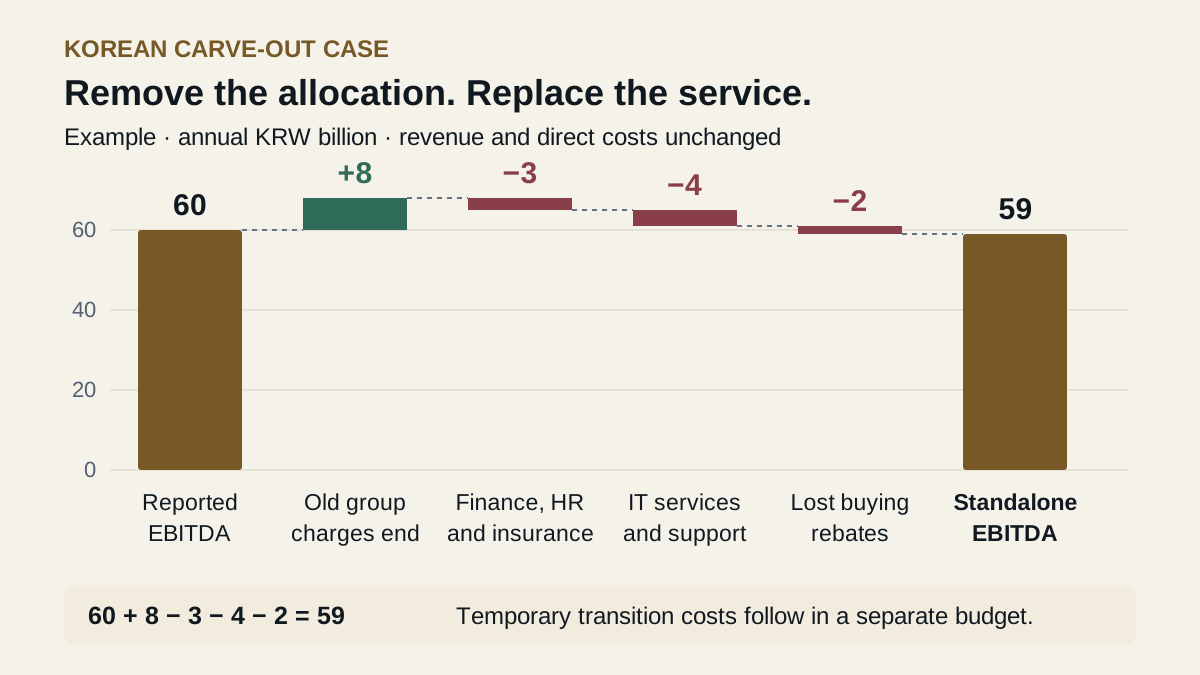
Suppose a sponsor is buying a Korean specialty-materials division with a plant in Changwon. All figures below are KRW billion. Revenue, production volumes and direct operating costs stay constant. Annual reported EBITDA—earnings before interest, taxes, depreciation and amortization—is 60, after 8 of group charges. Existing plant personnel and production costs already sit in that 60.
Assume the entire historical charge ends at closing. Diligence identifies three costs outside the existing direct-cost base: finance, human resources and insurance cost 3 annually; IT subscriptions and support cost 4; losing group purchasing rebates adds 2 to annual input costs. The replacement estimates provide the same operating capacity and service quality.
Rebuild the permanent earnings base
| Annual adjustment | KRW billion | Reason |
|---|---|---|
| Reported divisional EBITDA | 60 | Includes the old group charge |
| Remove the discontinued charge | +8 | Historical allocation ends |
| Finance, HR and insurance | −3 | Required after separation |
| IT subscriptions and support | −4 | Permanent replacement service |
| Lost purchasing rebates | −2 | Existing input terms cannot continue |
| Standalone EBITDA | 59 | Before buyer-specific improvements |
The calculation is 60 + 8 − 3 − 4 − 2 = 59. “Add back headquarters costs” gets you only to the intermediate 68. It does not establish sustainable earnings.
The rebate adjustment also needs commercial evidence. In this exercise, supplier quotations confirm the annual 2 increase at unchanged volumes. If a continuing supply agreement preserved the old price, that assumption would change. For a Korean group separation, ask which affiliate contracts and purchasing arrangements transfer, expire or require renegotiation; the group's scale is not an asset you automatically acquire.
For an illustrative 8× multiple, 59 implies enterprise value of 472, compared with 544 from multiplying the incomplete 68. The difference is 72. If the seller instead asks 480, the price represents approximately 8.14× standalone EBITDA, despite being 8× reported earnings. These are different denominators, not different purchase prices.
Model the transition by month
A transition service agreement, or TSA, lets the seller provide specified support after closing. PwC's November 2023 analysis explains why exiting these arrangements depends on disentangling systems and can expose both parties to additional costs. Use the actual service scope and exit conditions when modelling a case. PwC, TSA exit analysis.
Suppose the seller supplies temporary IT access for 0.5 per month, ending after month six. The buyer incurs replacement IT costs at an annual rate of 4 from day one: staff and subscriptions are needed during configuration and testing. Both costs therefore run together for six months. This overlap is explicit; it is not an accidental double count.
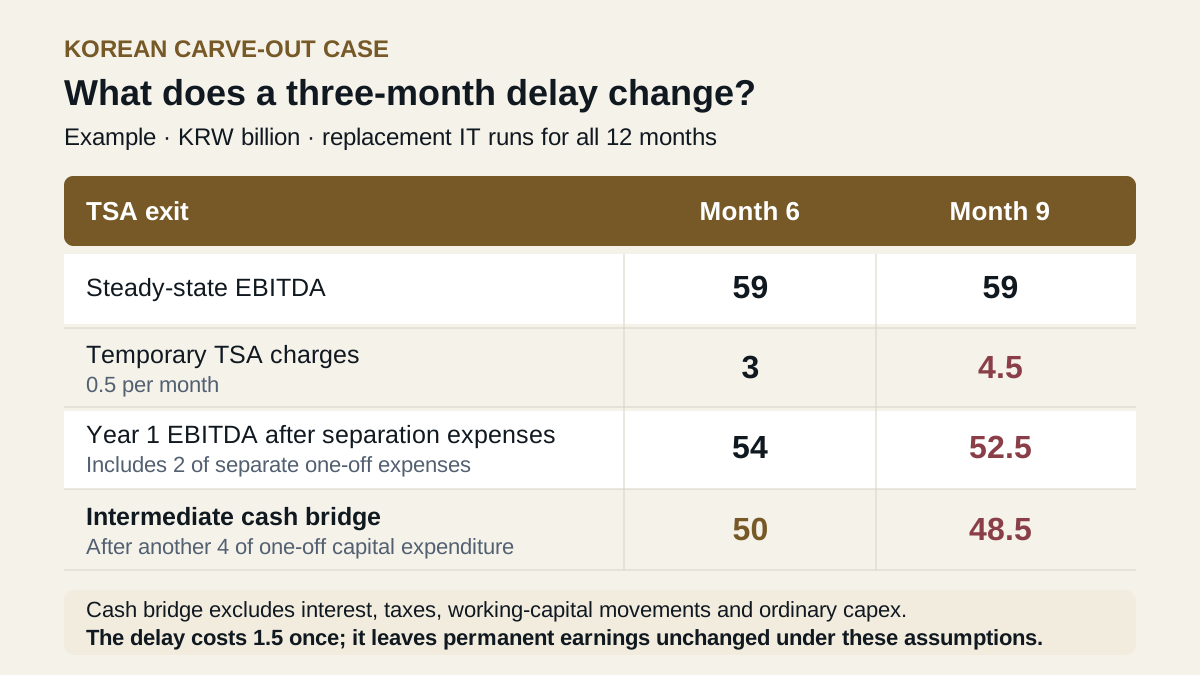
The first twelve months after closing incur 3 of TSA charges. With the other assumptions unchanged, EBITDA before separate one-off separation expenses is 59 − 3 = 56. Do not treat the TSA's temporary price as the permanent IT budget. Equally, do not subtract a full replacement budget during transition if the case actually delays those payments; build the monthly schedule first.
Assume additional one-time separation cash spending totals 6. For this exercise, 2 is expensed and 4 qualifies as capital expenditure. First-year EBITDA after those expenses is 54. Subtracting the capital expenditure leaves 50 before interest, taxes, working-capital movements and ordinary capital expenditure. That 50 is an intermediate cash bridge, not free cash flow or debt repayment capacity.
Give each cost the correct owner
Suppose 3 of annual central-team and office costs supported the sold division, but the seller cannot immediately reduce the team or lease. These are stranded costs: expenses left with the seller after the work they supported has departed. They do not automatically reduce the acquired company's 59. They affect the buyer only through an obligation it accepts, such as a reimbursement or service charge. Check whether that obligation is already in the TSA schedule before adding it again.
Buyer synergies belong elsewhere too. Suppose the sponsor proposes 3 of annual packaging savings through another portfolio company. These concern a different spend category from the lost input rebates. They would increase earnings from 59 to 62 once achieved, but require evidence of supplier terms, implementation cost and timing. Present the standalone case and the buyer improvement case separately; do not pay for the whole benefit merely because it appears in a model.
Turn the bridge into a recommendation
Challenge the largest uncertainty with a specific follow-up. If IT exit slips from month six to month nine at the same monthly charge and with replacement costs unchanged, TSA spending rises from 3 to 4.5. First-year EBITDA after the 2 separation expense falls to 52.5, and the intermediate cash bridge falls to 48.5. Steady-state EBITDA remains 59 if the delay creates no lasting cost or revenue damage. A temporary 1.5 outflow does not automatically justify multiplying 1.5 by the full valuation multiple.
Your next questions should resolve the operating dependencies: can orders, production records and payroll function at cutover? Who signs off on data migration? What triggers an extension fee? Which supplier quotes substantiate the recurring budget? An exit date is useful only when the business can operate without the seller on that date.
Practise a ninety-second recommendation that states 59, the first-year cash burden and the evidence needed to support TSA exit. Then raise permanent IT cost from 4 to 5: standalone EBITDA becomes 58, and the same illustrative 8× multiple gives 464. Explain why this permanent change affects the valuation differently from a three-month delay, then continue with Private Equity Interview Prep.