In a sum-of-the-parts valuation of a Korean conglomerate, first establish which businesses are consolidated. Value each operating business, add investments excluded from those operating values, and subtract the corresponding net debt and outside shareholders' claims. Alternatively, value the parent's equity stakes directly and subtract only net debt outside those stakes. Both approaches should reconcile when they use the same assumptions.
This matters whether your banking interview concerns Seoul or a regional team covering Korea. A familiar group name can hide different legal entities, reporting boundaries and listed investments. A polished explanation of a “Korea discount” cannot repair an answer that counts the same subsidiary twice.
Start with the filing boundary
Samsung Electronics' consolidated report for the six months ended 30 June 2025 illustrates why the notes matter. Note 6 presents both carrying amounts of associates and market values of shares held in marketable associates. Those columns answer different questions; a disclosed holding value is not necessarily the investee's entire market capitalization. The statements also distinguish millions of Korean won from thousands of US dollars. Samsung Electronics, statements and Note 6.
Before calculating, identify the company being valued, the valuation date, units, ownership and whether each investee is consolidated. IFRS 10 bases consolidation on control and treats the parent and its subsidiaries as one economic entity. Do not infer the accounting boundary from the group name or ownership percentage alone. IFRS Foundation, IFRS 10.
An associate is different: the investor has significant influence without control. Under equity accounting, its share of the associate's profit enters the investor's profit or loss; this is not line-by-line consolidation of the associate's sales and expenses. Check whether any such income has entered the earnings measure you intend to multiply. IFRS Foundation, IAS 28.
Set up one consistent exercise
Suppose a Korean industrial parent owns its core operations, 60% of a controlled components subsidiary and 25% of a listed logistics associate. All amounts below are KRW billion. EBITDA means earnings before interest, taxes, depreciation and amortization; use normalized annual figures, not an unadjusted quarter.
| Item | Assumption | Value represented |
|---|---|---|
| Parent's core operations | EBITDA 80 × 6 | Enterprise value 480 |
| Components subsidiary | EBITDA 50 × 8 | Enterprise value 400 for 100% |
| Components net debt | 100 | Subsidiary debt less surplus cash |
| Logistics associate | 25% × full market capitalization 240 | Parent's equity stake 60 |
| Parent net debt | 120 | Debt outside the subsidiary, less surplus cash |
Enterprise value measures the operating business before financing claims. An equity stake is already a claim after the investee's debt. This distinction determines where subtraction belongs.
Assume one ordinary share class, no other claims or circular holdings, and no intercompany loans. The EBITDA inputs exclude associate income and already include the relevant central costs. Net debt uses only third-party debt less accessible surplus cash; lease treatment is consistent with the multiples. These assumptions make the reconciliation readable without pretending that a real filing will be equally simple.
Approach one: value consolidated operations
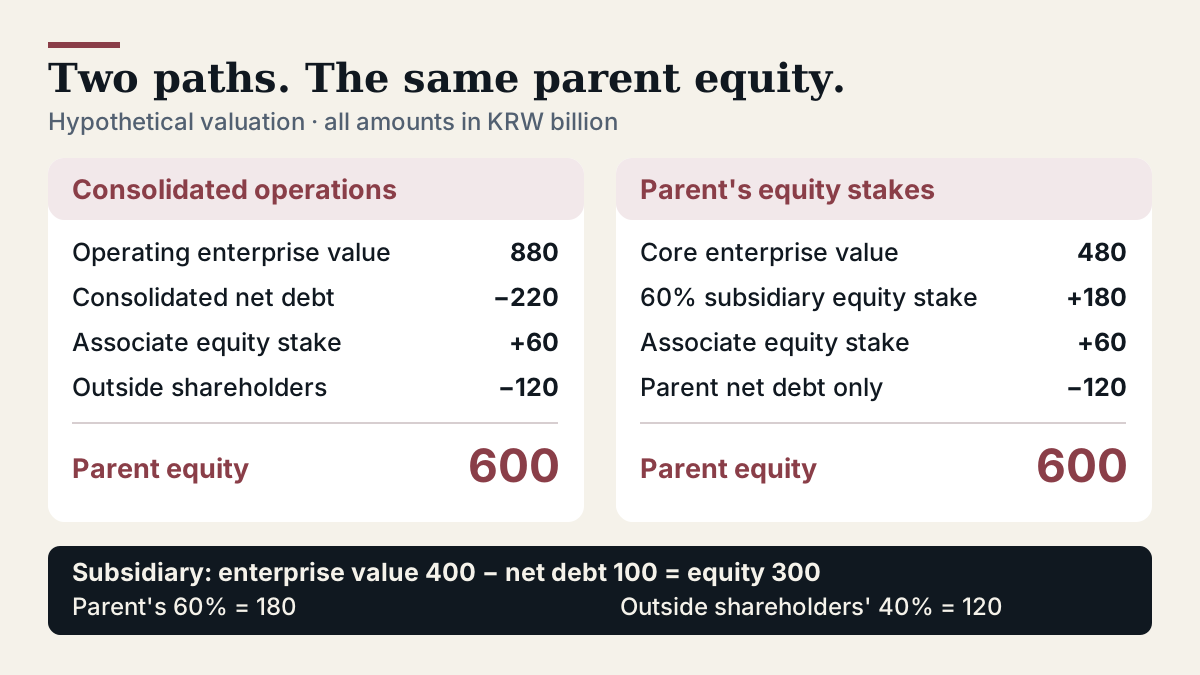
Start with 100% of each consolidated business: 480 + 400 = 880 of operating enterprise value. Subtract consolidated net debt of 120 + 100 = 220. Add the associate stake of 60, because the operating values exclude its earnings.
You must also remove the equity belonging to outside shareholders of the components subsidiary. First calculate that subsidiary's equity value: 400 − 100 = 300. The parent owns 60%; outside shareholders own 40%, worth 40% × 300 = 120 under these assumptions. This is the noncontrolling interest deduction.
The parent's equity value is therefore:
880 − 220 + 60 − 120 = KRW 600 billion.
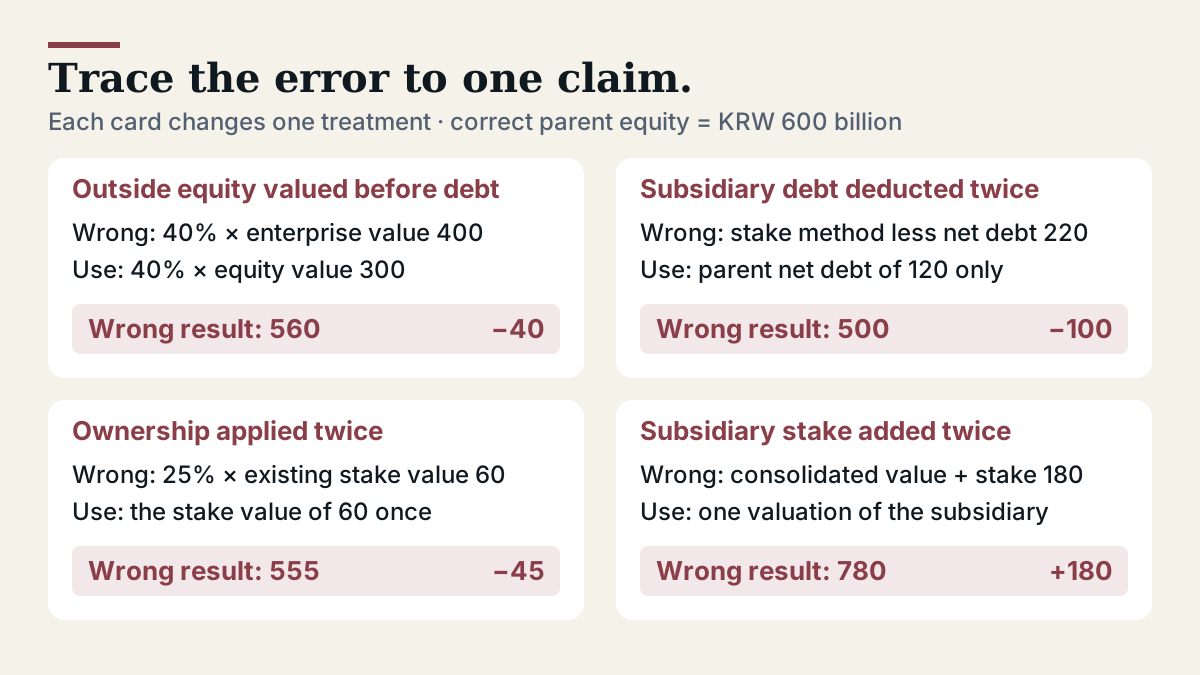
Do not calculate the outside interest as 40% × 400. That applies an equity ownership percentage to enterprise value before paying the subsidiary's lenders. And do not automatically substitute the balance sheet's book noncontrolling interest for its economic value. Damodaran's valuation guidance explicitly distinguishes those measures. NYU Stern, Holdings in Other Firms.
Approach two: value the parent's stakes
Keep the core operating enterprise value of 480. Convert the subsidiary's enterprise value to equity, then take the parent's share: 60% × (400 − 100) = 180. Add the associate stake of 60 and subtract parent net debt of 120.
480 + 180 + 60 − 120 = KRW 600 billion.
Here the subsidiary's debt is already deducted inside the 180 stake value. Subtracting consolidated net debt of 220 again would understate the answer by 100. Similarly, a second noncontrolling interest deduction would be wrong: taking only 60% already excludes outside shareholders.
If you start from consolidated accounts, remove the subsidiary's earnings from the core operating calculation before adding its equity stake. Switching methods means changing the whole calculation boundary, not replacing one line while leaving everything else untouched.
Listed shares create two extra traps
A quoted market capitalization can replace an independently estimated equity value. Suppose the components subsidiary's quoted capitalization is also 300; the parent's 60% stake is again 180. If its quoted capitalization is 350 instead, the stake is 210 and the second approach gives 630. That difference reflects different valuation assumptions. Reconcile them before declaring an arithmetic error.
In the consolidated approach, adding the 180 subsidiary stake on top of the 880 operating enterprise value counts the subsidiary again. A stock-market quotation is an alternative valuation input, not an extra asset.
For the logistics associate, our 240 is the whole company's equity value. If a filing instead labels 60 as the market value of shares already held, multiplying 60 by 25% would count ownership twice and produce 15. Match each number to its definition before applying a percentage.
The associate's own debt is not an additional parent deduction when you use its market capitalization. Its lenders already rank ahead of that equity. Likewise, do not add its book investment balance alongside the market-valued stake, or capitalize its equity-accounted income while also adding the stake.
Defend the answer under follow-ups
If asked which approach you prefer, explain the available evidence. Detailed segment accounts support separate operating valuations; reliable quoted stakes offer an observable alternative. Neither removes the need to reconcile ownership, debt and costs.
Then identify what could change 600. Are central costs fully captured? Is surplus cash distributable? Are there preferred shares, guarantees or intercompany balances? Would disposal taxes reduce realizable stake proceeds? If someone proposes a holding-company discount, ask what restriction or cost it represents and whether that effect is already included. Do not add a national discount by habit.
Practise a ninety-second answer using the table, then change subsidiary net debt from 100 to 150 while holding enterprise values and the associate stake fixed. Both methods should reduce parent equity by 30 to 570, because the parent owns 60% of the subsidiary's equity. Explain why before checking your arithmetic, then continue with Investment Banking Interview Prep.