In a Korea marketplace interview, evaluate whether a promotion creates more completed orders across the relevant market. First map how customers compare sellers and where capacity is shared. Then choose an assignment unit that contains those interactions, measure contribution after promotional costs, and account for effects that persist. A treated seller's gain alone cannot establish what would happen if the platform rolled out the policy.
This is useful for product, growth and analytics candidates interviewing for Korean platforms or regional teams covering Korea. You do not need to recite every experimental method. You need to explain why the control group's outcomes might change when somebody else receives treatment.
Define the Korean marketplace you are testing
Suppose a Seoul lunch-pickup platform wants to fill spare capacity at restaurants. Its proposed policy gives eligible shops more prominent placement and customers a KRW 1,000 credit per completed promoted order, valid only for that lunch service. There are no couriers in this example; the shared resource is customers' attention and lunch demand.
Locality changes the experiment. Assume customers choose a pickup area near work and can compare restaurants across adjacent neighborhood boundaries. Assigning by home address would miss that competition. Daangn's advertiser guide illustrates a real Korean product choice: advertisers can select neighborhoods for exposure. That does not establish that neighboring areas are independent markets. Daangn, advertising guide.
Ask for search-to-order paths, cross-area browsing and restaurant capacity before selecting a geographic unit. Group shops customers actually consider substitutes. The question is whether the policy improves the whole lunch market while remaining profitable, including effects on shops that receive no extra placement.
Separate orders won from orders created
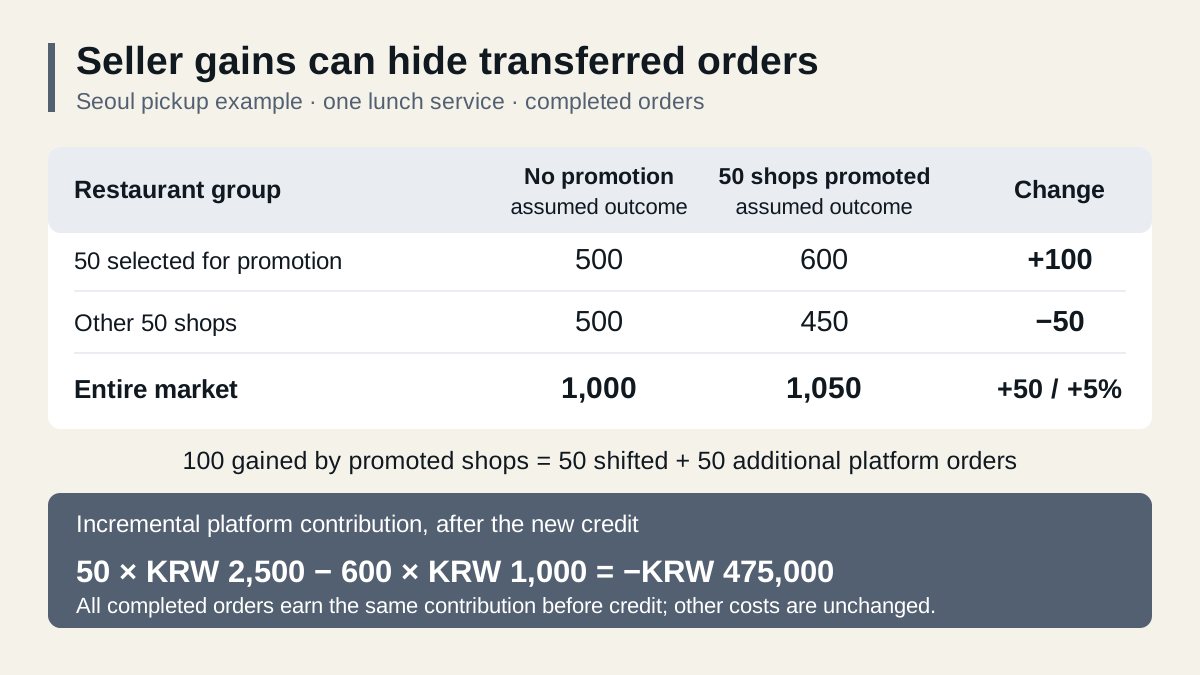
Suppose an initial design randomly promotes 50 of 100 eligible restaurants. For one lunch period, assume the following two possible outcomes for exactly the same market. The no-promotion column is supplied for this exercise; it is not an observable control or a before-and-after comparison.
| Restaurants | Without any promotion | With 50 shops promoted |
|---|---|---|
| The 50 shops selected for promotion | 500 completed orders | 600 completed orders |
| The other 50 shops | 500 completed orders | 450 completed orders |
| Entire market | 1,000 completed orders | 1,050 completed orders |
Promoted shops gain 100 orders, or 20% against their assumed no-promotion outcome. Comparing the two observed groups gives 600 ÷ 450 − 1 = 33.3%, since they contain equal numbers of shops. Neither number is platform growth.
Assume 50 of the promoted shops' extra orders shifted from the other group and 50 were additional platform orders. The market gained 5% in this constructed comparison. A control shop lost demand because competing shops received treatment: this is interference, when one unit's treatment changes another unit's outcome.
In a real experiment, you would not know both potential outcomes or the exact shifted-order count. The table demonstrates the accounting problem. It does not make 5% an estimate available from the seller split, nor show that promoting all 100 shops would produce the same effect.
Choose between stable clusters and switching over time
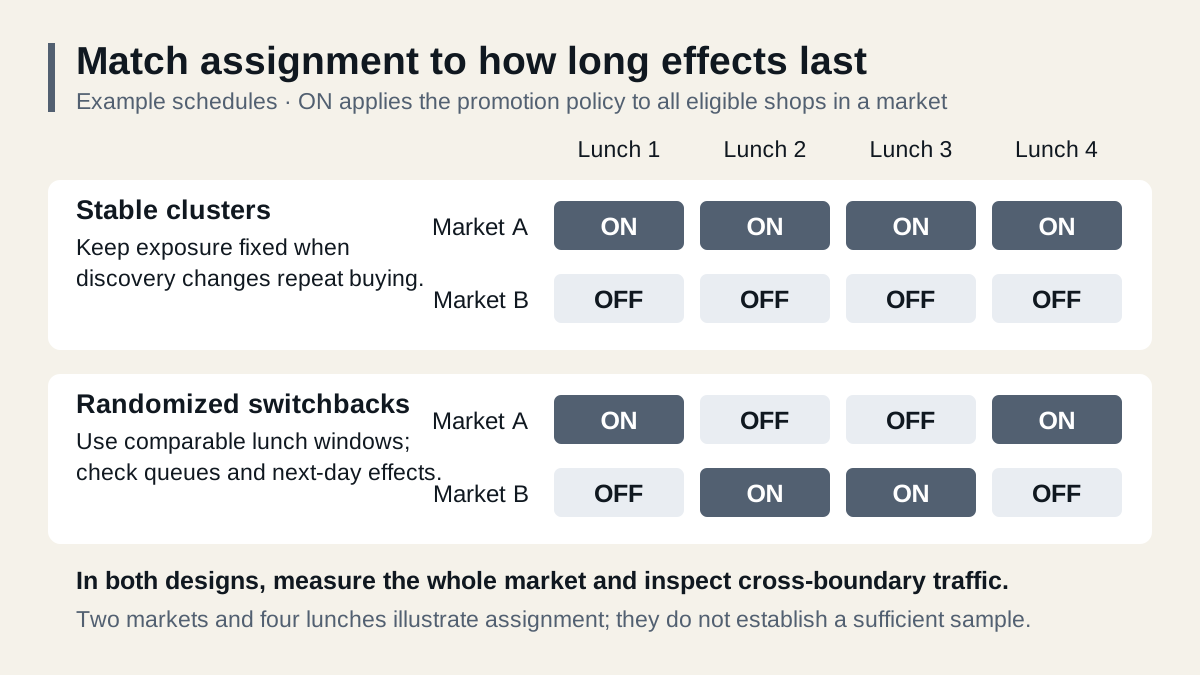
One option is cluster randomization: group competing shops and assign the promotion policy to entire groups. In treated clusters, apply the policy to every eligible shop under a fixed eligibility rule; control clusters retain the existing experience. Measure outcomes for all shops in each cluster, including ineligible ones that could lose demand.
Use prior browsing and ordering patterns to build these groups, then balance assignment using pre-experiment demand and capacity. Holtz and co-authors' 2020 preprint uses buyer search behavior to group Airbnb listings and compares individual-listing with cluster assignment. It provides a concrete precedent for investigating competition when designing clusters. Holtz et al., marketplace pricing experiments.
Larger clusters can contain more substitution but leave fewer assignment units. Inspect traffic crossing their boundaries. A Seoul neighborhood label does not eliminate spillovers, and thousands of orders do not turn a handful of clusters into thousands of independent observations.
A switchback instead assigns a whole market to treatment or control for different randomized time windows. DoorDash's 2018 account describes region-time assignment for dispatch experiments and explains why adjacent periods can remain dependent. Its example cadence is a property of that setting, not a rule to copy. DoorDash, switchback experimentation.
For the pickup example, investigate lunch-service windows rather than switching every few minutes. Randomize comparable weekdays; do not always treat Monday and control Friday. Define how orders initiated before a switch are attributed and completed. If queues require a transition interval, set its duration and rules for including or excluding outcomes before launch.
The expiring credit does not guarantee that effects disappear overnight. A buyer may discover a restaurant and return tomorrow. If repeat behavior is central to the decision, keep clusters in their assigned condition long enough to observe it. A short switchback could answer an immediate operating question while missing the sustained effect you actually need.
Set the economic test and safeguards together
Return to the table. Assume the platform earns KRW 2,500 contribution per completed order before the new credit, after all other variable costs, and nothing else changes. Fifty additional orders add KRW 125,000. Paying KRW 1,000 on all 600 promoted orders costs KRW 600,000. Incremental contribution is negative KRW 475,000 for that lunch period.
That makes contribution across the assigned market a better primary decision metric than promoted-shop orders. Track completed orders alongside it, with fixed market boundaries and measurement windows. Do not divide by only customers who redeemed the credit: redemption happens after assignment and selects a different group.
Specify safeguards before launch: cancellation rate, pickup lateness, complaints, and whether orders become concentrated in too few shops. Report repeat purchases over the intended horizon. Check assignment and exposure logs, credit-budget exhaustion and overlapping promotions; any could change which policy customers actually experience.
Choose the minimum economically useful effect, test duration and stopping rule before inspecting results. Use historical variation to assess whether the available clusters or time windows can detect that effect. Analyze uncertainty at the assignment level while allowing for remaining dependence. Without those data, the interview answer should describe the required evidence, not declare statistical significance.
Practise defending one design change
Give a ninety-second answer naming the market boundary, assignment, profit metric and biggest remaining spillover. Then answer three follow-ups: What if 30% of browsing crosses the proposed boundary? What if the credit expires today but repeat purchasing lasts two weeks? What if promoted shops grow while total contribution falls?
Revise your design after each answer. Widen or rebuild clusters when boundaries leak; reconsider switching when effects persist; separate a promising demand response from an unaffordable subsidy. Use this exercise with the Global Companies & Tech preparation options at Elite Interview Guide.