
Your model balances. Debt pays down. The return clears the threshold. Then the interviewer asks the question the spreadsheet cannot answer for you: what would make you reject the deal? If your only response is “a lower exit multiple,” you have described a sensitivity—not an investment decision.
An LBO model tells you what returns follow from a set of assumptions. It does not tell you whether those assumptions are commercially coherent, whether management can deliver them or whether the downside is survivable. The interview starts, rather than ends, when the output appears.
The examples use hypothetical model inputs to isolate the investment judgement after a return appears on screen.
A correct model and an investable thesis are different things
The model can be mechanically correct while the deal is unattractive because:
- The entry price already assumes the value-creation plan works.
- Revenue growth depends on an unproven channel or customer cohort.
- Margin expansion requires costs or disruption that the model omits.
- Cash conversion is weaker than EBITDA suggests.
- Debt capacity disappears in a realistic downside.
- Management or governance cannot execute the plan.
- The exit buyer and timing exist only as a multiple assumption.
McKinsey’s 2026 global private-equity report argues that purchase-price discipline and underwriting operational value creation have become increasingly important as leverage and favourable market movements carry less of the return burden. Deloitte’s Southeast Asia 2026 Almanac similarly describes more selective deployment focused on execution certainty, valuation discipline and tangible value-creation levers.
Those are market observations, not an interview script. Your script needs to connect each model line to an operating cause.
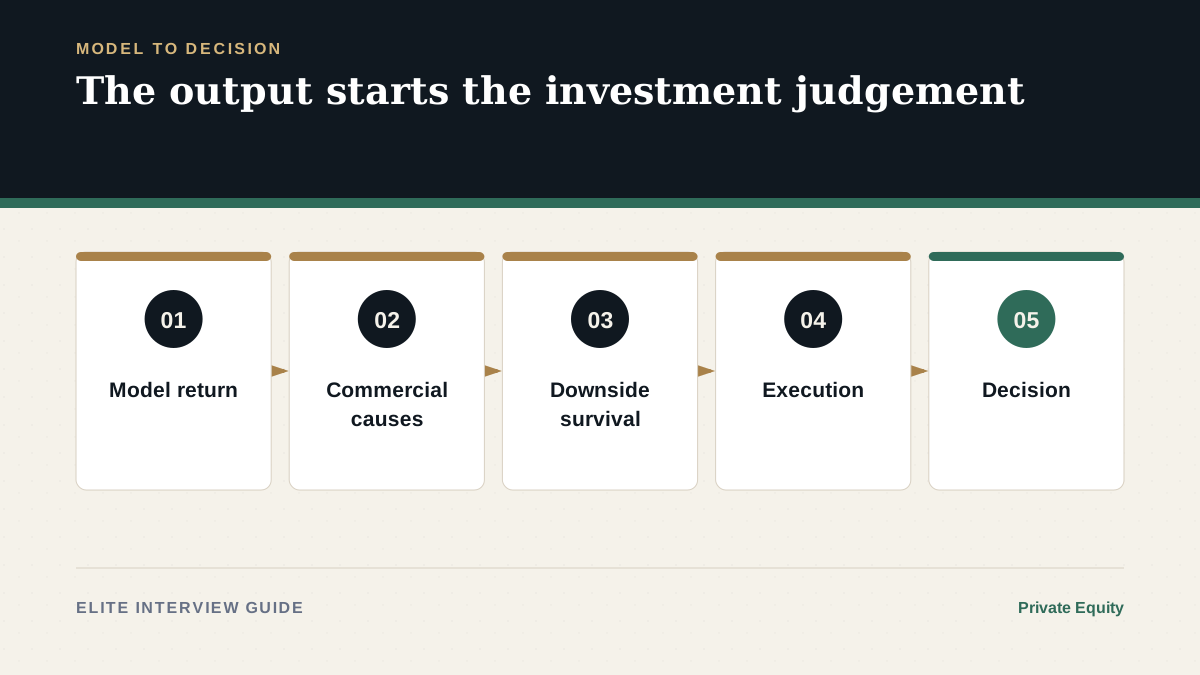
The model-to-commercial bridge
| Model output | Commercial cause to test | Downside question | Decision consequence |
|---|---|---|---|
| Revenue growth | Price, volume, mix, new sites, retention or acquisition | Which driver fails first, and how quickly do we see it? | Reduce price, stage capital or walk away |
| EBITDA margin expansion | Procurement, pricing, labour, mix or fixed-cost leverage | Does the plan require service degradation or unrealistic execution? | Rebuild the plan with costs and timing |
| Debt paydown | Cash conversion after capex, working capital, tax and interest | Is liquidity adequate before the improvement arrives? | Lower leverage or require more equity |
| Exit multiple | Buyer demand, asset quality, scale and market conditions | Why will a buyer pay this multiple for the business we actually own? | Underwrite flat or lower multiple; identify exit routes |
| Add-on value | Synergy, integration capacity and acquisition pipeline | Are targets available at the assumed price, and can management integrate them? | Remove uncommitted M&A from the base case |
If you cannot fill the second column, you do not yet have a thesis. If you cannot fill the third, you do not yet have a downside.
The five-sentence investment-committee opening
Sentence 1 — Recommendation
I recommend we invest / do not invest / continue only if [condition].
Do not spend a minute describing the company before revealing the decision. A conditional recommendation is acceptable when the missing evidence is specific.
Sentence 2 — Core thesis
Name two or three reasons the business can create value under ownership. Keep market attractiveness separate from company advantage.
Sentence 3 — Value-creation mechanism
Translate the plan into observable operating actions: improve retention in a named cohort, raise utilisation at mature sites, consolidate procurement, professionalise pricing or complete a defined carve-out separation.
Sentence 4 — Downside and survivability
State the most damaging plausible scenario, what happens to cash and covenants, and whether the equity still has time to recover.
Sentence 5 — Deal breaker
Name the fact that makes you stop: customer churn above a defined level, maintenance capex materially understated, required licences non-transferable, management unable to operate independently, or lender terms that remove downside capacity.
Risk, mitigation and uncertainty are not synonyms
| Category | Meaning | Example | How to speak about it |
|---|---|---|---|
| Risk | An adverse event with an assessable mechanism | A large customer may not renew | Size exposure and test renewal evidence |
| Mitigation | An action that reduces probability or impact | Multi-year contracts or diversified pipeline | Explain who controls it and by when |
| Uncertainty | A fact you cannot yet underwrite | No reliable cohort data after a product change | Request evidence; do not replace it with optimism |
| Deal breaker | A condition outside risk appetite or economics | Core licence cannot transfer on change of control | Stop or restructure the deal |
“Management will focus on it” is not a mitigation. “We will add a 10% haircut” is not always an answer to uncertainty. Some missing facts should lower the price; others should end the process.
Build the downside before touching the exit multiple
Start with operations:
- Which leading indicator weakens—orders, retention, utilisation, pricing or input availability?
- How does it reach revenue and margin?
- What happens to working capital and capex?
- When does liquidity tighten relative to covenant tests and maturities?
- Which management actions are available, and what do they cost?
- What is the resulting debt paydown and equity value under a defensible exit route?
Only then adjust the exit multiple. A lower multiple can compound an operating downside, but it should not substitute for one.
The CFA Institute’s public educational article on ideal LBO candidates highlights recurring revenue and predictable cash flows as attractive characteristics. Use that as a starting hypothesis. Then ask what makes the revenue recurring in this company and what could make the cash flow unpredictable.
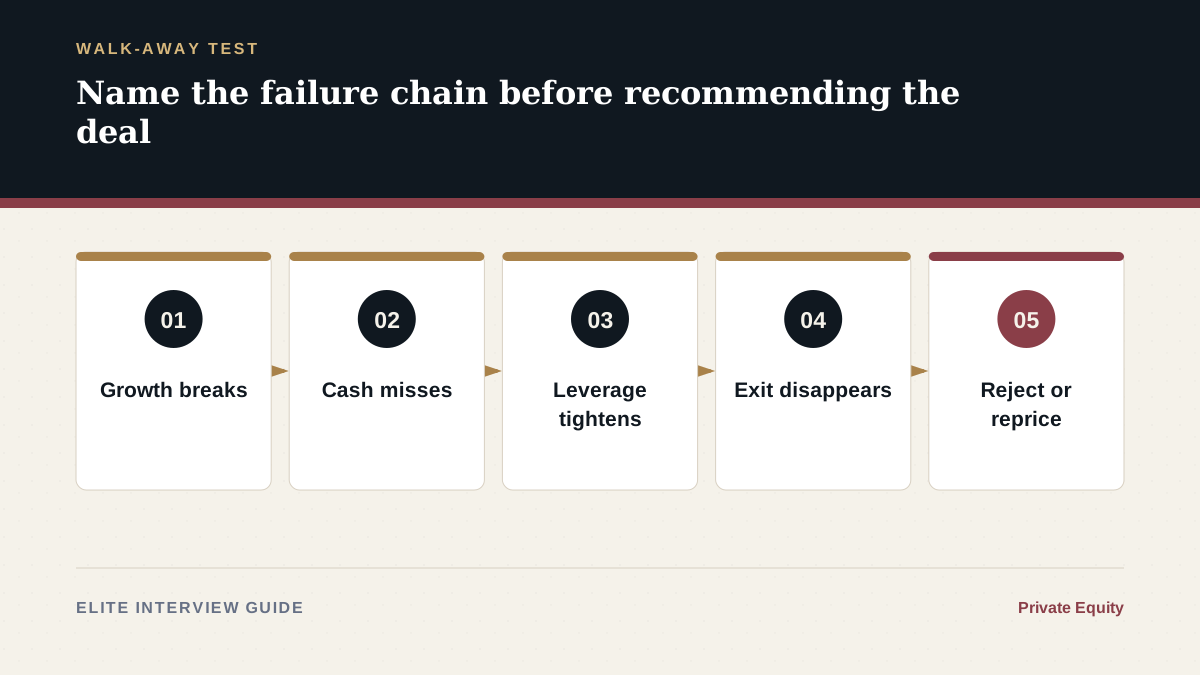
Three Southeast Asia drills
Consumer platform
The model assumes user growth, higher purchase frequency and stable take rate. Your commercial bridge should separate subsidised from organic activity, test merchant concentration and ask whether logistics or payment costs scale. A deal breaker might be evidence that retained cohorts are profitable only while incentives rise.
Healthcare roll-up
The model assumes new sites, add-on acquisitions and procurement savings. Test clinician recruitment, licence transfer, payer mix, site-level maturity and integration capacity. A deal breaker might be that the key licence or physician relationships cannot survive a change of control.
Industrial carve-out
The model assumes standalone margins recover after separation. Test transitional service agreements, stranded costs, customer approvals, ERP separation, management depth and working capital. A deal breaker might be that the business cannot operate independently within the separation timeline without materially more cost and capital.
These are drills, not claims about any real company or deal.
A completed five-sentence example
The example gives a decision, thesis, mechanism, downside and stopping condition. It also tells the diligence team what to prove.
Ask for the fact that would change your mind
McKinsey’s article on adaptive reunderwriting discusses updating KPIs, downside scenarios, value-creation plans and exit routes—and, in some cases, reassessing an asset as if acquiring it again. The interview habit is the same: state what evidence would move the recommendation.
Use this closing drill:
I currently recommend ______ because ______. The most important unresolved assumption is ______. If diligence shows ______, I would change the recommendation to ______.
An investor who cannot change their mind is not showing conviction. They are showing that the conclusion is disconnected from evidence.
Final deal-breaker checklist
- Is the company attractive at the proposed price, not merely attractive in isolation?
- Does each return driver have a commercial cause and an owner?
- Does the base case exclude uncommitted acquisitions and unexplained multiple expansion?
- Does the downside follow operating mechanics through cash, covenants and equity value?
- Can management execute the plan with the time, people and capital available?
- Is there more than one credible exit route?
- Which missing fact changes price, which changes structure, and which ends the deal?
Sources
- McKinsey Global Private Equity Report 2026 — purchase-price discipline and operational value-creation context.
- McKinsey: The second look—an adaptive approach to reunderwriting — KPI, downside and reunderwriting practices.
- CFA Institute: What makes an ideal leveraged buyout candidate? — public educational discussion of cash-flow qualities.
- Deloitte Asia Pacific Private Equity 2026 Almanac: Southeast Asia — regional selectivity and value-creation context.