You can derive a heat-transfer equation but freeze when someone asks why depreciation affects all three financial statements. So you download a 400-page banking guide, begin at page one and plan to “finish finance” before practising. Three evenings later, you know more definitions and still cannot connect profit, cash, debt and value in one answer.
This guide gives non-finance candidates a minimum connected syllabus. It begins with how a company works, moves through the statements and cash flow, reaches enterprise and equity value, and only then adds transaction rationale. Your degree is neither a technical exemption nor a disadvantage you need to apologise for.
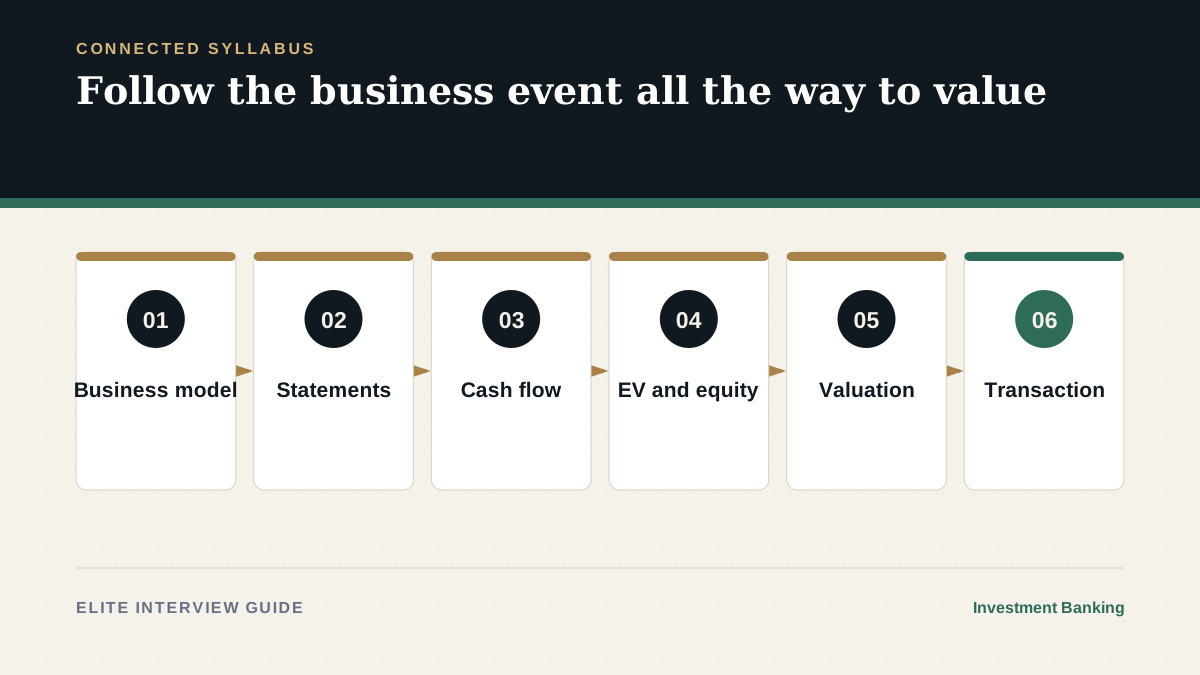
The chain you need before adding breadth
Use this order:
If a link breaks, study that link. Do not hide it under another 50 disconnected questions.
The SEC’s Beginners’ Guide to Financial Statements explains that the balance sheet shows what a company owns and owes at a point in time, the income statement shows revenue and expenses over a period, and the cash-flow statement shows cash moving through operating, investing and financing activities. It also stresses that the statements are related and that no one statement tells the complete story.
That is the baseline. A banking answer adds transaction and valuation implications, but it cannot skip the accounting.
Link 1 — Business model to statements
Before touching formulas, answer:
- What does the company sell?
- When does it recognise revenue?
- What variable and fixed costs produce that revenue?
- Which assets must be purchased before revenue arrives?
- When does the customer pay?
- How is growth financed?
Industrial distributor
The company buys inventory, stores it and sells to manufacturers on credit.
| Business event | Statement effect to expect |
|---|---|
| Buy inventory for cash | Inventory rises; cash falls; no immediate income-statement expense |
| Sell inventory on credit | Revenue and cost of goods sold appear; receivables rise; inventory falls |
| Customer pays | Cash rises; receivables fall; no new revenue |
| Build a warehouse | Cash falls; property, plant and equipment rises; expense emerges over time through depreciation |
Subscription software company
The company receives an annual payment before delivering twelve months of service.
| Business event | Statement effect to expect |
|---|---|
| Receive annual cash upfront | Cash rises; deferred revenue liability rises |
| Deliver one month of service | Revenue is recognised; deferred revenue falls |
| Capitalise eligible development cost | Cash falls; an asset may rise; later expense timing differs |
| Issue stock-based compensation | Expense can reduce net income without an immediate operating cash outflow, while equity accounts change |
Do not memorise “software has negative working capital.” Explain the contract and timing that create the balance.
Link 2 — Connect the three statements
Use one event at a time and follow a fixed sequence.
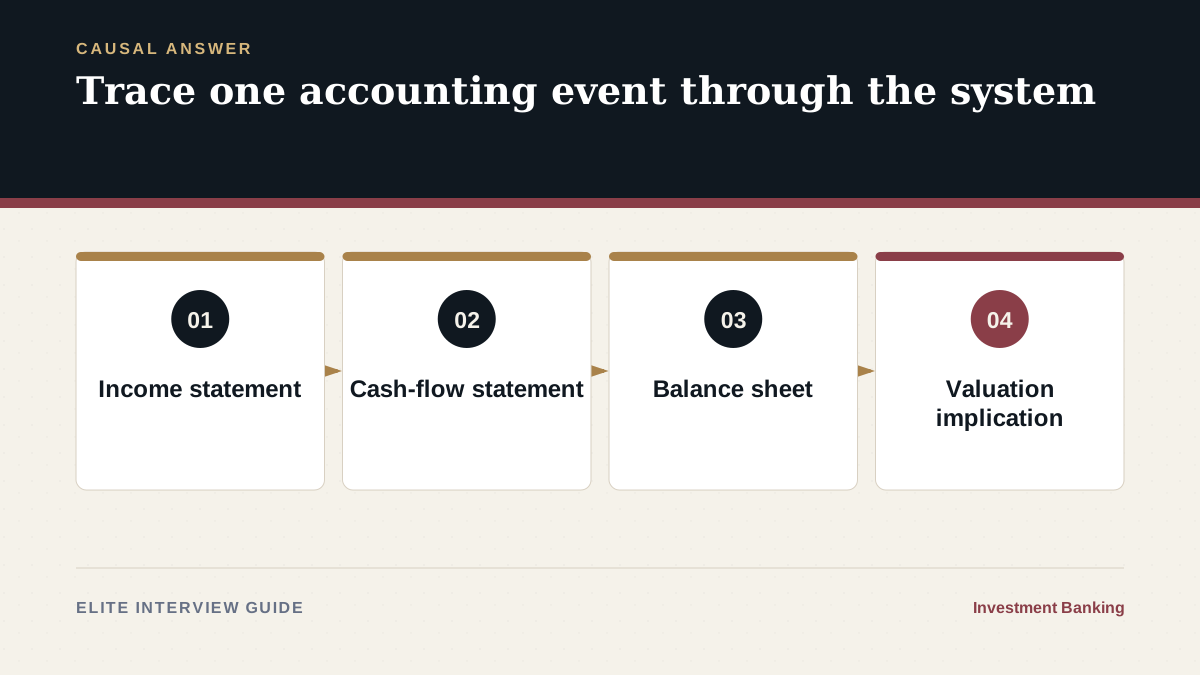
Example: depreciation increases by 10
Assume a 25% tax rate, no deferred-tax complexity and no other changes. These assumptions are illustrative.
- Income statement: depreciation expense rises by 10; pre-tax income falls by 10; tax falls by 2.5; net income falls by 7.5.
- Cash-flow statement: start with net income down 7.5; add back the non-cash depreciation of 10; cash from operations rises by 2.5 because of the tax effect.
- Balance sheet: cash rises by 2.5; property, plant and equipment falls by 10 through accumulated depreciation; retained earnings falls by 7.5. Assets and equity both fall by 7.5.
Then change one assumption: what if there is no immediate cash-tax benefit? The ending cash and deferred-tax treatment change. Saying the assumption is part of the answer.
Four events to practise
- Inventory purchased for cash but not sold.
- Customer prepays for a service not yet delivered.
- Company issues debt and later pays cash interest.
- Company buys equipment and depreciates it.
For each event, answer three questions:
- What economic event occurred?
- When is profit recognised?
- When does cash move?
If you can answer those, the statements become a record of the business rather than a memorised diagram.
Link 3 — Profit is not cash
Net income can differ from cash because of:
- Non-cash expenses such as depreciation.
- Revenue recognised before or after customer payment.
- Expenses recognised before or after supplier payment.
- Inventory and other working-capital movements.
- Capital expenditure that is not fully expensed immediately.
- Debt issuance and repayment.
Use this spoken bridge:
Do not call EBITDA cash flow. It excludes important uses of cash and can be far from cash conversion in capital-intensive or working-capital-heavy businesses.
Link 4 — Enterprise value and equity value
Aswath Damodaran’s Introduction to Valuation distinguishes valuing the whole operating business from valuing the equity claim. Cash flow to the firm is before debt payments and is discounted at a rate reflecting all capital providers; cash flow to equity is after debt-related claims and is discounted at the cost of equity.
A practical bridge begins:
The simplified interview formula “equity value plus debt minus cash” is a starting point, not a complete rule for every company. Depending on context, you may need to consider leases, preferred stock, non-controlling interests, pensions, investments and other claims.
Pair numerator and denominator
- Enterprise value pairs with pre-interest operating metrics such as revenue, EBIT or EBITDA.
- Equity value pairs with post-interest equity metrics such as net income or earnings per share.
If you put equity value over EBITDA, the numerator belongs only to common shareholders while the denominator is before payments to debt holders. The mismatch is the problem.
Link 5 — Valuation methods answer different questions
| Method | Core question | What you need to connect |
|---|---|---|
| Trading comparables | How does the market price similar companies now? | Peer business model, growth, margin, risk and metric |
| Precedent transactions | What was paid for comparable companies in transactions? | Timing, control, synergies, deal context and consideration |
| DCF | What are forecast cash flows worth today? | Operations, reinvestment, risk, discount rate and terminal value |
A strong answer does not say one method is “most accurate” in all cases. It explains which assumptions are observable, which are forecast and why the resulting ranges differ.
Industrial example
An industrial equipment company may have meaningful depreciation, maintenance capex and working capital. EV/EBITDA can make comparison easier, but it does not eliminate the need to compare capex and cash conversion. A DCF must model replacement investment and cyclicality.
Digital-business example
A loss-making platform may have positive revenue growth and negative operating cash flow. EV/revenue can be observed, but the multiple is meaningful only with a view on future margin, retention, reinvestment and risk. A DCF can be highly sensitive because profitability sits far in the future.
The industry label does not select the method by itself. The business economics do.
Link 6 — Add transaction rationale last
Once the accounting and valuation bridge holds, ask:
- What strategic problem is the buyer solving?
- Why buy rather than build, partner or do nothing?
- Which revenue, cost, capability or capital benefit is expected?
- What consideration and financing are used?
- What happens to leverage, ownership and key per-share metrics?
- Which integration or regulatory risk can destroy the rationale?
Do not jump from “the buyer has cash” to “the deal is accretive.” Consider purchase accounting, financing cost, target earnings, synergies, new shares and timing. Accretion is an output under assumptions, not a synonym for value creation.
The diagnostic: find the broken link
Answer each prompt aloud without notes:
| Prompt | Red signal | Green signal |
|---|---|---|
| Explain the business model | Lists products only | Connects customer, revenue timing, cost and cash |
| Depreciation rises | Recites one statement | Carries after-tax effect through all three |
| Profit versus cash | Says “non-cash items” only | Names timing, working capital and capex mechanisms |
| EV to equity | Gives formula only | Explains claimholders and context adjustments |
| Compare DCF and comps | Calls one universally better | Explains inputs, market information and sensitivity |
| Acquisition rationale | Repeats “synergies” | Names mechanism, alternative and execution risk |
Stop at the first red link. Rebuild it with one company example, then retest with a second company whose economics differ.
A seven-session minimum syllabus
| Session | Output |
|---|---|
| 1 | One-page business-model map for an industrial company |
| 2 | Same map for a digital business |
| 3 | Four three-statement event chains |
| 4 | Cash-conversion bridge for both companies |
| 5 | Enterprise/equity and multiple-pairing drills |
| 6 | DCF, trading comps and transaction-comps comparison |
| 7 | One acquisition rationale with financing and downside |
Each session ends with a two-minute recording. Reading time does not count as a pass.
Present the non-finance background without asking for an exemption
Weak:
Stronger:
The stronger version gives evidence. It does not imply that quantitative study automatically produces banking skill.
The current JPMorganChase APAC Investment Banking Analyst Internship description names analytical, quantitative, interpretive and communication skills and describes training in accounting, financial modelling and valuation. That supports the importance of both analysis and communication; it does not establish one firm-wide interview cutoff.
Next action
Choose one industrial and one digital public company. Without building a full model, map how each makes money, where profit differs from cash and which valuation method would require the most judgement. Record both explanations in under two minutes and mark the first broken link.
Sources
- SEC Beginners’ Guide to Financial Statements — statement purpose, cash-flow categories and interconnections.
- Aswath Damodaran: An Introduction to Valuation — firm versus equity cash flow and valuation.
- JPMorganChase Investment Banking Analyst Internship — current APAC role and training description.