
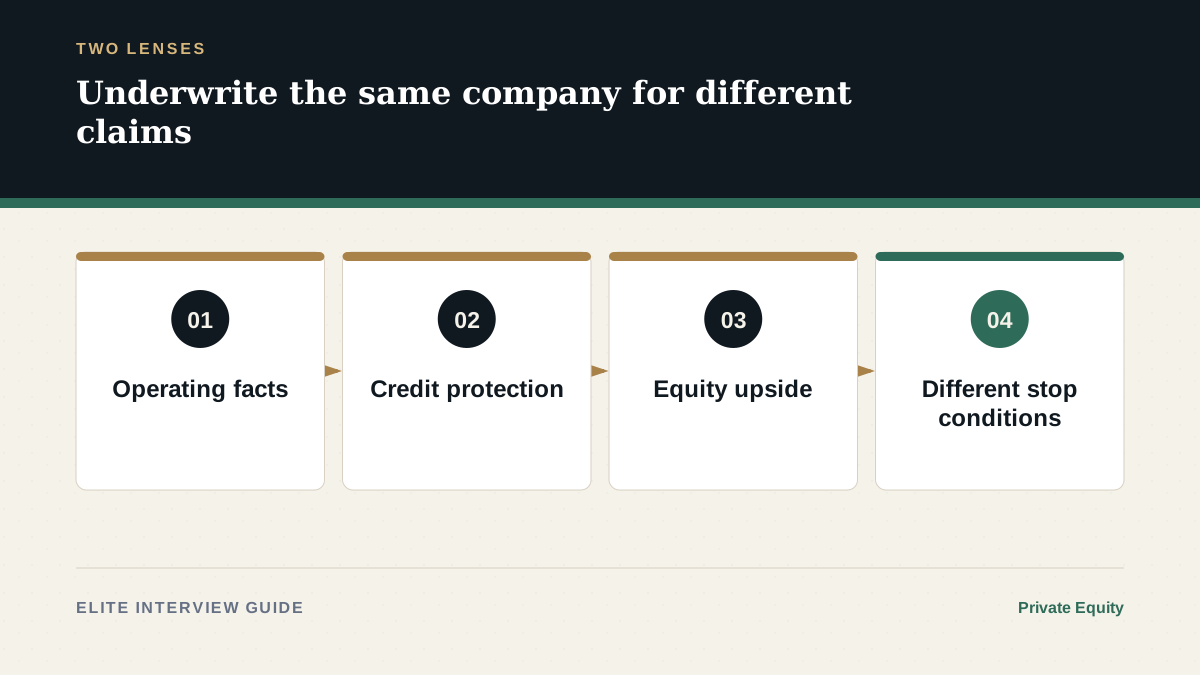
You prepare one investment pitch for a private-credit interview and a buyout interview. In both, you say the company has recurring revenue, 18% EBITDA margin and attractive growth. The lender asks how principal is protected if earnings fall. The buyout investor asks why the entry price leaves enough equity upside. Your facts are the same; the security, rights, return source and failure condition are not.
This guide holds one fictional company constant and underwrites it twice. You will see which questions belong to credit, which belong to control equity and where both investors need the same operating truth.
The company, price and financing terms below are fictional teaching inputs.
Start with the security, not the theme
CFA Institute’s 2026 Private Debt material describes a range of corporate, real-estate and infrastructure debt structures with different covenants, contingencies, rates and equity-like features. “Private credit” can mean direct lending, mezzanine, venture debt, distressed or other strategies. It is not one standard loan.
BlackRock’s public explanation of direct lending focuses on privately negotiated loans, often senior in the capital structure, with contractual interest, principal and covenants. It also explains why seniority and negotiated protections matter. That is one strategy description, not a promise that every private loan is senior, secured or protected in the same way.
For buyout equity, the investor owns the residual claim and may control governance. McKinsey’s 2026 private-equity report highlights entry-price discipline and operational value creation in an environment where leverage and market movement cannot be assumed to carry returns.
The fictional company: Meridian Industrial Services
Meridian is a fictional Southeast Asian maintenance-services and equipment-distribution company.
| Item | Synthetic case fact |
|---|---|
| Revenue | US$100 million |
| EBITDA | US$18 million |
| Maintenance capex | US$3 million |
| Cash tax | US$2 million |
| Normal working-capital investment | US$2 million |
| Cash interest on existing debt | US$2 million |
| Existing gross debt | US$25 million |
| Revenue under multi-year service contracts | 70% |
| Largest customer | 12% of revenue |
| Revenue growth | 8% last year |
Additional case facts:
- Equipment distribution is lower-margin and more working-capital-intensive than maintenance service.
- Two customer contracts renew within 18 months.
- The founder owns 80% and wants partial liquidity.
- Management proposes expansion into a second country.
- The company has service equipment and receivables, but liquidation values are not yet verified.
Do not assume “70% contracted” means 70% guaranteed cash. Read termination rights, pricing, service obligations and customer credit.
The two proposed transactions
Credit case
A lender is asked to provide a synthetic US$45 million senior facility to refinance the US$25 million existing debt, fund US$10 million of expansion and provide US$10 million of founder liquidity and fees. Interest, amortisation, security and covenant terms must be proposed by the candidate.
Buyout case
A fund is asked to acquire control at a synthetic 9.0x EBITDA enterprise value, or US$162 million, using US$60 million of debt at close. Management retains a minority stake. The candidate must decide whether the business and price can produce an acceptable risk-adjusted return through operating improvement and exit.
The transactions have deliberately different leverage and uses. Do not compare them as if the lender and equity fund invest the same amount for the same claim.
The side-by-side underwriting map
| Question | Private-credit lens | Buyout-equity lens |
|---|---|---|
| Primary return | Cash interest, fees and principal repayment | EBITDA growth, cash generation, debt paydown and exit value |
| Position | Contractual claim with negotiated priority | Residual ownership claim |
| Control | Covenants, consent and information rights; usually not day-to-day control | Board, ownership and management rights depend on deal |
| Entry concern | Leverage, debt service and loan-to-value cushion | Purchase price and equity cheque |
| Operating focus | Stability and downside cash flow | Growth, margin and executable value creation |
| Downside | Default probability, liquidity and recovery | Equity impairment and ability to change the plan |
| Exit | Repayment, refinancing, sale or recovery | Strategic sale, sponsor sale, public market or other realisation |
| Deal breaker | No viable repayment or recovery path | Price or risk leaves insufficient equity return |
Both must understand the company. They ask different questions of the same cash flow.
Credit underwriting: can the company pay and can we recover?
Step 1: Rebuild cash available for debt service
Starting EBITDA is US$18 million. Subtract cash tax, maintenance capex and normal working-capital investment before assuming cash can pay lenders. Examine:
- Which costs are missing from EBITDA?
- Is maintenance capex really US$3 million?
- Does working capital rise with equipment sales?
- What cash is trapped across countries?
- Are contract payments seasonal or subject to service credits?
Do not call the remaining number “free cash flow” until the definition is clear.
Step 2: Test leverage and interest
The requested US$45 million facility is 2.5x current EBITDA. That ratio alone does not establish safety. Build:
- Base cash interest and amortisation.
- Downside interest coverage.
- Liquidity before and after expansion spend.
- Refinancing or maturity path.
- Capacity for acquisition, dividends and additional debt.
Founder liquidity uses debt without directly adding operating capacity. A lender should ask whether the post-transaction capital structure still has a sufficient cushion.
Step 3: Underwrite contracts, not the word recurring
For the 70% service revenue:
- Can customers terminate for convenience?
- How is pricing reset?
- What performance failures trigger credits or cancellation?
- What renewal evidence exists?
- How concentrated are profit and cash, not only revenue?
If two contracts renew within 18 months, the loan structure may need a covenant, amortisation schedule or draw condition that reflects the renewal risk.
Step 4: Design protections
Illustrative topics—not proposed market terms—include:
- Security over shares, receivables or assets where legally effective.
- Limits on additional debt, acquisitions and distributions.
- Minimum liquidity or maximum leverage.
- Information and reporting requirements.
- Conditions before expansion capital is drawn.
- Mandatory prepayment from asset sales or excess cash.
The IMF’s chapter on the rise and risks of private credit notes the role of security and covenants but also highlights opaque valuation, risky borrowers and weakening standards in parts of the market. A covenant is not protection if it is set too loosely, measured too late or difficult to enforce.
Step 5: Build the recovery case
Estimate value under stress:
- Which assets can actually be sold?
- Are receivables collectible after customer disruption?
- Can service contracts transfer?
- What claims rank ahead?
- How long and costly could enforcement be?
- Does the business lose value if key staff or licences leave?
“Senior secured” is a legal and economic starting point, not a recovery percentage.
Buyout underwriting: can ownership create enough value at this price?
Step 1: Separate company quality from entry price
At 9.0x current EBITDA, the fund pays for part of the expected improvement upfront. Ask:
- Which growth and margin assumptions are embedded in the price?
- Does the case work at a flat or lower exit multiple?
- How much equity is at risk after debt and fees?
- Which comparables truly match the mix of services and distribution?
Step 2: Define value creation
Potential levers must become actions:
- Improve renewal and pricing in service contracts.
- Shift mix toward higher-margin maintenance.
- Reduce equipment inventory without harming service levels.
- Expand geographically only after anchor demand and local delivery are proven.
- Build management depth beyond the founder.
Each needs a cost, owner, timing and KPI. Expansion is not value creation if it consumes cash without attractive returns.
Step 3: Test governance and management
The founder retains a minority stake. Examine:
- Who controls budget, hiring, acquisitions and exit?
- Is management capable of operating across two countries?
- Which relationships depend personally on the founder?
- How are incentives linked to cash and value creation?
Step 4: Build exit evidence
Name possible buyer categories and their rationale. A strategic buyer may value service density or customer access; another sponsor may require a larger, more institutional business. Do not write “exit at 9.0x” without a company that deserves that valuation.
One operating downside, two investment consequences
Synthetic downside:
- One large contract does not renew.
- Service revenue falls 12%.
- Fixed technician and depot cost delays margin adjustment.
- EBITDA falls from US$18 million to US$12 million.
- Receivable days and equipment inventory rise.
Credit consequence
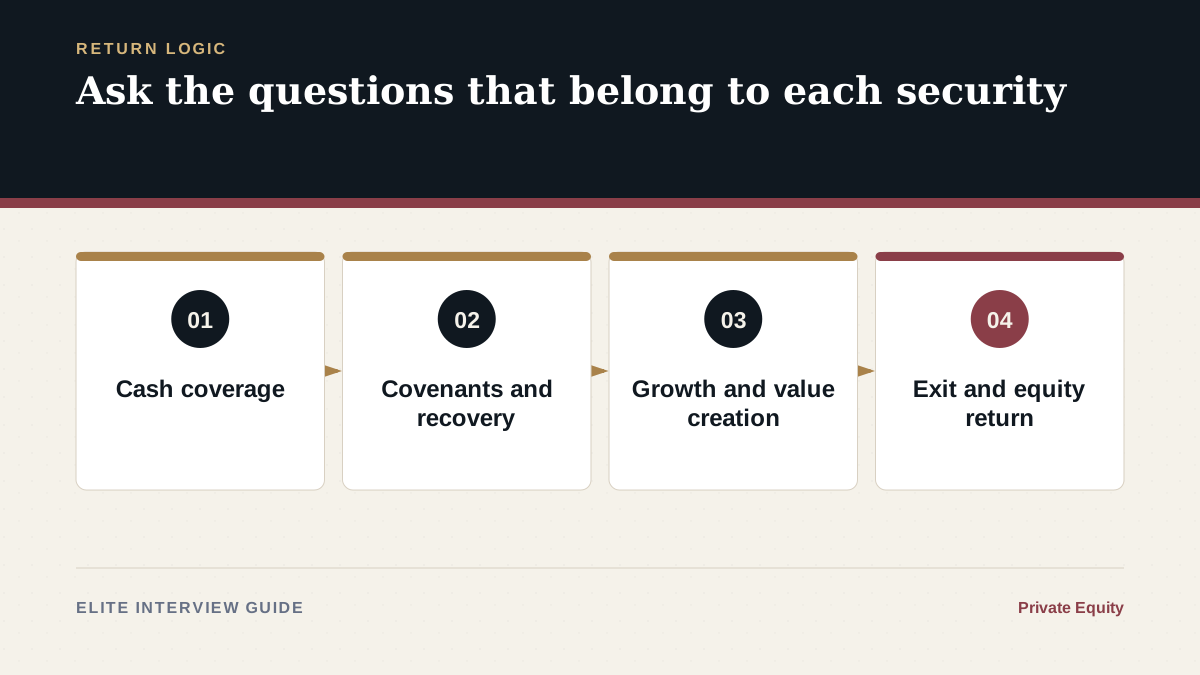
Interest coverage and liquidity tighten before cost action takes effect. The lender asks whether covenants trigger early enough, whether distributions stop, and how much debt can be repaid or recovered. The core question is survivability and principal protection.
Equity consequence
Debt consumes more of the lower enterprise value, the expansion plan may need to pause, and the exit could be delayed. The owner asks whether customer diversification and cost redesign can restore value—and whether the original entry price left enough room. The core question is whether equity should be committed at all.
The operating truth is shared. The decision threshold differs.
Two recommendations
Illustrative credit recommendation
Illustrative buyout recommendation
The lender changes size, draw conditions and protections. The equity investor changes price, ownership plan and value-creation case.
Decode the interview before choosing the template
Ask:
- Is the role direct lending, mezzanine, special situations or distressed?
- Is the equity strategy buyout, growth, minority or sector-specific?
- What security is being underwritten?
- What rights and return source follow from it?
- Does the case ask for a loan structure, an investment decision or both?
If the invitation is unclear, prepare the company facts once and two separate recommendation pages. Do not merge them into a generic “good business with risks” pitch.
Final side-by-side checklist
| Evidence | Credit recommendation needs | Equity recommendation needs |
|---|---|---|
| Revenue quality | Contract enforceability and renewal cash | Growth durability and pricing power |
| Cash flow | Debt service and liquidity | Debt paydown and reinvestment |
| Capital structure | Priority, covenants and recovery | Equity cheque, control and dilution |
| Management | Reporting and covenant compliance | Ownership plan and value-creation execution |
| Downside | Default timing and recovery | Equity impairment and repair options |
| End state | Repayment or enforcement path | Credible exit and return |
Next action
Use the Meridian facts to write two five-sentence recommendations without changing the company. In the credit version, name repayment, protection and recovery. In the equity version, name entry price, value creation and exit. If the two answers use the same deal breaker, explain why it destroys both claims.
Sources
- CFA Institute: Private Debt — debt structures, covenants, contingencies and strategy range.
- IMF Global Financial Stability Report: The Rise and Risks of Private Credit — market structure, borrower risk, covenants, collateral and valuation limits.
- BlackRock: Digging into Direct Lending — direct-lending seniority, negotiated terms and contractual return.
- McKinsey Global Private Equity Report 2026 — current entry discipline, value creation and underwriting context.