For a discounted cash flow (DCF) question in a Singapore banking interview, value foreign operations using cash flows, discount rates and terminal growth expressed consistently in one currency. Convert the resulting present value at the valuation-date spot rate. Alternatively, build a fully consistent model in the buyer's currency. Do not combine local-currency growth with an unrelated Singapore-dollar discount rate, or treat a forward quote as a guaranteed future spot rate.
Suppose a Singapore-based buyer is considering a Malaysian distributor. Management forecasts in Malaysian ringgit (MYR), while the buyer presents its acquisition analysis in Singapore dollars (SGD). The target also has US-dollar debt. Three currencies appear in the same assignment, but they serve different purposes: operating forecasts, presentation and financing. Your answer should identify those purposes before inserting an exchange rate.
Establish the currency and cash-flow definitions
Start with free cash flow to the firm: operating cash after tax and reinvestment, before payments to debt and equity providers. Discount it using the weighted average cost of capital, or WACC, appropriate to those operating cash flows. The buyer's borrowing rate alone is insufficient.
Use nominal MYR forecasts, meaning future prices and costs include their assumed inflation. The discount rate and perpetual growth rate must also be nominal MYR inputs. Damodaran's Critical Thinking Questions, Chapter 11 explains why a higher local discount rate cannot be assessed separately from the inflation embedded in local cash flows. That does not mean inflation automatically cancels: selling prices, wages, imported costs and taxes may respond differently.
For this exercise, assume annual cash flows arrive at year-end, the target's risk and financing assumptions support a 10% MYR WACC, and normalized cash flow grows 4% annually after year three. Assume frictionless currency conversion and no repatriation restrictions. These are given assumptions, not estimates of current Malaysian conditions. Any imported operating costs have already been incorporated in the MYR forecasts.
Calculate enterprise value before translating it
All amounts below are MYR millions. The terminal value represents operating cash flows after year three; it is measured at the end of year three.
| Component | Cash flow or terminal value | Discount calculation | Present value |
|---|---|---|---|
| Year 1 | 30.00 | 30 ÷ 1.10 | 27.273 |
| Year 2 | 33.00 | 33 ÷ 1.10² | 27.273 |
| Year 3 | 36.00 | 36 ÷ 1.10³ | 27.047 |
| Terminal value | 624.00 | 624 ÷ 1.10³ | 468.820 |
| Operating enterprise value | Sum | 550.413 |
Year-four cash flow is 36 × 1.04 = 37.44. Therefore, terminal value is 37.44 ÷ (10% − 4%) = 624. The 4% assumption requires enough ongoing reinvestment to support that growth; it cannot simply extend a sales forecast while leaving capital expenditure and working capital unchanged.
Assume today's spot quotation is MYR 3.00 per SGD 1.00. Divide MYR value by 3.00: enterprise value is SGD 183.471 million. The quotation matters. If it were expressed as SGD per MYR, you would multiply instead.
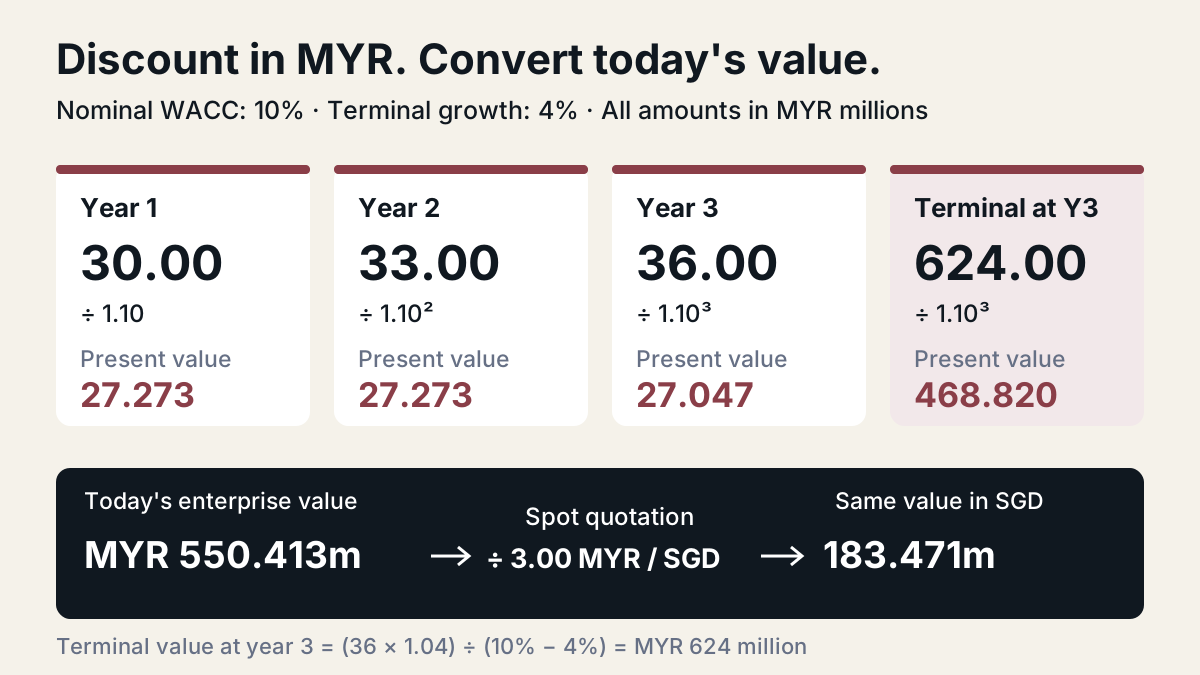
This conversion changes the unit in which today's value is stated. It does not eliminate the buyer's exposure to later exchange-rate movements or establish the final acquisition price.
Reconcile an SGD model with the MYR valuation
A second currency model should reconcile when it expresses the same valuation in different units. Consider a deliberately simplified check: assume the MYR-per-SGD quotation rises exactly 2% every year, with no uncertainty, while preserving the underlying MYR cash-flow model.
Year-one conversion then uses 3.00 × 1.02 = 3.06 MYR per SGD, giving SGD 9.804 million. To preserve the original present values under this particular transformation, the equivalent SGD discount rate is 1.10 ÷ 1.02 − 1 = 7.843%, and terminal growth is 1.04 ÷ 1.02 − 1 = 1.961%. Applying the same conversion to every subsequent cash flow and the terminal value again produces SGD 183.471 million.
This is an algebraic consistency check under an assumed deterministic currency path. It is not a general method for deriving a market WACC from an exchange-rate forecast. With uncertain currency movements, the risk of the translated cash flows needs assessment, including how operating performance and exchange rates move together. Replacing 10% with a convenient SGD rate while leaving every future conversion at today's spot creates a different set of assumptions.
Explain what a forward rate actually fixes
A forward contract specifies an exchange rate for a future contractual exchange. Its quotation is not a promise about where the spot market will trade. The RBA's analysis of covered and uncovered interest parity separates the pricing relationship for hedged positions from the additional assumptions required to interpret forwards as expected future spot rates.
To isolate hedging from operating risk, consider a separate one-year receipt. Suppose a certain MYR 30 million payment will be received in full, with no default, transaction costs or funding constraints. Assume no cross-currency basis, meaning no extra pricing spread beyond the simple interest-rate relationship. With comparable one-year risk-free rates of 4% in MYR and 2% in SGD, covered interest parity gives a forward quotation of:
3.00 × 1.04 ÷ 1.02 = 3.058824 MYR per SGD.
The receipt converts forward into SGD 9.808 million; discounting at 2% gives SGD 9.615 million today. Discounting MYR 30 million at 4% first, then dividing by spot 3.00, gives the same SGD 9.615 million.
The operating cash flows in our DCF are risky, so this risk-free receipt calculation cannot replace their WACC. A hedge fixes conversion for its specified amount and maturity; it does not guarantee that the distributor generates the forecast cash, or hedge its entire terminal value automatically.
Bridge enterprise value to the shares being acquired
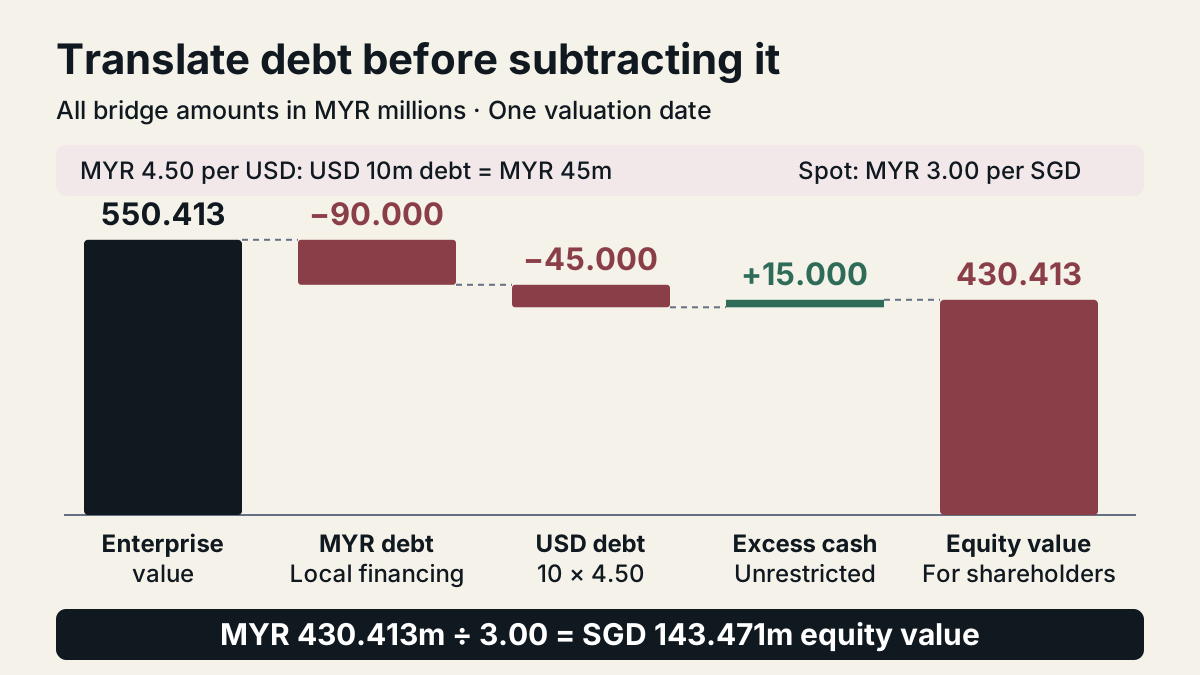
Return to the acquisition at today's valuation date. Assume debt values equal their stated amounts: MYR 90 million of local debt and USD 10 million of dollar debt. Today's second spot quotation is MYR 4.50 per USD, so dollar debt equals MYR 45 million. Assume MYR 15 million of unrestricted excess cash and no other equity-bridge adjustments.
Equity value is 550.413 − 90 − 45 + 15 = MYR 430.413 million, or SGD 143.471 million. Use one valuation date for enterprise value, debt, cash and spot rates. In an actual assignment, investigate debt-like claims, minority interests and cash restrictions rather than assuming that every balance-sheet cash amount belongs in the addition.
Practise the follow-ups that test your assumptions
- What if MYR weakens? Separate translating today's value from revising future operating cash flows, imported costs and debt exposure. A full scenario can affect all three.
- Why not use the buyer's lower funding rate? The operating asset's risk remains relevant. Assess any financing benefit separately and avoid counting it twice.
- What if the forward curve ends before the forecast? State the available maturities and the assumption beyond them; do not present an extrapolated curve as a tradable hedge.
- Why is terminal value so influential? Its present value is about 85.2% of enterprise value here. Test normalized reinvestment, growth and WACC before defending a precise price.
Rebuild the MYR valuation and equity bridge on one page, then explain in ninety seconds why spot conversion, an assumed currency path and a forward hedge answer different questions. Continue with Investment Banking Interview Prep to connect this exercise with your valuation preparation.