
“AI demand is booming, so the client should build a data centre in Southeast Asia.” The sentence sounds current and still fails as a case answer. Which client? Build where? For which customer, power date and capacity? A growth headline cannot tell you whether the binding constraint is demand, grid connection, water, land, regulation, financing or a signed start date.
This guide turns public sources into a decision-led case. You will choose one decision, label facts and inferences separately, build a constraint-led downside, and deliver a 30-second recommendation that names the fact most likely to reverse it.
Data-centre announcements, capacity figures, project status and power forecasts change quickly, so each figure below stays attached to its source and date.
Pick the client decision before collecting facts
“Data centres in Southeast Asia” is a sector. It is not a case question. Choose one:
| Decision | Example question | Primary output |
|---|---|---|
| Market entry | Should an operator enter one named market in the next three years? | Enter, wait or reject—with conditions |
| Site selection | Which of two feasible sites should host a 60 MW first phase? | Ranked site and binding constraints |
| Capacity | Should the client commit the full campus or phase it? | Capacity sequence and decision gates |
| Customer segment | Should the site target hyperscale, enterprise, sovereign or mixed demand? | Customer proposition and economics |
| Investment | Should an infrastructure investor fund the asset at the proposed terms? | Return drivers, downside and deal breakers |
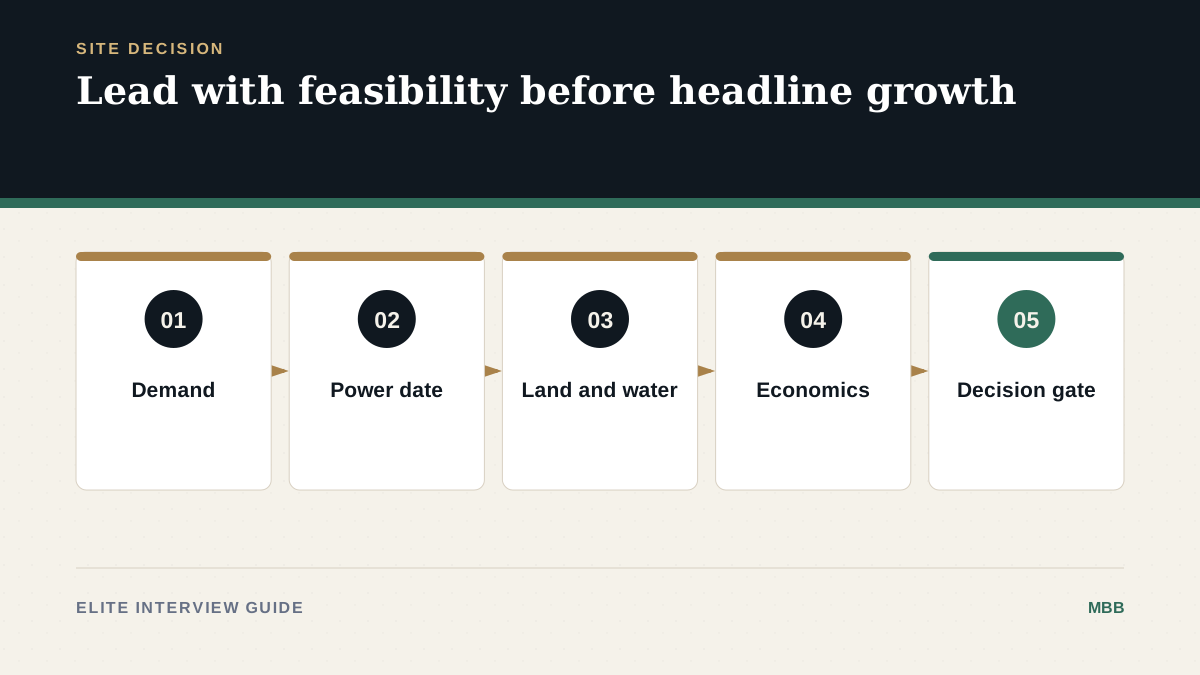
Each question requires different evidence. A market-entry case starts with addressable customers, competitive capacity and an executable route. A site case starts with delivery constraints. An investment case adds price, contracts, financing and exit.
Start with four public facts—and their limits
Singapore’s Green Data Centre Roadmap aims to provide at least 300 MW of additional capacity in the near term, with further growth linked to green-energy deployments. The roadmap also frames data centres as power- and resource-intensive infrastructure. This supports a capacity ambition and a constraint; it does not prove that any proposed site will receive a connection.
Malaysia’s official Guideline for Sustainable Development of Data Centres ties tax-incentive applications to sustainability conditions. It includes energy-efficiency, carbon and water guidance, including attention to water-stress areas. This is evidence that resource use belongs inside the site decision, not a footnote after economics have been calculated.
The ASEAN Centre for Energy’s August 2026 analysis, Anticipating Uncertainty in Data Centres Electricity Demand, identifies hardware power density, AI penetration and utilisation, and power usage effectiveness as important demand levers. It says impact can emerge at both national-system and local-grid levels. That supports scenarios, not one certain load forecast.
The International Energy Agency’s 2026 Energy and AI update reports that global data-centre electricity use grew 17% in 2025 and projects it to roughly double between 2025 and 2030 in its central outlook. The IEA also highlights near-term bottlenecks across power equipment, chips, grid connections and approvals. Global demand growth is context; it is not a Southeast Asian site forecast.
Use a fact–inference–question ledger
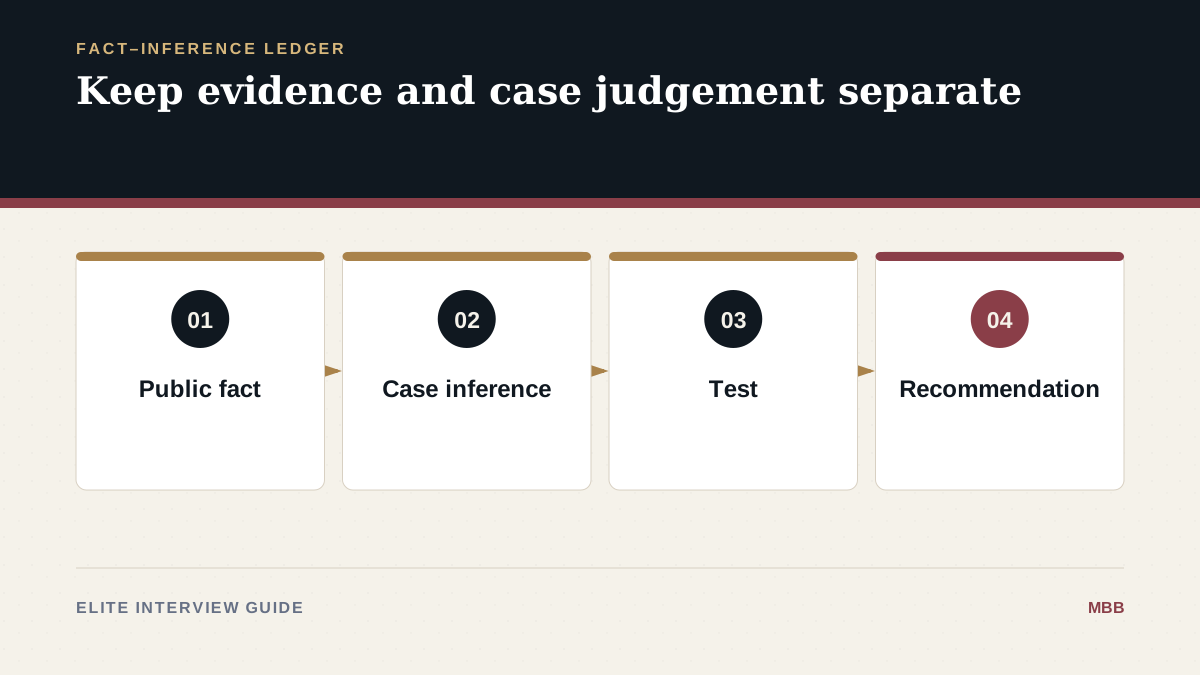
| Statement | Label | Why |
|---|---|---|
| Singapore’s roadmap aims for at least 300 MW of additional near-term capacity | Public fact | The figure and aim appear in an official source |
| The client should therefore build in Singapore | Unsupported conclusion | Capacity policy does not establish site availability or returns |
| Power connection date may determine which site is feasible | Inference | Supported by sector constraints, but must be tested for the sites |
| Site A can connect 40 MW by January 2029 | Information needed | Requires a utility offer, permit and project schedule |
| AI customers will accept any price for capacity | Unsupported assumption | Demand strength does not remove customer economics |
Build this ledger before creating a market-size slide. It prevents sourced facts from quietly becoming unsourced client claims.
Structure the decision around six branches
1. Customer demand
Identify the customer, workload and contract—not just “AI.”
- Which customers can buy in the required geography?
- Is demand contracted, in negotiation or based on market commentary?
- What capacity, redundancy, latency, data-residency and start date do they require?
- How concentrated is revenue in the anchor customer?
- What happens if utilisation ramps one year later?
2. Power
Power is capacity, timing, quality, price and carbon—not a single tariff.
- How much firm power is available at each phase?
- When can the connection be energised, and which approvals or equipment sit on the critical path?
- What backup and redundancy are required?
- How do tariff, pass-through clauses and renewable sourcing affect customer pricing?
- Can a smaller phase launch while later power is secured?
3. Land, water and physical design
Check flood, heat, water stress, access, construction logistics and expansion rights. A low land price can be irrelevant if cooling, foundations or transmission upgrades erase the advantage.
4. Connectivity
Map fibre routes, carrier diversity, cable access, latency and single points of failure. “Near a cable landing station” is not enough if the route into the site is not diverse.
5. Regulation and approvals
List licences, planning approvals, environmental requirements, local-content or incentive conditions, and data-residency implications. Separate eligibility for an incentive from the commercial case without it.
6. Economics and financing
Connect contracts and delivery to:
- Revenue per contracted unit of capacity.
- Utilisation ramp and churn or renewal assumptions.
- Power and cooling operating cost.
- Upfront and replacement capex.
- Financing draw schedule and interest during construction.
- Expansion options and residual value.
A synthetic site-selection case
Client: a fictional regional colocation operator. Decision: choose Site North or Site South for a 60 MW campus, starting with a 20 MW phase. Customer: one fictional anchor customer wants 12 MW by January 2029. Important: all facts and numbers below are invented for practice.
| Factor | Site North | Site South |
|---|---|---|
| Land | Higher price; expansion option secured | Lower price; expansion parcel not controlled |
| Power | 20 MW indicative connection by Q4 2028; later phases unconfirmed | 40 MW possible, but earliest indicated date is Q3 2029 |
| Connectivity | Two physically diverse routes in preliminary design | One current route; second requires third-party access |
| Water | Lower-water cooling design already in concept | Conventional design requires revision |
| Anchor start | Feasible with six-month schedule buffer | Misses requested date unless interim capacity is found |
| Main uncertainty | Timing and price of phase-two power | Connection timing and fibre diversity |
If the anchor contract is credible and the January 2029 date is binding, Site North leads despite higher land cost. The decision is not yet final: the client must verify the connection offer, construction schedule and economics of a smaller first phase. Site South’s nominal power capacity does not help if it arrives after the customer requirement.
Build a constraint-led downside
A weak downside reduces price and utilisation by 10% and calls the result conservative. A useful downside begins with a failure mechanism.
Downside A: power delay
- Connection slips nine months because key equipment delivery moves.
- Customer start is missed; part of the anchor volume is lost.
- Revenue begins later while interest during construction and fixed team cost continue.
- Phase two is delayed to preserve liquidity.
- The client must decide whether the remaining customer pipeline supports the site.
Downside B: utilisation gap
- AI-related enquiries remain high, but signed demand converts slowly.
- The first phase opens at 35% rather than 65% utilisation.
- Fixed facility cost and debt service remain.
- Discounting to fill capacity may weaken return and renewal pricing.
- Phasing protects downside only if the first phase is small enough and future expansion rights remain intact.
Downside C: resource condition changes
- A new water, carbon or efficiency condition requires design changes.
- Capex rises and the construction critical path moves.
- Incentive eligibility may change.
- The project must still work without assuming the full incentive.
The downside should tell the decision maker when to pause, resize or reject—not merely produce a lower spreadsheet output.
A 30-second recommendation
The recommendation includes:
- A choice.
- The decision-driving evidence.
- A condition before commitment.
- A downside protection.
- A reversal fact.
Five follow-up questions
- If the anchor customer disappears, is either site still viable?
- Why is the 20 MW phase the right size rather than 10 MW or 30 MW?
- Which risk belongs in price, which in contract, and which makes the site infeasible?
- How would a higher power tariff affect customer pricing and contract terms?
- What evidence would distinguish genuine demand from an announcement pipeline?
Next action
Choose one public data-centre headline and rewrite it as a named client decision. Create a ten-row fact–inference–question ledger, then record a 30-second recommendation that contains one condition and one fact that would reverse it.
Sources
- Singapore IMDA Green Data Centre Roadmap — official capacity ambition and sustainability frame.
- Malaysia Guideline for Sustainable Development of Data Centres — energy, carbon and water conditions for the incentive framework.
- ASEAN Centre for Energy: Anticipating Uncertainty in Data Centres Electricity Demand — ASEAN demand levers and system-level uncertainty.
- IEA: Key Questions on Energy and AI — current global electricity-demand evidence and bottlenecks.