
You say Southeast Asia has young consumers, rising digital adoption and strong long-term growth. The interviewer nods—and asks which company, which country, which revenue driver and which transaction that view could produce. In four seconds, a regional slogan has become a banking question.
The way out is not to memorise more macro facts. It is to move down a five-step funnel: region → company → financial driver → transaction → risk. At each step, narrow the claim until a banker could act on it.
“Regional” is a working footprint, not one market
Bank of America’s current Singapore Global Investment Banking Summer Analyst posting says analysts may work in industry, country or product coverage groups. Its APAC description spans 19 cities in 12 markets, 12 currencies, more than a dozen languages and five time zones.
That is why “regional coverage” can involve several different jobs:
- Understanding a sector across countries while recognising that regulation, ownership and customer economics differ.
- Connecting a local company with regional or global capital and buyers.
- Coordinating product specialists, country teams and client coverage.
- Comparing transaction structures across currencies and legal regimes.
- Deciding when a regional story is real and when the company remains fundamentally domestic.
You do not need to claim that every team works this way. You do need to show that a regional label does not erase country-level mechanics.
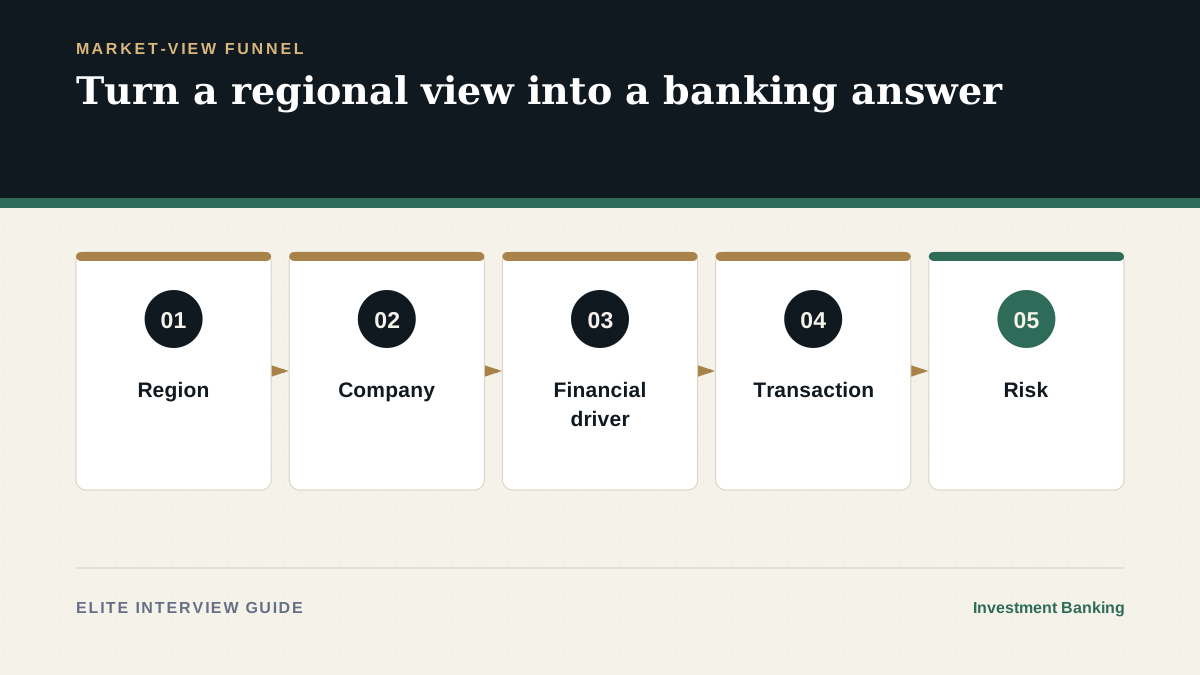
The five-step market-view funnel
| Step | Question to answer | Weak version | Bankable direction |
|---|---|---|---|
| Region | What changed, over what period? | “SEA is growing” | A sourced change in one sector or corridor |
| Company | Which business is exposed, and how? | “Consumer companies benefit” | Named business model and customer or cost channel |
| Financial driver | Which line in the model moves? | “Revenue goes up” | Volume, price, mix, margin, capex, working capital or cost of capital |
| Transaction | What financing or strategic decision follows? | “It may do M&A” | Capacity, objective, structure and timing question |
| Risk | What could reverse the view? | “Competition” | Observable disconfirming fact and how it changes the recommendation |
The funnel forces you to convert context into a decision. It also makes unsupported leaps visible.
Start with evidence, then choose a lane
ASEANstats’ Statistical Highlights 2025 is a useful official starting point for economy, trade, investment and connectivity data. It is not an answer generator. Use it to locate a pattern, then move to national statistics, company filings and transaction documents.
The Asian Development Bank’s July 2026 outlook projected different 2026 growth and inflation paths across Indonesia, Malaysia, the Philippines, Thailand and Vietnam. The precise forecast will change; the interview lesson is durable. A regional average can hide different domestic demand, export exposure, policy constraints and price pressures.
Choose one of three lanes:
- Country × sector: Indonesian consumer finance, Vietnamese manufacturing or Philippine infrastructure.
- Cross-border corridor: Singapore–Johor–Riau operations, intra-ASEAN supply chains or a regional digital product.
- Capital flow: a local issuer reaching offshore markets, a sponsor exit or a multinational buying regional capacity.
One defended lane beats six headlines.
Worked example 1: Indonesian consumer platform
Region
Start with a sourced observation about domestic demand, digital usage or financing conditions. Do not use “large population” as the conclusion.
Company
Assume a hypothetical platform earns transaction fees from merchants and consumers. Ask whether growth comes from new users, higher frequency, larger ticket size or take rate. Each has different quality and durability.
Financial driver
If growth requires heavier incentives, gross transaction value can rise while contribution margin worsens. If merchant density improves retention and reduces acquisition cost, the same top-line growth may become more valuable.
Transaction
Now a banking question appears: does the company need growth equity, debt for a specific asset base, a strategic partner, or selective acquisition capacity? Do not jump to an IPO because the company is “digital.” Match funding to cash generation, use of proceeds and investor tolerance.
Risk
State the fact that would change your view: subsidy intensity rises, take rate falls, credit losses increase, or regulation changes unit economics. Then explain which valuation or financing assumption breaks.
Worked example 2: Vietnamese manufacturing expansion
Assume a component maker is gaining export orders. The lazy answer is “supply chains are moving to Vietnam.” A stronger path is:
- Company exposure: order pipeline, customer concentration and production bottleneck.
- Financial driver: utilisation, margin mix, capex and working-capital needs.
- Transaction: equipment financing, project debt, minority growth capital or acquisition of a specialised supplier.
- Risk: orders are non-binding, customer qualification takes longer, imported inputs compress margin, or the new plant starts below planned utilisation.
The transaction implication depends on cash-flow timing. A company can have attractive demand and still choose the wrong financing structure.
Worked example 3: Singapore data-centre financing
Singapore can be a decision centre, funding market and operating base, but a regional data-centre thesis must still specify where power, land, customers and assets sit. The Singapore Economic Development Board’s Southeast Asia expansion page describes cross-border operating models such as locating headquarters or R&D in Singapore and complementary activities in Johor or the Riau Islands. Treat it as investment-promotion context and verify the company-specific facts independently.
An interview answer could test:
- Contracted versus speculative capacity.
- Power availability and cost pass-through.
- Customer concentration and credit quality.
- Development capex, ramp-up timing and refinancing risk.
- Whether financing belongs at the asset, operating company or holding-company level.
From there, a plausible question is whether a platform should fund organic build-out, acquire operating capacity, bring in an infrastructure investor or recycle mature assets. You are not claiming a mandate; you are showing how operating facts create financing choices.
The 60-second answer structure
Use six sentences:
My view is that [specific change] matters most in [country/corridor and sector].The company exposure I would focus on is [business model or named public company].The key financial mechanism is [driver], because [cause].That could create a need for [financing or strategic decision], provided [condition].The main risk is [specific disconfirming fact], which would change [assumption or structure].I would update the view with [two pieces of evidence].
Here is a synthetic version:
Questions that expose a shallow view
Practise these before the interview:
- Why this country rather than its neighbour?
- Which company would be most exposed, and which would not?
- Where does the trend appear in the income statement, balance sheet and cash flow?
- Why would management transact now rather than wait?
- Who is the natural buyer, lender or investor?
- What valuation method fits, and what does it miss?
- Which single new fact would reverse your recommendation?
If you cannot answer, narrow the thesis. Do not cover the gap with another regional statistic.
A research stack you can defend
Use sources in this order:
- Official statistics or regulators for the market fact.
- Company filings and investor materials for exposure and financial drivers.
- Transaction announcements and exchange filings for deal terms.
- Reputable industry research for interpretation.
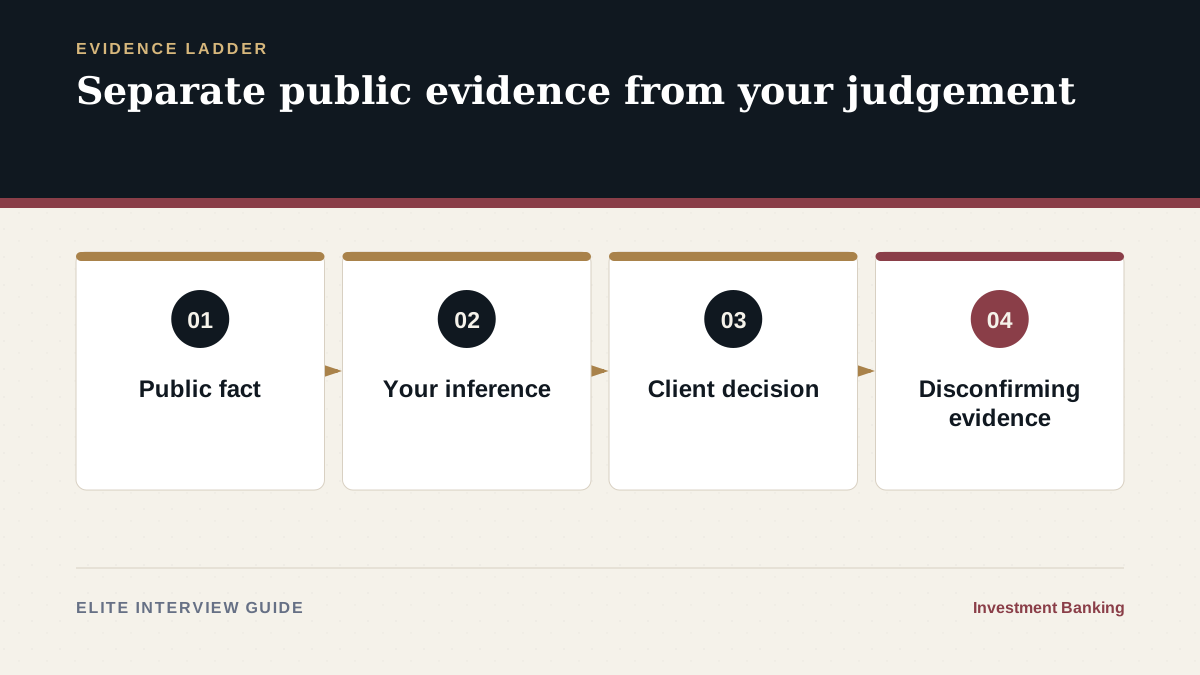
- Your own conclusion, clearly labelled as analysis rather than fact.
The separation matters. A forecast is not a company result; a financing idea is not a live mandate; an interview hypothesis is not inside information.
Sources
- Bank of America Singapore Global Investment Banking Summer Analyst — current role responsibilities, coverage language and APAC footprint.
- ADB Asian Development Outlook, July 2026 — country-level growth and inflation outlook.
- ASEAN Statistical Highlights 2025 — official regional data catalogue.
- Singapore EDB: Scale your business in Southeast Asia — cross-border operating examples and headquarters context.