
You know the example. You can explain it clearly in your first language. In English, the opening sentence keeps growing, a technical word sends you back to the beginning and you finish without stating the answer. It is easy to blame your accent. Yet the recording often shows a different problem: the conclusion arrived late, the sentence carried four ideas, and the interviewer had no signpost when the logic changed.
This five-minute lab evaluates observable communication. It does not rank accents or ask you to imitate an American or British voice. Pronunciation deserves attention when it blocks comprehension; otherwise, structure, pace and recovery usually give you more useful levers.
What clear spoken English means in an interview
Clarity is not the absence of an accent. It is the listener’s ability to answer four questions:
- What is your conclusion?
- What evidence supports it?
- Which part of the story or analysis are you in?
- What changed when the interviewer challenged you?
Yale’s guidance on “Tell Me About Yourself” recommends a relevant, concise answer and practice without sounding memorised. That balance matters: structure should reduce the listener’s work while leaving you able to respond naturally.
Employer pages also imply more than one speaking task. McKinsey’s interviewing overview separates personal-experience and problem-solving discussions. Bain’s experience-interview page highlights motivations and accomplishments. A candidate therefore needs to communicate a story, a recommendation and a follow-up—not perfect one-way recitation.
The five-minute recording
Use your phone or laptop. Do not read a script.
Minute 1: introduction
Answer “Tell me about yourself” in 60 seconds. Listen for a professional thread, one or two choices and a clear reason for the role. Mark the first sentence that becomes a list.
Minute 2: experience
Tell one impact story. State the team goal, your decision, your action and the result. Mark every “we” that hides what you did and every “I” that claims the team’s result.
Minute 3: analysis
Give a 60-second case or market recommendation. Put the conclusion in the first sentence, then two reasons and one risk. Mark any number that lacks a business implication.
Minute 4: follow-up
Ask yourself: “What evidence would change your answer?” Respond without restarting the original speech. State what changes, why and what you would test next.
Minute 5: language switch or retell
If the role may require another language, retell the same answer in it. Otherwise, give the English answer again in 30 seconds. Preserve the logic rather than translating sentence by sentence.
Score comprehension, not identity
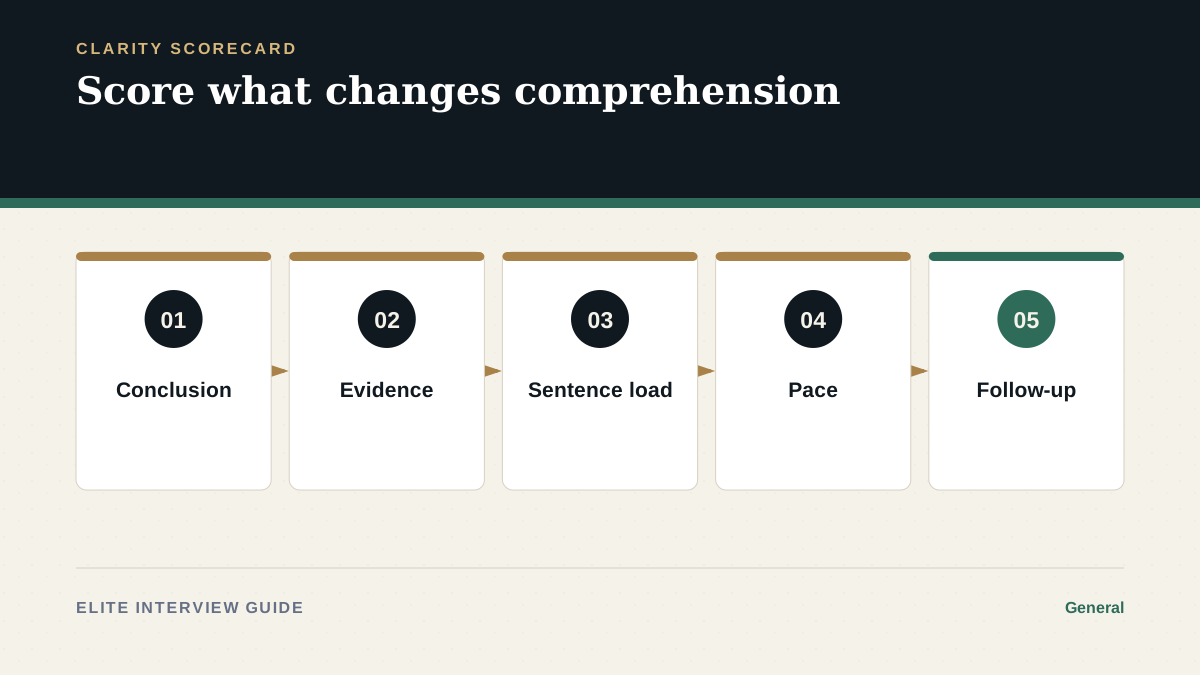
Use a 0–2 score for each item:
| Item | 0 | 1 | 2 |
|---|---|---|---|
| Conclusion | absent | appears late | first or second sentence |
| Evidence | generic | one vague example | specific action or fact |
| Sentence load | repeated run-ons | mixed | mostly one idea per sentence |
| Signposting | listener must infer | occasional | transitions are audible |
| Pace | rushes or stalls | uneven | gives important ideas room |
| Follow-up | repeats or defends | partial update | directly revises the logic |
| Pronunciation | repeatedly blocks meaning | occasional repair | meaning is consistently clear |
Do not combine the scores into a claim that you are “80% fluent.” Use them to choose the next practice target. If the conclusion scores zero, accent drills will not repair the missing conclusion.
Diagnose four different problems
1. Logic problem
You cannot state the conclusion even in your strongest language. Return to the content. Write the decision, two reasons and one risk before practising English.
2. Translation problem
The logic exists, but you construct a full sentence in another language and translate it while speaking. Build short English units for recurring moves: “My recommendation is…,” “The first reason is…,” “This would change if….” These are navigation tools, not a memorised answer.
3. Retrieval problem
You know the term but cannot access it under pressure. Replace it with plain English and continue. “The amount customers owe us” is better than freezing while searching for “accounts receivable.” Add the technical term after the idea is stable.
4. Pronunciation problem
A specific word repeatedly creates misunderstanding. Mark it, check a reliable pronunciation source or ask a qualified speaker, and practise it inside the sentence you need. Do not generalise one difficult sound into a judgement about your whole accent.
Use shorter spoken architecture
Written English tolerates nested clauses that spoken answers do not. Use a headline plus controlled units:
Each sentence carries one main function. The listener knows when evidence begins and what would reverse the conclusion.
For a behavioral story, use:
team goal → my decision → my action → result → reflection
For an analytical answer, use:
conclusion → two reasons → risk → next test
These structures are not native-speaker tricks. They make reasoning audible.
Recover without apologising for the whole answer
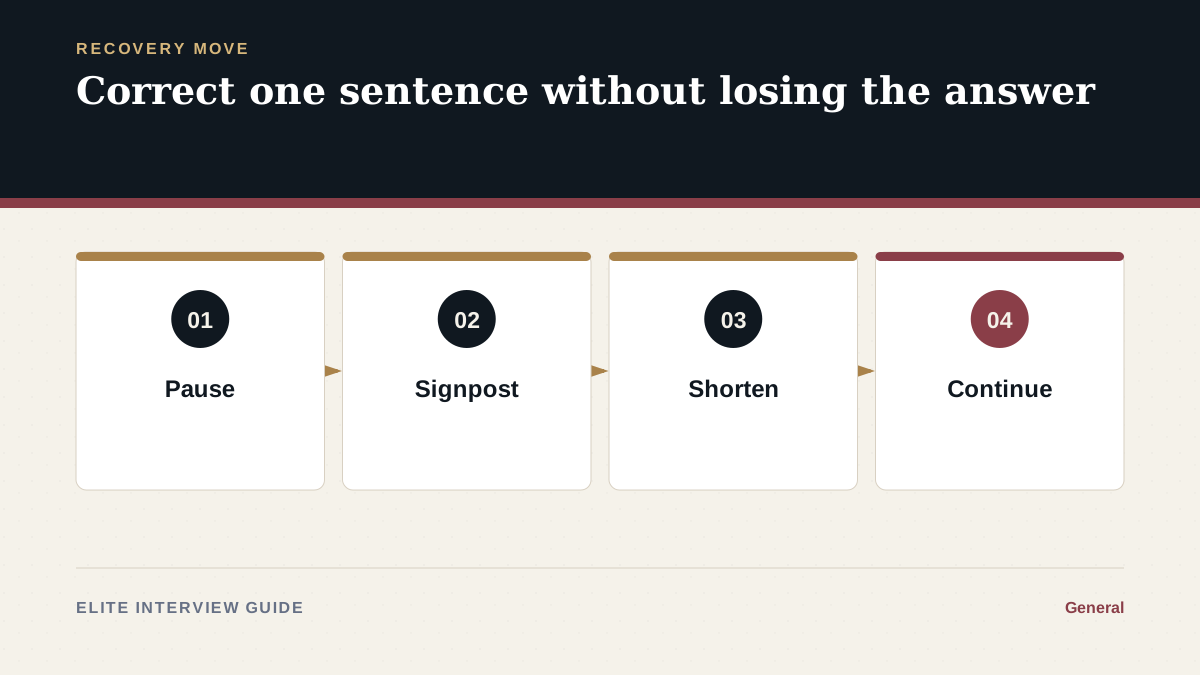
When a sentence fails, use a short restart:
- “Let me state the conclusion first.”
- “The key distinction is…”
- “I used the wrong term; I mean…”
- “That new fact changes my second point.”
- “I will answer in two parts.”
Then continue from the decision point. Avoid a long apology, a joke about your English or restarting from the beginning. Recovery itself demonstrates control.
A two-week practice measure
Choose one fit story and one analytical answer. Record each three times a week under the same time limit. Track only:
- seconds until the conclusion;
- number of sentences with more than one main idea;
- number of vague references such as “this,” “things” or “somehow”;
- whether the follow-up changes the answer;
- words that genuinely block comprehension.
Ask one listener to write your conclusion and two reasons after hearing the recording once. If their notes match your intended logic, communication improved. Do not ask only, “How is my English?” That question invites an impression rather than evidence.
Your next action
Make the five-minute recording today. Score each item before changing anything. Pick the lowest comprehension score—not the feature of your accent you dislike most—and practise one fix for a week. At the end, ask a listener to reconstruct your conclusion, evidence and risk. The goal is not to sound like someone else. It is to make your own judgement easy to follow when the interview becomes difficult.