In a Taiwan manufacturing private-equity case, accept an EBITDA adjustment only after tracing it into reported earnings, identifying the economic cause and estimating what the buyer will still need to spend. Replace owner compensation with the cost of doing the same work, retain recurring scrap, and assess relocation expenses together with related grants. Then distinguish sustainable earnings from valuation and cash available for principal repayments.
Quality of earnings, often shortened to QoE, tests how well reported profit represents the business's underlying performance. For a Taiwan components supplier, that means connecting New Taiwan dollar accounts to factory records, customer qualification work and management responsibilities. An English investment memo should preserve those operational distinctions, rather than translating every unusual expense into an add-back.
Establish what the starting number includes
EBITDA means earnings before interest, taxes, depreciation and amortization. Ask for its reconciliation to the accounts before debating adjustments. A grant recorded under other income may be inside one seller's EBITDA measure and outside another. An expense already excluded from the starting measure cannot be added back again.
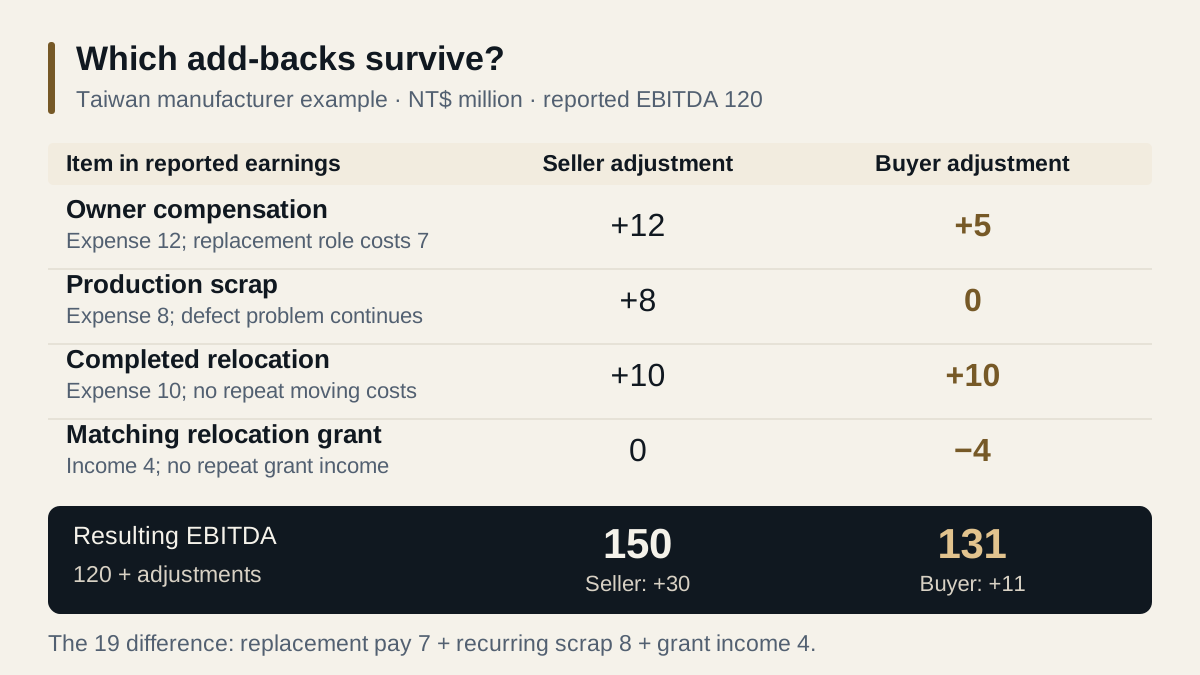
Suppose you are reviewing a Taoyuan components manufacturer after a factory move. Its last twelve months show NT$120 million of reported EBITDA, including all four items below. Assume the owner will leave, the move is complete, customer approvals for the new site are in place, and future rent and operating costs are already represented in the starting figure. All amounts are NT$ million.
| Item included in reported EBITDA | Seller's proposed adjustment | Buyer adjustment | Reason |
|---|---|---|---|
| Owner compensation expense: 12 | +12 | +5 | Replace the owner's work at a fully loaded annual cost of 7 |
| Production scrap expense: 8 | +8 | 0 | The underlying defect problem continues |
| Completed relocation expense: 10 | +10 | +10 | Separately documented moving costs will not recur |
| Grant income for that relocation: 4 | 0 | −4 | The matching one-off benefit will not recur either |
| Total adjustments | +30 | +11 | Sustainable earnings require both positive and negative adjustments |
The seller reaches 150. Your supported case reaches 120 + 5 + 10 − 4 = 131. That estimate remains provisional until the assumptions above are supported. Each row needs evidence before it becomes a price input.
Owner pay disappears; the work may remain
The owner manages production planning and key customer relationships. Removing the entire 12 would assume those responsibilities can disappear with the shareholder. Here, the 7 replacement estimate covers salary, expected bonus, employer contributions and benefits for the required role. The defensible adjustment is 12 − 7 = 5.
Ask for a responsibility map, payroll records and evidence for replacement compensation. If two hires are needed, price both. If the owner was underpaid relative to the work performed, normalization could reduce EBITDA. Ownership is not itself evidence that an expense is unnecessary.
Do not add the 5 again as a future management saving in the operating plan. It is already included in 131. Any further improvement needs a separate cause, timing and cost.
Scrap needs an operational explanation
Assume the 8 of scrap comes from the same defect mode across several customer batches, with no demonstrated process improvement. Retain it. A management label such as “exceptional production loss” does not establish that future output will cost less.
IAS 2 recognizes inventory losses and write-downs as expenses when they occur. That accounting rule answers when a loss enters earnings; your diligence must separately establish whether its cause persists. IFRS Foundation, IAS 2.
Request monthly yield and scrap records by product, defect cause and customer batch. Check whether promised improvements survived normal production volumes. A new machine might reduce waste, but its purchase cost and commissioning time belong in the investment plan. A forecast improvement is not automatically an adjustment to historical earnings.
Match relocation costs with their benefits
The 10 consists of separately invoiced trucking and external recommissioning services, already expensed. It excludes new equipment, depreciation and the recurring scrap above. Verify invoices, the old site's closure and the new site's stable operation. If repeated product transfers remain necessary, their recurring cost needs to stay in the earnings estimate.
The 4 grant specifically reimburses this completed move and is included in the reported 120. Removing the relocation event therefore means reversing both entries: +10 expense − 4 income = +6. Keeping the grant while removing the cost would preserve income from an event you have assumed will not repeat.
Presentation matters. IAS 20 allows income-related grants to appear separately or reduce the related expense. If the ledger instead records only a net relocation expense of 6, reverse that 6 once. Do not add 10 to an already net amount. IFRS Foundation, IAS 20.
Equipment grants require a different trace. Delta Electronics' 2024 consolidated statements describe grants that reduce an asset's carrying amount and subsequently reduce depreciation. For EBITDA constructed by adding actual depreciation back to earnings, lower depreciation also means a smaller add-back; that effect cancels. Do not subtract a cash grant from EBITDA merely because it was received. Inspect the target's policy and reconciliation. Delta Electronics, Note 4(35).
For our Taoyuan target, the 4 reimburses relocation expenses, so the equipment-grant treatment does not change the adjustment table. For a separate grant supporting ongoing engineering work, investigate renewal conditions and the associated recurring costs before deciding which earnings are sustainable.
Carry the earnings decision into price and cash
Assume an 8× enterprise-value-to-EBITDA multiple for this exercise, with consistent lease treatment. The seller's 150 implies enterprise value of 1,200; 131 implies 1,048. The adjustment disagreement changes value by 19 × 8 = 152. This is sensitivity to the earnings base, not evidence that 8× is the right market multiple.
With net debt of 250 and no other equity-bridge adjustments, buyer equity value is 1,048 − 250 = 798. Holding that bridge fixed, the same 152 difference reaches equity value. Enterprise value and the equity value attributable to shareholders answer different questions.
Cash is another calculation. Suppose next year's EBITDA remains 131, with cash interest of 18, cash taxes of 20, maintenance capital expenditure of 30 and an operating working-capital increase of 12. Cash remaining before debt principal repayments and distributions is 131 − 18 − 20 − 30 − 12 = 51. Assume no other cash movements and that historical relocation bills and the grant were settled before the period.
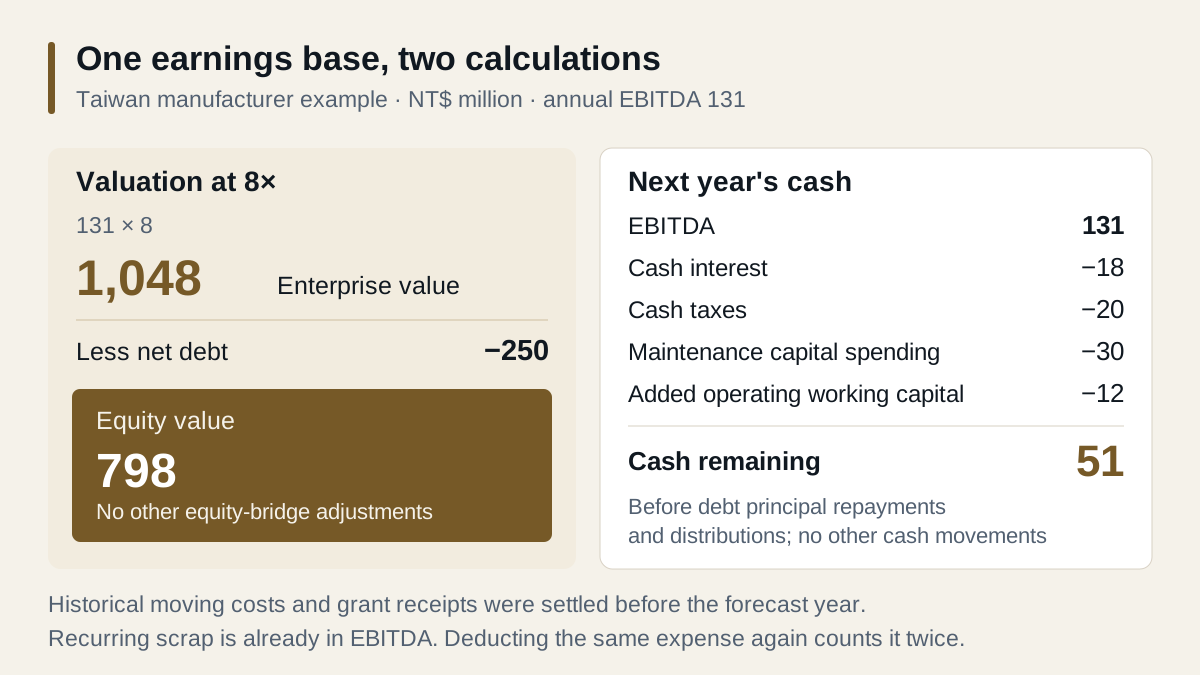
The retained scrap expense is already inside 131; deducting the same 8 again would double count it. Normalization also does not refund the historical cash spent on the move. If a relocation bill remains unpaid at closing, track its settlement and purchase-price treatment together so the buyer does not deduct it twice.
Defend the largest uncertain adjustment
Present the conclusion as “131, subject to replacement-cost and relocation evidence,” then identify the item most likely to change it. What proves the replacement role costs 7? Has scrap improved at full volume? Does the grant require repayment after a change of ownership? These questions test different assumptions; a general request for more financials will not resolve them.
Practise explaining the bridge aloud, then raise replacement compensation from 7 to 9. EBITDA should fall to 129, enterprise value to 1,032, and equity value to 782, holding the other assumptions fixed. State the evidence needed for that change, then continue with Private Equity Interview Prep.