
“I grew up in Hong Kong, studied in the United Kingdom, exchanged in Singapore, interned in Shanghai and now I am back in London.” Twenty seconds have passed, but the interviewer still does not know what you are good at, why you made those choices or why this interview is the logical next step. An international life can provide unusually strong evidence; presented as a travel timeline, it becomes noise.
This guide builds one truthful career story from a complicated chronology. It does not invent a cleaner motivation than the one you actually had. The task is selection and structure: keep the facts that explain your professional direction, then prepare the obvious follow-ups.
What the opening needs to do
Yale’s career guidance on “Tell Me About Yourself” recommends a concise answer organised around relevant background, interest and goal, generally under two minutes. That is a useful constraint. It means your answer is not an autobiography and should not be memorised as a recital.
Official employer pages also show why one generic introduction is not enough. McKinsey describes both a personal-experience discussion and a problem-solving interview on its interviewing page. Bain’s experience-interview guidance asks candidates to discuss experiences, motivations and accomplishments. Your opening should therefore make the interviewer want to examine evidence you truly own; it should not try to answer every possible behavioral question in advance.
Use this backbone:
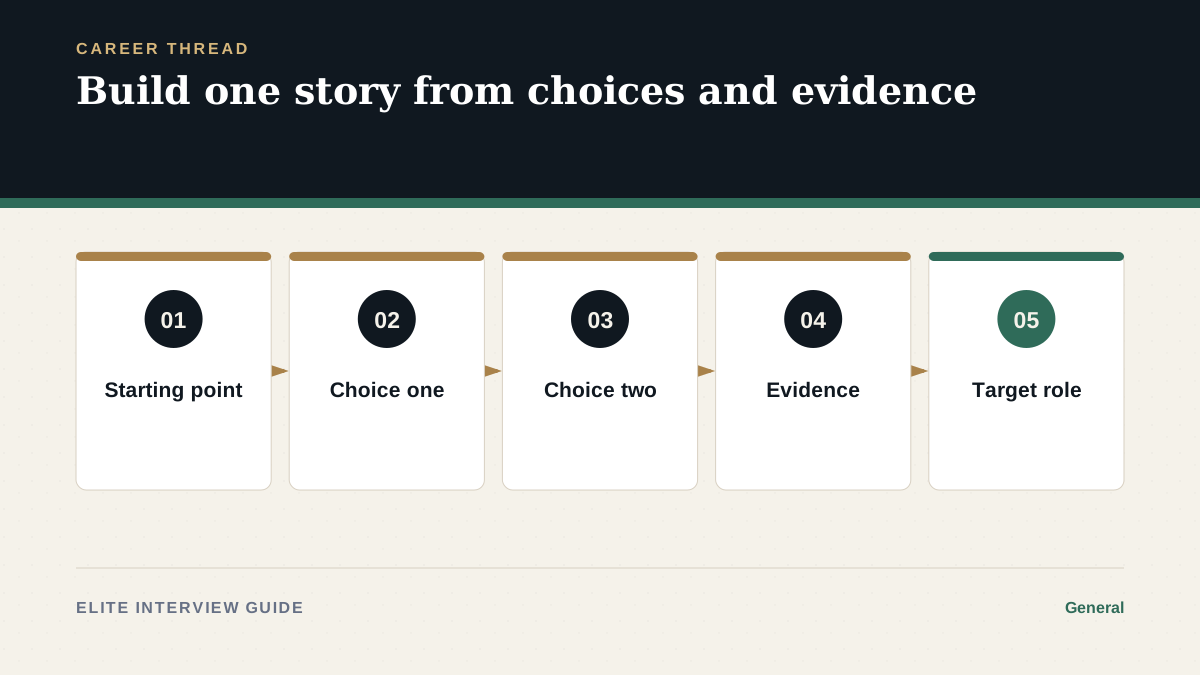
starting point → choice one → choice two → evidence → why this role now
The starting point gives context. The choices reveal agency. The evidence shows a repeated capability. The final line connects the thread to this role and office.
Step 1: choose one professional thread
Write every experience on a page, then look for one repeated question or contribution. Examples might include:
- translating technical work into commercial decisions;
- helping teams make choices with incomplete information;
- understanding how capital changes a company’s options;
- building operations across markets;
- learning how customers behave in different channels.
Do not choose “I am global” as the thread. It is a conclusion without proof. Choose observable evidence: you adapted a product analysis for two markets, led people with different working norms, or changed a recommendation after learning that an assumption from one country did not transfer to another.
One thread does not mean pretending every move was planned. You may have moved because of family, cost, a scholarship, immigration rules or the only offer available. Say what was true. The professional meaning can come from what you did after the move, not from inventing a lifelong plan.
Step 2: keep geography only when it does work
Each place in the answer must perform at least one function:
- Decision: it explains a real choice and trade-off.
- Capability: it provides evidence of something useful to the role.
- Direction: it explains why the current office or market makes sense.
If removing a city does not change the logic, remove it. “I studied in three countries” is not automatically useful. “Moving from a domestic engineering programme to a regional supply-chain internship showed me that the same technical bottleneck creates different customer decisions” has a professional point.
Avoid prestige inventory. School and employer names are already on the CV. Mention one only when the experience changes the story. The interviewer can read the rest.
Step 3: write two choices, not five chapters
For each selected choice, use three moves:
- Context: what decision were you facing?
- Choice: what did you choose, and what did you give up?
- Evidence: what did you do or learn that now matters?
A synthetic example:
This is a composite teaching example, not a candidate story. Its value is the sequence: discipline, choice, proof, direction. Your version must preserve your dates, ownership and reasons.
Step 4: make “why now” specific
The last line should answer four quiet questions:
- Why this type of work?
- Why are you ready now?
- Why this office or team?
- What evidence can the interviewer test next?
“I want to work in a fast-paced environment” does none of this. “After two operating internships, I want to move from analysing one function to making cross-functional client decisions; this role lets me use the industry evidence I already have while building that broader skill” is testable.
If you apply to several tracks, write a different final bridge for each. The chronology can stay the same, but the reason an investment-banking team should care will differ from the reason a consulting office should care. Do not simply replace the company name.
Build three lengths with the same facts
Your 45-, 90- and 180-second versions are not different personalities.
45 seconds
Use the thread, one choice, one piece of evidence and why now. This works when the interviewer wants a quick start.
90 seconds
Use the complete backbone: starting point, two choices, evidence and target. This is the default practice version.
180 seconds
Do not speak for three uninterrupted minutes unless invited. Treat this as the 90-second answer plus branches you can open when the interviewer asks about a move, a project or the office choice.
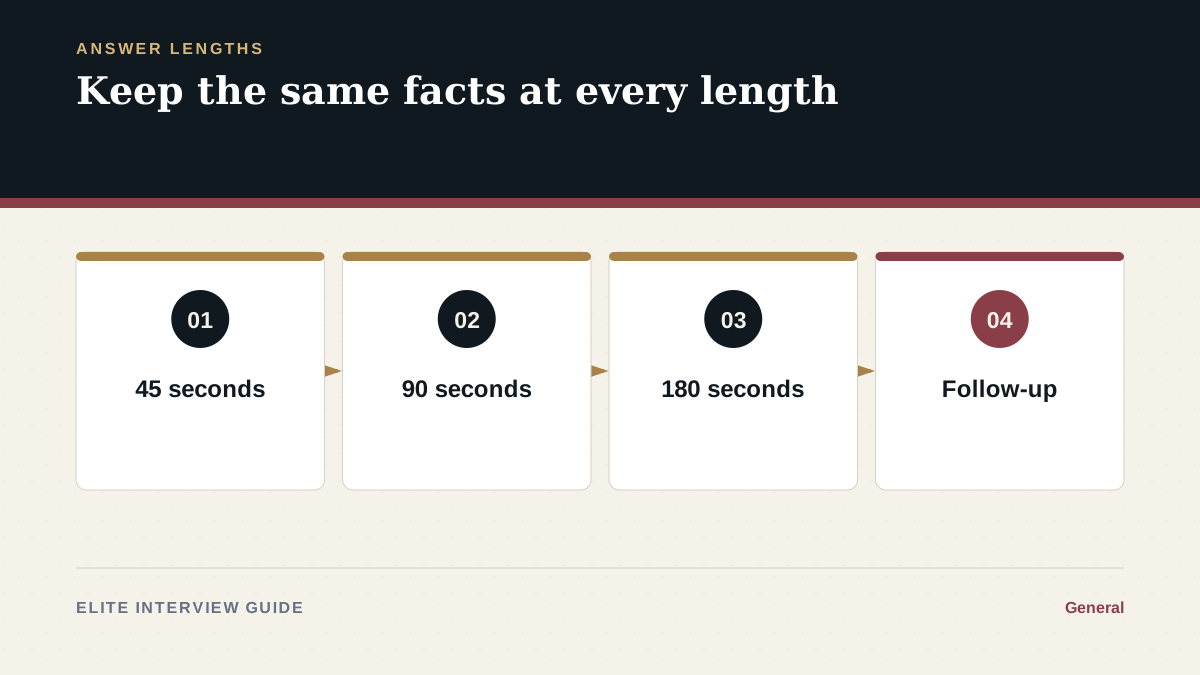
Record all three and compare them. If a country, employer or motivation appears in one version but contradicts another, fix the underlying story rather than memorising harder.
Prepare the follow-ups your geography creates
An international introduction naturally prompts questions. Prepare direct answers to:
- Why did you move at each point?
- Why this office rather than the other places you know?
- Which languages can you use in a professional interview or client setting?
- Where do you have the right to work, and what still requires verification?
- What did the moves cost you—relationships, continuity, domain depth or something else?
- Where do you intend to build depth rather than keep moving?
Separate identity from deployability. Belonging to a place does not automatically prove professional fluency, language ability or work authorisation. Conversely, a candidate can build strong market evidence without claiming the market as an identity.
Editing tests
Read each sentence and ask:
- Does this explain a decision or provide evidence?
- Can the claim be verified from my real experience?
- Is this already obvious from the CV?
- Does it invite a follow-up I can answer?
- Would the story still make sense without the city name?
Remove sentences that merely signal status. Replace adjectives with events. Instead of “I developed a global mindset,” describe the assumption that failed across markets and what you changed.
Your next action
Draw five boxes: starting point, choice one, choice two, evidence and target role. Write no more than one sentence in each. Record a 90-second version without reading, then mark the first moment the interviewer would lose the thread. Cut one location or credential and replace it with a decision you made. Repeat until the answer sounds like one person moving toward one kind of work—not a passport being read aloud.