In a Vietnam minority-investment case, separate the fund's economic stake from its power to influence decisions and realize an exit. Calculate what the shares could receive, then identify which information, approvals and counterparties make that outcome possible. A board seat can improve oversight; it does not, by itself, let the investor run the company or demand repayment.
The distinction is relevant to regional Private Equity interviews. Mekong Capital describes its own strategy as growth capital focused on substantial minority positions in Vietnam-focused founder businesses. That is one manager's approach, not a description of every Vietnamese investment. Mekong Capital, investment approach.
Define the company and the decisions
Suppose a Singapore-based fund considers a Vietnamese consumer distributor. The founder manages operations, while a separate company owned by the founder leases it the main warehouse. The fund will subscribe for ordinary shares in the Vietnamese operating company; this exercise has no offshore holding company. Assume the proposed governance structure gives the fund one of five board seats, with the founder appointing the other four.
Map the company that receives the money, owns customer contracts and owes debt. Record who owns the warehouse, who signs its lease and who approves changes. An investor can own part of the distributor while having no equity claim on its landlord.
For a real case, verify the entity's legal form, charter, shareholder agreements and approval requirements with local counsel. IFC's checklist for founder-owned unlisted companies asks for ownership charts, governance documents and director-appointment arrangements precisely because a percentage alone does not describe the structure. IFC, document and information request list.
Calculate the claim before discussing protection
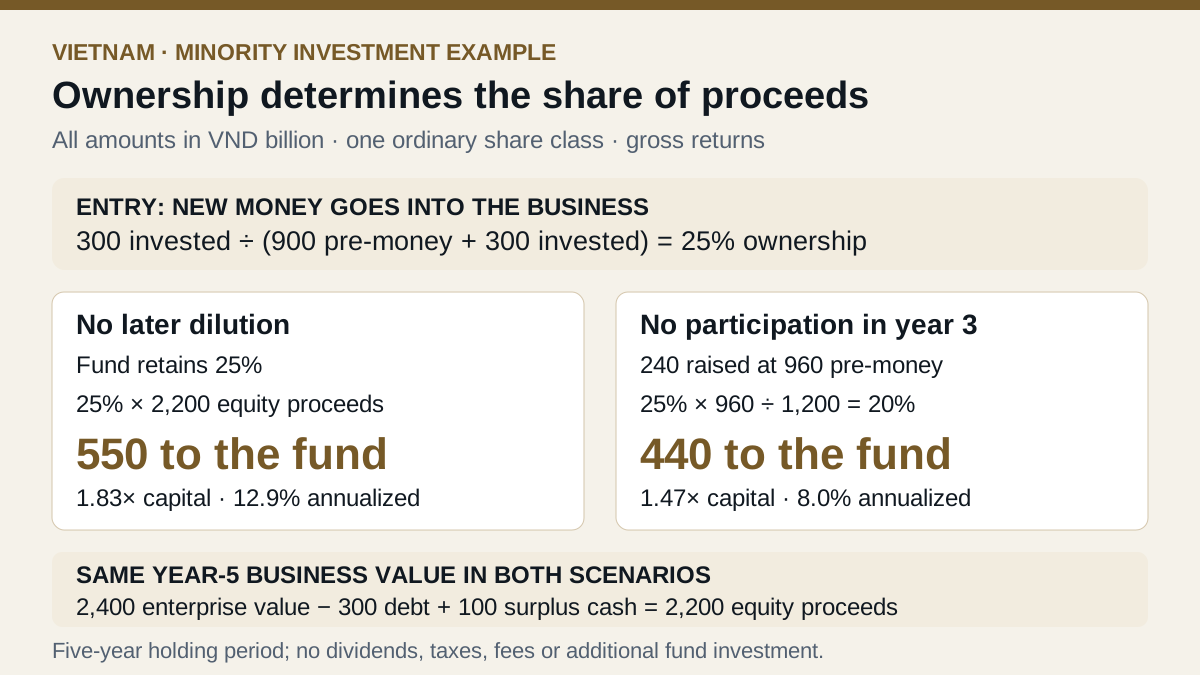
Assume a VND 300 billion primary investment at a VND 900 billion pre-money equity value. Primary means the money goes into the business. The post-money equity value is 900 + 300 = 1,200, so the fund owns 25%, not 300 ÷ 900 = 33.3%.
All following amounts are VND billion. There is one ordinary share class, no options or preferential claims, and no dividends, fees or taxes in this exercise. The company uses the new capital to expand; do not add the original 300 again at exit.
Suppose a buyer acquires all shares at the end of year five. An enterprise value of 2,400, less debt of 300, plus accessible surplus cash of 100 gives total equity proceeds of 2,200. The fund receives 25% × 2,200 = 550: 1.83 times its original investment and approximately 12.9% annualized over five years.
These are gross VND returns. A Singapore-based fund reporting in another currency must separately model conversion, taxes, transaction costs and the actual route for receiving proceeds. A valuation in a spreadsheet is not money already available to distribute.
Stress the ownership assumption
Now suppose expansion takes longer than planned. In year three, the company raises another 240 at a pre-money equity value of 960. If the fund does not participate, its existing stake is valued at 25% × 960 = 240 against a new total equity value of 1,200. Ownership falls to 20%.
Hold the year-five enterprise value, debt and cash unchanged to isolate dilution. Assume the additional funding has been spent and is already reflected in those exit balances. Proceeds fall to 440, producing 1.47 times the original 300 and approximately 8.0% annualized. This sensitivity is not a claim that new financing always destroys value; compare what the business could achieve, or survive, without it.
If a negotiated participation right permits the fund to retain 25%, it must contribute 60, its share of the 240 round. That requires available capital and a fresh investment decision. Any return calculation must include the additional payment at year three. A right to invest is not free protection against dilution.
Connect each requested right to evidence
Dilution changes the percentage owned; other decisions can change what the business is worth. Warehouse rent above market terms could transfer value to the founder's other company even while reported sales grow. The OECD's 2023 principles emphasize disclosure of material related-party dealings and control structures. Use that principle to investigate the lease; it does not establish which vetoes this investor has. OECD, disclosure and transparency.
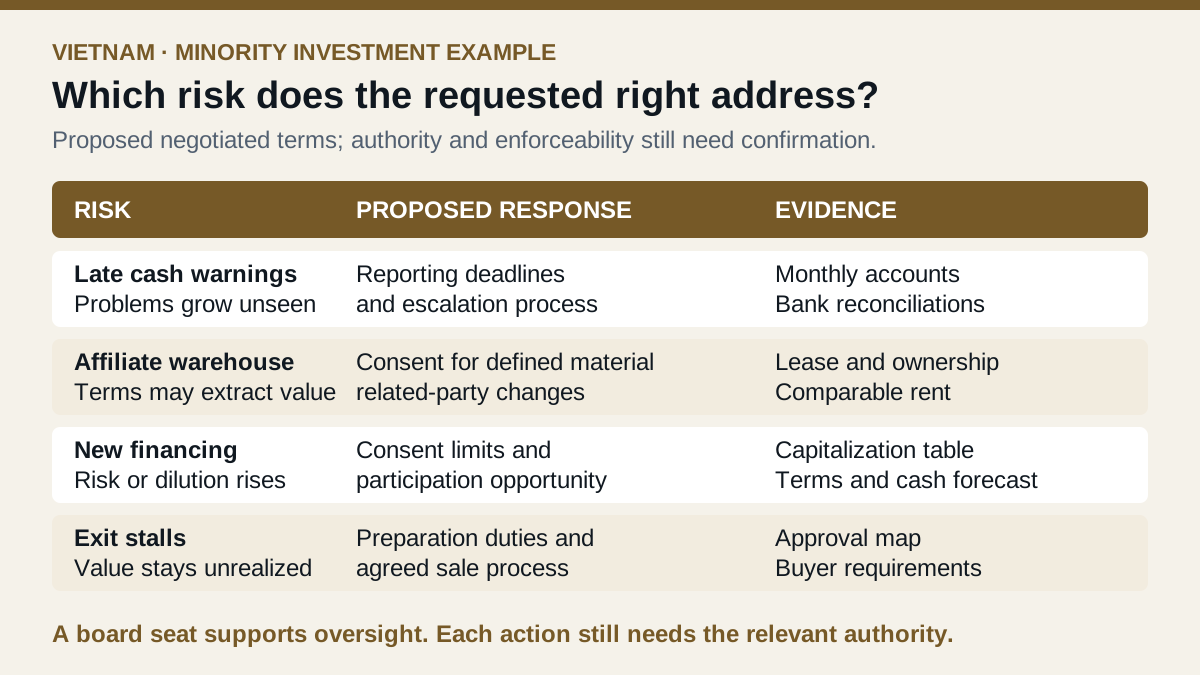
Treat the following as proposed terms to negotiate and verify, not automatic rights under Vietnamese law:
| Risk in this company | Proposed response | Evidence to request |
|---|---|---|
| Cash problems arrive too late to act | Monthly reporting deadlines and an escalation process | Recent management accounts, bank reconciliations and reporting history |
| Affiliate lease extracts value | Investor consent for defined material related-party changes | Signed lease, landlord ownership and comparable rent |
| Financing changes ownership or risk | Consent above agreed debt/issuance limits; participation opportunity | Full capitalization table, financing terms and cash forecast |
| Exit process stalls | Agreed preparation duties, adviser process and transfer mechanics | Governing documents, approval map and buyer requirements |
Reserved matters are specified decisions requiring additional approval. The useful question is what triggers consent, at which entity and before which action. A veto over large borrowing may restrict financing; it does not make the fund responsible for daily purchasing or automatically authorize it to replace the chief executive.
Inspect thresholds, exceptions, recurring transactions and what happens when reporting or approvals are bypassed. The commercial assessment also needs evidence that management will provide usable information and act on agreed decisions. Detailed drafting cannot substitute for that relationship or for enforceability analysis.
Turn an exit label into an executable scenario
Mekong Capital describes past exits through public markets, corporate buyers and other PE funds, as well as work on investee investor relations. Its experience demonstrates several routes worth investigating; it does not establish an available buyer for this distributor. Mekong Capital, exits.
For the assumed whole-company sale, ask whether the founder will sell, whether other holders must cooperate, and who can provide the buyer's diligence materials. A negotiated tag-along right may let the fund join a qualifying shareholder sale under specified conditions. It does not require the founder to start selling. Any provision intended to compel other holders to sell needs its own trigger, parties and enforceability analysis; 25% ownership supplies no answer by itself.
An agreed company or founder buyback also needs a credible payer, funding and required approvals. Keep it separate from a guaranteed cash exit. If the same 550 arrives only in year seven, the gross annualized return falls to 9.0%, despite the unchanged 1.83-times multiple.
Give a conditional investment answer
Your recommendation should identify the missing condition that changes the decision: “I would continue diligence if the lease is supportable, cash reporting works and the founder accepts a credible sale process. I would revise the valuation or decline if the projected return depends on rights or cooperation we cannot establish.”
Practise a two-minute recommendation for this distributor. Explain the 550-to-440 proceeds change, select two essential protections and name the documents that could change your conclusion. Then continue with Private Equity Interview Prep.