
“Singapore is a regional hub with a diverse economy and exciting growth.” Nothing in that sentence is wrong. That is exactly why it is weak: the candidate before you can say it, the candidate after you can say it, and neither sentence tells the interviewer why you would be useful on a Southeast Asian team.
A strong answer is not a tourism pitch and not a macroeconomic speech. In 90 seconds, it connects your real contact with the region to a problem you want to work on, shows evidence that you can contribute, and explains why this office and firm are the right setting.
What the interviewer may be testing
“Why Singapore?” can sound like one question while carrying four separate tests:
| Test | What a credible answer shows | What a generic answer hides |
|---|---|---|
| Informed motivation | You know what work is actually done from the office | “Regional hub” with no client or problem attached |
| Deployability | You can learn across markets without treating them as interchangeable | A list of countries you have visited |
| Contribution | Your experience gives the team something usable | Enthusiasm with no evidence |
| Office fit | You chose this office deliberately and can explain the trade-off | Singapore as a default because it feels international |
Current firm pages make the distinction visible. McKinsey Singapore describes work with leading institutions and enterprises in Singapore and across Southeast Asia. BCG Singapore describes projects for Singaporean and Southeast Asian companies, government agencies and multinationals across sectors including energy, healthcare, insurance, technology, private equity, finance and consumer or industrial goods.
That is more specific than “a hub,” but it still is not your answer. Your job is to choose the part that connects to evidence you own.
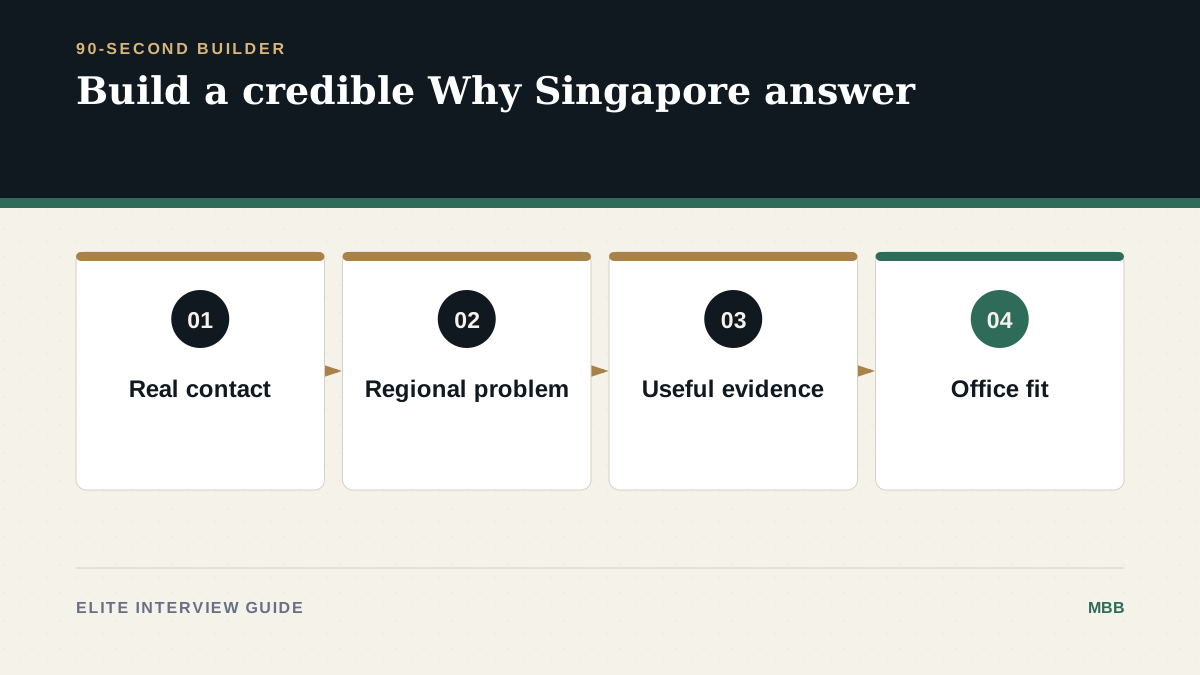
The four-part, 90-second builder
1. Real contact: where did your interest come from?
Start with one real encounter—a project, internship, course, family business, research question or operating problem. The contact does not need to be dramatic. It does need to be true.
Weak: I have always loved Southeast Asia’s culture and dynamism.
Stronger: During a payments internship, I saw the same merchant-acquisition playbook perform very differently in Singapore and Indonesia because channel economics and customer trust were different.
The second version gives the interviewer something to test. Expect: What changed? What did you do? What did you misunderstand at first?
2. Regional problem: name one issue, not the whole region
The Asian Development Bank’s July 2026 outlook projected materially different growth rates and risks across Southeast Asian economies. Forecasts are not destiny, but the variation is a useful reminder: “Southeast Asia” is not one demand curve, one regulatory system or one consumer.
Choose one problem with a cross-market dimension:
- How should a consumer platform adapt pricing and distribution between Indonesia and Singapore?
- How should a manufacturer redesign its footprint across Vietnam, Malaysia and Thailand?
- How can a financial institution scale a digital product while meeting different regulatory and trust requirements?
- How should an energy client balance affordability, security and transition goals across markets?
Do not claim expertise in every market. A better line is: I understand this problem in one market and want to learn how teams test which parts travel.
3. Evidence you can contribute: show a behaviour, not a label
“Cross-cultural,” “analytical” and “adaptable” are labels. Replace one with an observable action.
You might say that you interviewed distributors in two languages, rebuilt a market model when local channel data contradicted a global assumption, or coordinated a team across three time zones. The point is not to make your experience sound larger. It is to show how you work when the market does not fit the first template.
4. Why this firm and office: attach your reason to current work
Use the current office page, not a global slogan. If you are discussing regional operations, point to the office’s cross-market client work. If you care about financial services or AI, identify that practice only after confirming it appears in the office’s current work.
Singapore’s Economic Development Board describes the city’s role in hosting regional headquarters and connecting businesses across Asia on its headquarters page. That context can explain why regional decisions are made in Singapore. But remember: EDB is promoting Singapore as an investment location. It supports background research; it does not prove what your target consulting team will staff next year.
Put the four parts together
Here is a synthetic example. Use its anatomy, not its facts:
The answer works because every sentence has a job:
| Sentence | Job | Follow-up you should survive |
|---|---|---|
| Real contact | Makes motivation personal and testable | What exactly differed between the two markets? |
| Regional problem | Shows you have chosen a business question | Why does that problem matter now? |
| Contribution | Gives evidence of how you work | What did your analysis change? |
| Firm and office | Proves deliberate choice | Why this firm rather than another Singapore office? |
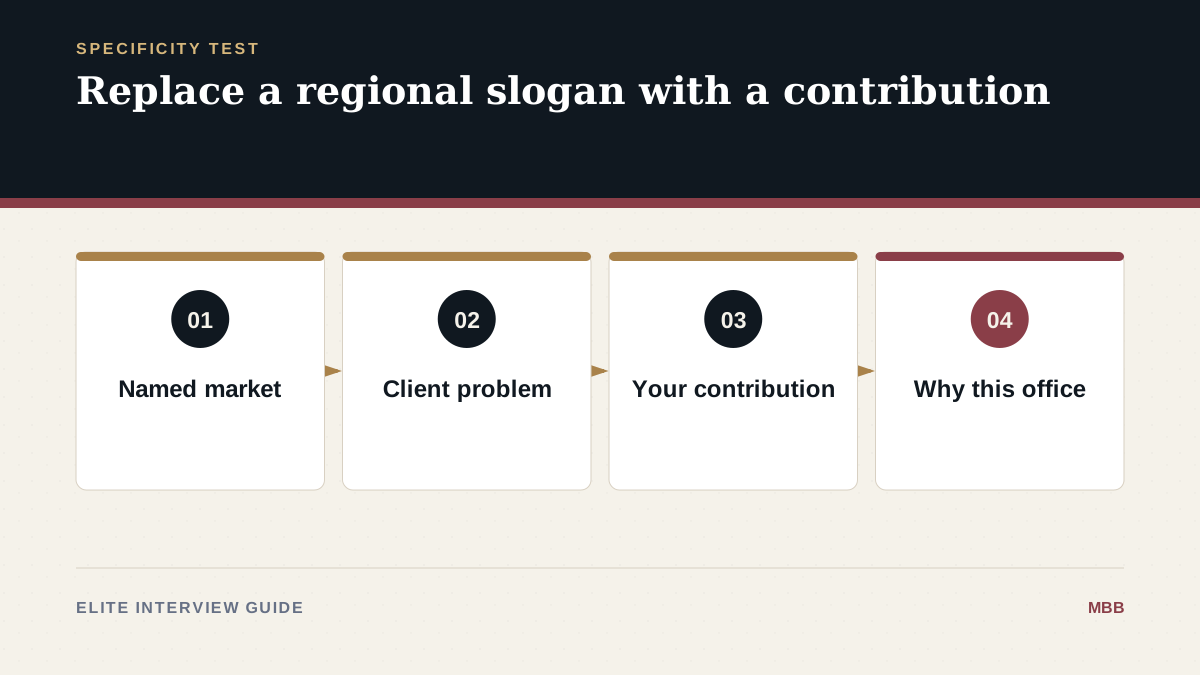
Three versions to delete
The travel answer
I have visited Singapore several times and love the food, safety and energy.
This can explain why you like the city; it does not explain why you understand the work. Keep one personal sentence if it matters, then move to the business problem and your contribution.
The growth answer
Southeast Asia has a young population, rapid digital adoption and huge growth potential.
Even if sourced, this is a regional summary. Choose a country, sector and mechanism. Does adoption change customer acquisition, cost to serve, capital needs or regulation? What would a client decide differently?
The country-list answer
Singapore gives me exposure to Indonesia, Malaysia, Thailand, Vietnam and the Philippines.
Exposure is not automatic, and countries are not collectibles. Current staffing, client demand and mobility policies determine actual work. Explain the problem you want to study across markets, then ask recruiters factual questions about staffing.
Follow-ups worth practising
- Why not Hong Kong, London or your home office? State the positive case for Singapore, then one honest trade-off. Do not attack another office.
- Which Southeast Asian market do you actually understand? Choose one and separate first-hand evidence from desk research.
- What assumption about the region might be wrong? Name the assumption and the evidence you would seek.
- What can you contribute on day one? Offer a working behaviour or domain exposure—not senior-level expertise you do not have.
- What do you still need to learn? A specific gap signals self-awareness; “everything” signals that your answer was not researched.
The recording test
Record one 90-second attempt. Listen once without editing and score five items from zero to two:
| Item | 0 | 1 | 2 |
|---|---|---|---|
| Real contact | Generic interest | Real event, weak link | Real event that clearly caused the interest |
| Regional problem | “Growth” | Sector or country named | Decision and mechanism are clear |
| Contribution | Trait label | Evidence but no result | Action and relevance are clear |
| Firm / office | Global slogan | Current office fact | Current fact tied to your goal |
| Honesty | Claims broad expertise | Some boundaries | Clear about what you know and need to learn |
If you score below seven, do not add adjectives. Replace the weakest section with one piece of evidence.
Sources
- McKinsey Singapore — current office description and Singapore/Southeast Asia work.
- BCG Singapore Careers — current client types and industries described for the office.
- Singapore EDB: Headquarters — official investment-promotion context on regional headquarters and connectivity.
- ADB Asian Development Outlook, July 2026 — current country-level outlook showing regional variation.